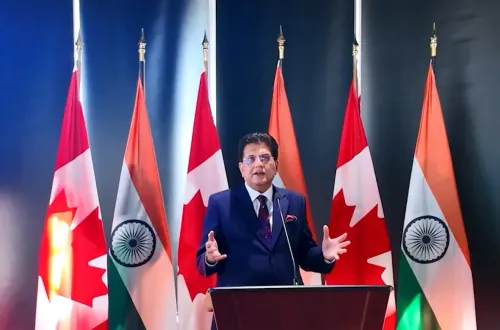
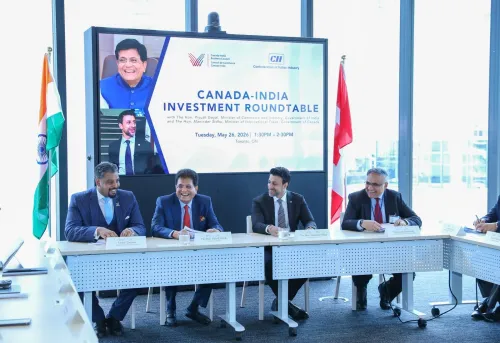
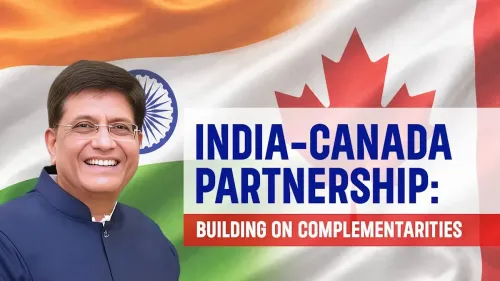
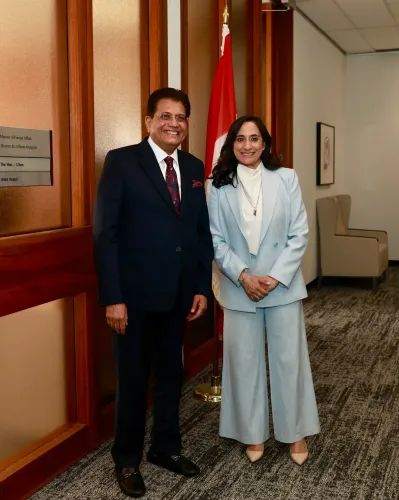
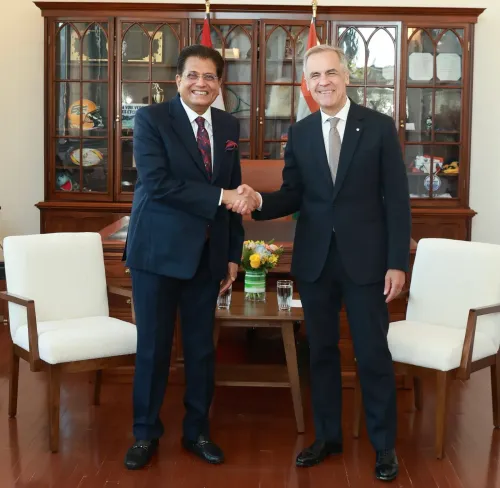
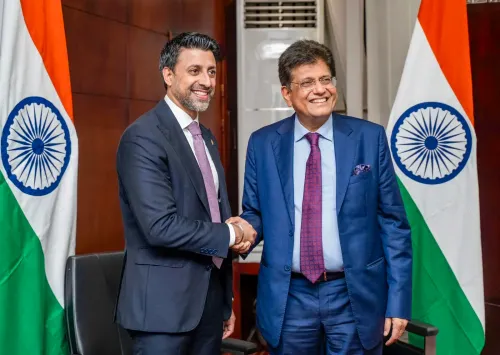
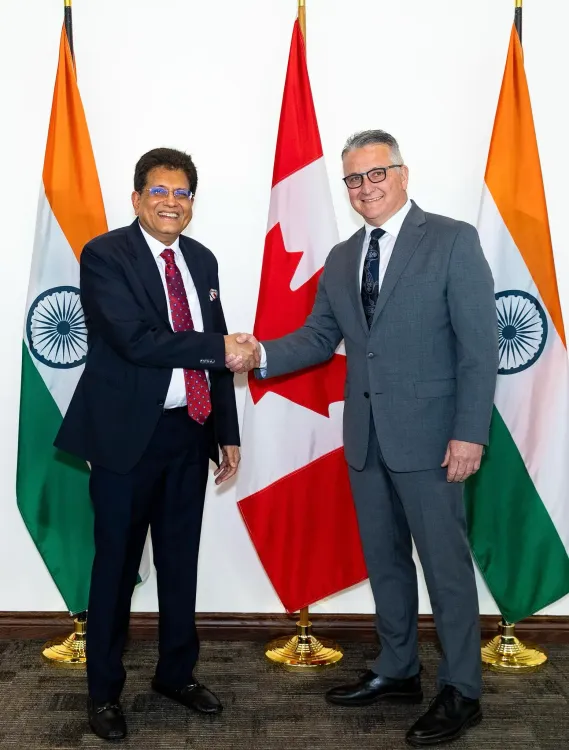
Piyush Goyal meets Canada's Agri Minister on food security
Synopsis
Union Commerce Minister Piyush Goyal met Canada's Agriculture Minister Heath MacDonald on May 26, 2026, to explore cooperation on food security, sustainability, agri-tech, and food processing — part of broader India-Canada bilateral engagement running alongside long-standing CEPA negotiations.
Key Takeaways
Piyush Goyal held a bilateral meeting with Canada's Agriculture and Agri-Food Minister Heath MacDonald on May 26, 2026 .
Talks focused on food security, sustainability, agri-tech, and food processing sector collaboration.
The stated goal is to boost incomes of Indian farmers and producers through bilateral cooperation.
India and Canada have been negotiating a Comprehensive Economic Partnership Agreement (CEPA) since 2010 , with agriculture among the key chapters.
Any follow-up MoU or joint working group on agri-tech will be closely watched as a concrete outcome of the meeting.
Union Commerce and Industry Minister Piyush Goyal met Canada's Minister of Agriculture and Agri-Food, Heath MacDonald, on Tuesday, May 26, 2026, for talks centred on deepening bilateral cooperation in agriculture. The discussions covered food security, sustainability, agri-tech, and opportunities in the food processing sector, with a stated aim of boosting incomes of Indian farmers and producers.
Context
Goyal, in a post on X, said the two ministers 'discussed strengthening cooperation in agriculture, with a focus on food security, sustainability, agri-tech, and exploring opportunities for collaboration in the food processing sector, aimed at boosting the incomes of Indian farmers and producers.' The meeting marks a ministerial-level touchpoint between the two countries at a time when India is actively seeking to diversify its agricultural export markets and attract technology partnerships for farm productivity.
Canada is a significant supplier of pulses and canola to India and has been engaged in sustainability and food-security dialogues with New Delhi for several years. The bilateral conversation on agriculture sits within a broader effort to widen sector-specific cooperation beyond trade in commodities.
Policy Backdrop
India and Canada launched negotiations on a Comprehensive Economic Partnership Agreement (CEPA) in 2010, with agriculture and processed foods among the chapters under discussion. The talks have seen intermittent progress, and ministerial-level contacts of this kind are widely seen as part of the diplomatic groundwork that runs parallel to the formal negotiating rounds.
India has pursued similar sector-specific bilateral engagements on agriculture with multiple partner countries, aiming to diversify export destinations and access technology for improving farm yields, reducing post-harvest losses, and scaling food processing capacity. Agri-tech — covering precision farming, cold-chain logistics, and crop-science innovation — has emerged as a recurring theme in such engagements.
Stakeholders and Impact
Indian farmers and food processing firms stand to benefit most directly if the discussions translate into concrete outcomes such as joint research programmes, technology-transfer arrangements, or eased market access for processed food products. The food processing sector in India has been identified as a priority area for investment and employment generation under multiple central government initiatives.
Canadian agri-businesses, particularly those in the pulses, canola, and food-technology segments, could find expanded commercial opportunities in India's large and growing domestic market. Sustainability-focused cooperation could also help Indian producers meet increasingly stringent international standards for agricultural exports.
What's Next
Observers will watch for any announcement of a joint working group or a Memorandum of Understanding (MoU) on agri-tech and food processing as a follow-up to the Goyal-MacDonald meeting. The next round of India-Canada CEPA negotiations will be another indicator of whether the ministerial-level momentum translates into formal progress on the trade and agriculture chapters. For Indian farmers, the practical test will be whether such engagements open new export corridors and bring down the cost of agricultural inputs through technology collaboration.
Point of View
The Ministry of Commerce is giving the bilateral agriculture conversation a domestic political dimension that goes beyond trade statistics. The emphasis on agri-tech and food processing also reflects India's strategic interest in moving up the agricultural value chain rather than remaining a raw-commodity exporter. If this ministerial contact produces a working-group mechanism, it could inject fresh momentum into the stalled CEPA negotiations on the agriculture chapter.
NationPress
9 Oct 2026
Frequently Asked Questions
Why did Piyush Goyal meet Canada's Agriculture Minister?
Piyush Goyal met Canada's Agriculture and Agri-Food Minister Heath MacDonald on May 26, 2026, to discuss bilateral cooperation on food security, sustainability, agri-tech, and food processing, with the aim of boosting incomes of Indian farmers and producers.
What is the India-Canada CEPA?
The India-Canada Comprehensive Economic Partnership Agreement (CEPA) is a broad free-trade deal under negotiation since 2010. Agriculture and processed foods are among the key chapters being discussed.
How does this meeting affect Indian farmers?
The talks aim to open new export markets for Indian agricultural produce, facilitate technology transfer through agri-tech cooperation, and attract investment into the food processing sector — all of which could raise farm incomes if concrete agreements follow.
What is Canada's role in India's agriculture sector?
Canada is a major supplier of pulses and canola to India and has been a partner in sustainability and food-security dialogues. Canadian agri-tech and food-processing companies also represent potential investment and technology partners for India.
What outcomes should we watch for after this meeting?
Key developments to watch include the announcement of a joint working group or MoU on agri-tech and food processing, and progress in the next round of India-Canada CEPA negotiations on the agriculture chapter.