Gujarat CM Patel backs delimitation and women’s reservation
Synopsis
Gujarat Chief Minister Bhupendra Patel on 28 November 2026 urged India to carry forward constitutionally mandated delimitation and secure women’s reservation in Parliament and assemblies, calling both essential for equal voice.
Key Takeaways
Gujarat Chief Minister Bhupendra Patel on 28 November 2026 backed delimitation and women’s reservation as twin democratic reforms.
He said delimitation is essential so every citizen’s voice carries equal weight.
He said women’s reservation ensures Nari Shakti has a rightful share in shaping laws and leading India’s future.
The 84th Constitutional Amendment Act, 2001 froze constituency delimitation until after the first census after 2026 .
The 106th Constitutional Amendment Act, 2023 provides 33 percent reservation for women, with implementation tied to delimitation.
Women’s reserved seats require fresh delimitation for proportional allocation across states.
Gujarat Chief Minister Bhupendra Patel on 28 November 2026 put two of India’s unfinished democratic jobs on the same table: redrawing the electoral map so every vote weighs the same, and locking in a one-third share of legislative seats for women. A stronger democracy, he said, must give its people a stronger voice — and institutions that truly reflect the nation they serve.
Patel’s case for equal weight and Nari Shakti
In a post on X, Patel wrote that carrying forward the constitutionally mandated exercise of delimitation is essential to ensuring fair representation where every citizen’s voice carries equal weight. He did not treat the exercise as a dry cartographic drill. He treated it as the machinery of political equality.
He paired that demand with women’s reservation in Parliament and state assemblies. Securing that quota, he said, ensures that Nari Shakti (women’s power) has its rightful share in shaping laws, setting priorities, and leading India’s future. Together, these steps build a more inclusive, representative, and future-ready democracy.
The 2001 freeze meets the 2023 women’s quota
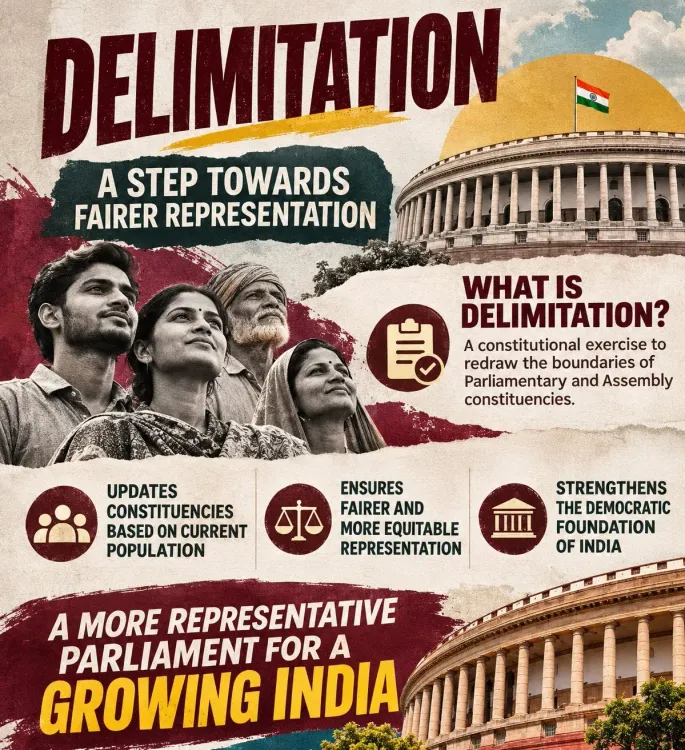
Delimitation is the constitutionally mandated redrawing of Lok Sabha and assembly constituency boundaries on the basis of population. The 84th Constitutional Amendment Act, 2001 froze that redraw until after the first census conducted after 2026, holding the existing seat map in place for a generation.
The Constitution (One Hundred and Sixth Amendment) Act, 2023 then inserted a 33 percent reservation for women in the Lok Sabha and state assemblies. Implementation was tied to the next delimitation so reserved seats can be allocated in proportion across states once new boundaries exist. Women’s reserved seats need fresh maps. Without them, the quota stays on paper.
Why maps and reservation move together
That legal knot is why a state chief minister’s message reads as national politics. New constituency maps decide how many seats each state sends to Parliament. They also decide where the women’s quota sits. Women aspirants, state legislatures, and parliamentary constituencies all wait on the same sequence: census, commission, notification — then reservation.
Successive governments have linked boundary updates to the census while advancing gender quotas through constitutional amendment. BJP-led state leaders have publicly backed both as a way to strengthen federal democratic representation. Patel’s post, under the tags DelimitationBill and WomenReservation, puts the combined case in one frame.
Watch the census rollout and any delimitation commission notifications that follow. Debates in assemblies and in Parliament will turn on how women’s reservation is synchronised with those new maps. Patel’s closing claim is already the political test: inclusion and equal weight, or neither fully arrives.
Point of View
Not a distant technicality. The sharper fight ahead will be over how seats are reallocated across states once the freeze lifts — a federal arithmetic problem as much as a gender one.
NationPress
28 Nov 2026
Frequently Asked Questions
What did Gujarat CM Bhupendra Patel say about delimitation?
He said carrying forward the constitutionally mandated exercise of delimitation is essential to fair representation so every citizen’s voice carries equal weight. On 28 November 2026 he linked that exercise with women’s reservation as steps toward a more inclusive democracy.
What is delimitation of constituencies in India?
Delimitation is the constitutionally mandated redrawing of Lok Sabha and assembly constituency boundaries based on population. It is meant to keep representation roughly equal as the population shifts.
How is women’s reservation linked to delimitation?
The Constitution (One Hundred and Sixth Amendment) Act, 2023 provides 33 percent reservation for women in the Lok Sabha and state assemblies, with implementation tied to the next delimitation. Reserved seats need new constituency maps for proportional allocation across states.
Why was delimitation frozen until after 2026?
The 84th Constitutional Amendment Act, 2001 froze delimitation of constituencies until after the first census conducted after 2026. The freeze kept the existing seat map in place for decades.
What is the women’s reservation law of 2023?
It is the Constitution (One Hundred and Sixth Amendment) Act, 2023, which inserts provisions for 33 percent reservation for women in Parliament and state assemblies. Its rollout was designed to follow delimitation.