Haryana Land Pooling Policy 2026: Landowners to get 50% saleable area under new rules

Synopsis
Haryana has overhauled its land pooling rules for the second time in four years, now guaranteeing landowners a flat 50 per cent of saleable project area — scrapping the old market-value-linked formula. With a tightened four-year completion deadline and a land-reversion clause for defaulting developers, the 2026 policy puts real teeth behind landowner protections.
Key Takeaways
Haryana Cabinet approved the Land Pooling Policy 2026 on 3 November 2026 , replacing the 2022 version.
Landowners will receive 50 per cent of total saleable area; the earlier market-value-linked formula has been removed.
Annual interim support of ₹1 lakh per acre will be paid for 4 years from sale deed registration; delays attract 9% simple interest .
Project completion deadline tightened from 5 years to 4 years ; land reverts to owners if developers miss the deadline.
Minimum plot sizes fixed at 100 sq m (residential), 250 sq m (industrial), 500 sq m (institutional).
TDR policy amended to base calculations on weighted average collector rate at time of application, replacing the 1 January benchmark.
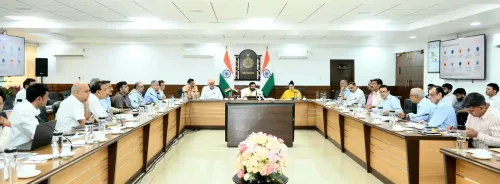
The Haryana Council of Ministers, chaired by Chief Minister Nayab Singh Saini, on Tuesday, 3 November 2026, approved the Land Pooling Policy 2026, replacing the earlier 2022 policy, to restructure how landowners participate in state-led development projects. Under the revised framework, landowners will receive 50 per cent of the total saleable area of a project — a significant departure from the previous model that tied landowners' share to market value.
Key Features of the New Policy
The 50 per cent saleable area allotted to landowners will be distributed across residential, industrial, or institutional plots, depending on the nature of the project. Commercial sites within that share will be offered according to prescribed entitlement norms. The earlier provisions linking the landowner share to market value have been removed, according to an official statement.
Minimum plot sizes for landowners have been fixed: 100 square metres for residential plots, 250 square metres for industrial plots, and 500 square metres for institutional plots. The actual allotment will be proportionate to land contributed.
Financial Support and Timelines
Landowners will receive annual interim financial support of ₹1 lakh per acre, proportionate to land contributed, for four years from the date of registration of the sale deed. If payments are delayed beyond 15 days of the sale deed, the landowner becomes entitled to simple interest at 9 per cent per annum for the period of delay.
Notably, the project completion period has been reduced from five years to four years. The development organisation must complete infrastructure facilities within this window from the date of final project approval — failing which the land will revert to the original landowners.
Provisions for Small and Large Contributors
Landowners contributing more than 2,000 square metres will be allotted commercial plots in the form of kiosks or booths. Those contributing less than 999 square metres will receive monetary compensation under the Right to Fair Compensation and Transparency in Land Acquisition, Rehabilitation and Resettlement Act, 2013, or at the reserve price of the plot — whichever is higher.
Holders of Land Entitlement Certificates can club their certificates and jointly apply for larger developed plots. The buyback period for allotted plots by the development organisation has also been extended from one year to three years.
The land aggregator's remuneration has been fixed at 0.5 per cent of the collector rate for agricultural land in the revenue estate, to be borne by the development agency and paid after the project's sale deed process is completed.
TDR Policy Also Amended
The Cabinet also approved amendments to the policy governing Transferable Development Rights (TDR), addressing valuation, transfer, and utilisation of TDR certificates to streamline infrastructure development across the state. Under the revised formula, the notional land calculation for TDR certificates will now be based on the weighted average collector rate applicable to surrendered land as on the date of submission of the application, replacing the earlier provision that used the rate applicable on 1 January of the calendar year of application.
What This Means for Haryana's Development Landscape
The policy overhaul comes amid growing demand from landowners and developers for a more transparent and time-bound development framework in Haryana, one of India's fastest-urbanising states. By removing market-value linkages and fixing area-based entitlements, the government aims to reduce litigation and speed up large-scale project execution. This is the second major revision to Haryana's land pooling framework since 2022, reflecting the state's effort to align land assembly practices with urban growth pressures. All eyes will now be on the implementation guidelines and whether the four-year completion mandate is enforced in practice.
Point of View
Though technical, matters: tying valuations to the application date rather than a fixed January benchmark removes an incentive to delay filings, which had been a quiet source of procedural gaming. Whether these reforms translate into faster, dispute-free land assembly or remain aspirational targets will depend entirely on administrative follow-through.
NationPress
3 Nov 2026
Frequently Asked Questions
What is the Haryana Land Pooling Policy 2026?
The Haryana Land Pooling Policy 2026 is a revised framework approved by the state Cabinet on 3 November 2026, replacing the 2022 policy. It guarantees landowners 50 per cent of the total saleable area of a development project and removes the earlier provision that linked their share to market value.
How much will landowners receive under the new policy?
Landowners will receive 50 per cent of the total saleable area of the project, allotted as residential, industrial, or institutional plots proportionate to their land contribution. They will also get annual interim financial support of ₹1 lakh per acre for four years from the date of the sale deed.
What happens if the development organisation delays the project?
If the development organisation fails to complete infrastructure within four years of final project approval, the land reverts to the original landowners. Payment delays beyond 15 days of the sale deed also attract simple interest at 9 per cent per annum.
Who is eligible for monetary compensation instead of a plot?
Landowners contributing less than 999 square metres are entitled to monetary compensation under the Right to Fair Compensation and Transparency in Land Acquisition, Rehabilitation and Resettlement Act of 2013, or at the reserve price of the plot — whichever is higher.
What changes were made to the Transferable Development Rights policy?
The amended TDR policy revises the formula for calculating notional land for TDR certificates, now using the weighted average collector rate as on the date of application submission, replacing the earlier benchmark tied to rates on 1 January of the calendar year of application.