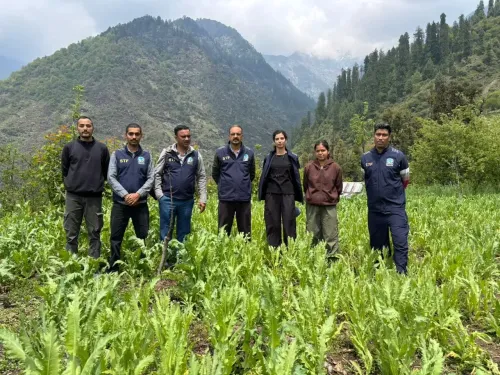
HP CM Office: 205 Drug Mafia Detained, PIT-NDPS Active

Synopsis
The Himachal Pradesh CM's Office says the Sukhu government has mapped the chitta drug mafia to the panchayat level, invoked the PIT-NDPS Act to detain 205 traffickers, and launched financial investigations in 400 cases — directly contrasting its record with the previous BJP administration.
Key Takeaways
The Chief Minister's Office of Himachal Pradesh posted the claim on August 15, 2026 .
The state says it has mapped the chitta drug mafia down to the panchayat level .
The PIT-NDPS Act (1988) , a central preventive detention law, has been invoked — something the CMO claims the previous BJP government (2017–2022) failed to do.
205 drug mafia figures have been detained under the Act so far.
Financial investigations are ongoing in 400 cases .
Independent verification of these specific figures is not available from public records.
On Independence Day, August 15, 2026, the Chief Minister's Office of Himachal Pradesh made a pointed claim: the state's Congress government has mapped the chitta (synthetic drug) mafia down to the panchayat level — and is now wielding a legal tool its predecessor allegedly left sheathed.
Posting in Hindi, the CMO declared that the Prevention of Illicit Traffic in Narcotic Drugs and Psychotropic Substances (PIT-NDPS) Act has been activated — a central law enabling preventive detention of drug traffickers that, the post claims, the previous BJP government failed to invoke during its 2017–2022 tenure. The result, according to the office: 205 drug mafia figures detained so far, with financial investigations running in 400 cases.
What PIT-NDPS Actually Does — and Why It Matters
Enacted by Parliament in 1988, the PIT-NDPS Act operates alongside the primary Narcotic Drugs and Psychotropic Substances Act, 1985, but with a sharper edge: it allows the state to detain individuals suspected of drug trafficking without the immediate burden of a criminal trial, using preventive detention powers. For a state like Himachal Pradesh — where districts such as Kullu and Mandi have long been documented hotspots for cannabis cultivation and, more recently, synthetic drug networks — the law's activation represents a significant escalation in enforcement posture. The panchayat-level mapping claim is the operationally significant detail here. Drug networks in hill states tend to be deeply local, embedded in village economies and supply chains that conventional urban-centric policing struggles to reach. Mapping them at the panchayat tier — the most granular unit of rural governance — signals an intelligence-led approach rather than reactive crackdowns.The BJP Comparison and the Political Subtext
The CMO's framing is deliberately comparative. Chief Minister Sukhvinder Singh Sukhu's government, in power since December 2022, has consistently sought to draw contrasts with the preceding BJP administration on law-and-order issues. The assertion that PIT-NDPS was available but unused by the BJP is a direct political charge — one the research notes cannot be independently verified from available records. Both major parties in Himachal Pradesh have announced drug crackdowns periodically since the early 2000s. The pattern is familiar: a new government inherits the problem, announces enhanced measures, and frames its predecessor as having been soft. What distinguishes the current claim is the specificity — named numbers, a named law, and a named mechanism (financial investigation) — which sets a measurable benchmark that courts, assembly sessions, and annual crime reports will eventually test. The 400 ongoing financial investigations are the thread to watch. Choking drug networks through asset seizure and money-trail prosecution is widely regarded as more durable than detention alone. Whether those cases produce convictions and forfeitures will be the real verdict on this drive.Point of View
A specific number, and a specific institutional failure by the opposition as a single rhetorical package. The panchayat-level mapping claim, if substantiated, would represent a genuine operational shift in how Himachal Pradesh polices its drug supply chains, moving from reactive raids to intelligence-led network disruption. The 400 financial investigations are the real indicator to watch: asset-seizure prosecutions are harder to dismiss as political theatre and produce lasting deterrence if they reach conviction. Until court outcomes and crime-report data are available, the announcement sits at the intersection of genuine enforcement ambition and routine electoral positioning.
NationPress
30 Sept 2026
Frequently Asked Questions
What is the PIT-NDPS Act?
The Prevention of Illicit Traffic in Narcotic Drugs and Psychotropic Substances Act, enacted by Parliament in 1988, allows state governments to preventively detain individuals suspected of drug trafficking without an immediate criminal trial. It operates alongside the primary NDPS Act of 1985 as a sharper enforcement tool.
How many drug mafia members have been detained in Himachal Pradesh?
The Chief Minister's Office of Himachal Pradesh stated on August 15, 2026 that 205 drug mafia figures have been detained under the PIT-NDPS Act. These figures are government claims and have not been independently verified.
What is chitta and why is it a problem in Himachal Pradesh?
Chitta is a street name for heroin or synthetic opioids widely abused in Himachal Pradesh. The state's hill districts, particularly Kullu and Mandi, have documented networks involved in both cannabis cultivation and synthetic drug trafficking.
What did the HP government mean by panchayat-level mapping of drug mafia?
The CMO's claim means the state has identified and mapped drug trafficking networks at the panchayat — the most granular unit of rural local government — allowing targeted, intelligence-led enforcement rather than broad crackdowns.
Did the BJP government in Himachal Pradesh use the PIT-NDPS Act?
The Congress-led Sukhu government has claimed the previous BJP administration (2017–2022) did not invoke the PIT-NDPS Act against drug traffickers. This assertion has not been independently verified from available public records.