HP CM Office flags 10% state share burden in new rural jobs scheme
Synopsis
The Chief Minister's Office of Himachal Pradesh has flagged that a new rural employment scheme will require the state to fund 10 percent of total costs — unlike MGNREGA's fully central-funded wage model — straining the hill state's limited finances. The office confirmed it will raise the matter with the central government.
Key Takeaways
The Chief Minister's Office of Himachal Pradesh posted on 8 July 2026 flagging a new rural employment scheme's cost-sharing structure.
Under MGNREGA , the central government funded 100 percent of unskilled wage costs; the new scheme shifts 10 percent of total expenditure to the state.
The office stated this would place an 'additional burden on the state's limited financial resources.' Himachal Pradesh will formally raise the issue with the central government .
Hill and north-eastern states have repeatedly objected to rising state co-funding obligations in centrally sponsored schemes across successive finance commission cycles.
Rural labourers dependent on guaranteed employment and the state finance department are the most directly affected stakeholders.
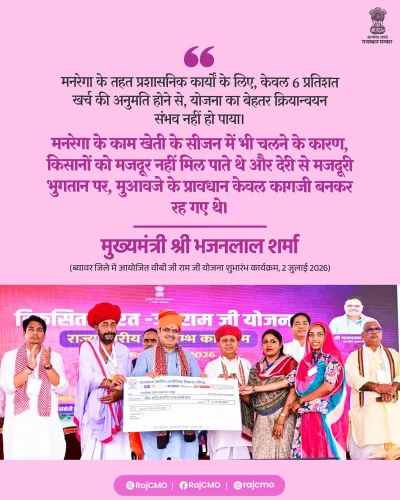
The Chief Minister's Office of Himachal Pradesh on Wednesday, 8 July 2026, publicly flagged a significant fiscal concern: a proposed new rural employment scheme would require the state government to bear 10 percent of total expenditure, a departure from the Mahatma Gandhi National Rural Employment Guarantee Act (MGNREGA) model under which the central government funded 100 percent of wage costs. The office stated that the matter would be raised before the central government.
Context
The post, written in Hindi, states: 'मनरेगा के तहत केंद्र सरकार 100 प्रतिशत धनराशि उपलब्ध करवाती थी, जबकि नई योजना में कुल खर्च का 10 प्रतिशत राज्य सरकार को वहन करना होगा।' ('Under MGNREGA, the central government provided 100 percent of the funds, whereas in the new scheme, the state government will have to bear 10 percent of total expenditure.')
The office further noted that this would place an 'additional burden on the state's limited financial resources' and confirmed the issue would be formally raised with the central government.
Policy Backdrop
MGNREGA, enacted in 2005, was designed with the central government bearing the full cost of unskilled wages and a substantial share of material costs, specifically to insulate states with weak fiscal capacity. Himachal Pradesh, a Himalayan state with constrained own revenues owing to its topography, limited industrial base, and dependence on tourism, has historically been among the states most sensitive to any upward revision in cost-sharing ratios.
Over successive finance commission cycles, the centre has progressively raised state co-funding obligations across many centrally sponsored schemes — from negligible or zero shares to between 10 and 40 percent — drawing repeated objections from hill states and north-eastern states that cite limited fiscal headroom. Himachal Pradesh has consistently sought special-category treatment to offset such pressures.
Stakeholders and Impact
Rural labourers in Himachal Pradesh are the most direct stakeholders, as any disruption in scheme funding or implementation could delay wage payments and reduce the number of person-days generated. The state's finance department faces the immediate operational question of identifying budgetary space for the additional 10 percent contribution without crowding out other development expenditure.
Broader implications extend to other hill and smaller states that may face the same cost-sharing structure, making Himachal Pradesh's decision to escalate the matter to the Ministry of Rural Development a potential rallying point for a collective representation.
What's Next
The Chief Minister's Office has signalled that the state will formally take up the issue with the central government, likely through the Ministry of Rural Development. Any revised operational guidelines, a clarification on the cost-sharing formula, or a reference in the next Union Budget or Himachal Pradesh state budget speech would be the key indicators to watch.
If the centre does not revise the funding structure, the state may need to weigh fiscal trade-offs that could affect scheme coverage, directly impacting the rural workforce that depends on guaranteed employment during lean agricultural seasons.
Point of View
Using the trusted MGNREGA benchmark to frame the new scheme as a regression in centre-state equity. The move fits a well-worn pattern where hill and special-category states use public statements to build pressure ahead of formal inter-governmental negotiations. By invoking 'limited financial resources,' the CM Office is also laying groundwork for a potential demand to restore special-category status or seek enhanced central devolution. Whether this escalation translates into a policy revision will depend on how many other states join the representation and the political calculus at the centre ahead of budget season.
NationPress
8 Jul 2026
Frequently Asked Questions
What is the difference between MGNREGA funding and the new rural employment scheme?
Under MGNREGA, the central government funded 100 percent of unskilled wage costs with no financial obligation on states for wages. The new scheme being referenced by the Himachal Pradesh CM Office requires the state to bear 10 percent of total expenditure, marking a significant shift in cost-sharing.
Why is the 10 percent state share a problem for Himachal Pradesh?
Himachal Pradesh has constrained own revenues due to its mountainous terrain, limited industrial activity, and dependence on tourism. Any additional mandatory expenditure on centrally sponsored schemes strains its budget and reduces funds available for other development priorities.
What action has the Himachal Pradesh CM Office announced?
The Chief Minister's Office has stated that it will formally raise the issue of the new scheme's 10 percent state cost-sharing obligation before the central government.
Which ministry oversees MGNREGA and rural employment schemes?
The Ministry of Rural Development at the central government level is responsible for MGNREGA guidelines, funding patterns, and operational directives for rural employment schemes.
Have other states objected to rising cost-sharing in central schemes?
Yes. Successive finance commission reviews have raised state co-funding obligations across many centrally sponsored schemes, prompting repeated objections from hill states and north-eastern states that cite limited fiscal capacity, with Himachal Pradesh historically seeking special-category treatment.