HP CM Office launches HiBiSCUS scheme for biodiversity

Synopsis
Himachal Pradesh has launched HiBiSCUS, a stakeholder-led scheme to conserve medicinal plants, develop nurseries, and document traditional knowledge, with an initial outlay of Rs 2 crore. The initiative aligns with the Biological Diversity Act, 2002 and India's commitments under the Convention on Biological Diversity.
Key Takeaways
The Chief Minister's Office of Himachal Pradesh announced the launch of the Himachal Biodiversity Stakeholder-led Conservation Unified Scheme (HiBiSCUS) on 27 July 2026 .
The scheme covers four pillars: medicinal plant conservation, sustainable use, nursery development, and documentation of traditional knowledge.
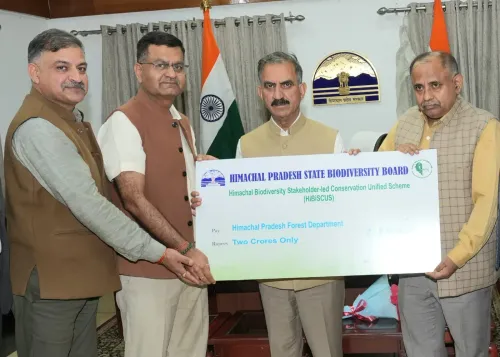
An initial fund of Rs 2 crore has been released for the scheme's implementation.
Primary beneficiaries include local communities, traditional healers, and medicinal plant growers in Himachal Pradesh .
HiBiSCUS operationalises India's Biological Diversity Act, 2002 and aligns with commitments under the Convention on Biological Diversity .
The scheme's rollout and potential linkages with the National Medicinal Plants Board will be closely watched during 2026-27.
The Chief Minister's Office of Himachal Pradesh announced on Monday, 27 July 2026 the launch of the Himachal Biodiversity Stakeholder-led Conservation Unified Scheme (HiBiSCUS), a state-level initiative aimed at conserving medicinal plants, promoting sustainable use, developing nurseries, and documenting traditional knowledge. The government has released Rs 2 crore as the initial outlay for the scheme.
Context
The official post from the Chief Minister's Office stated: 'HiBiSCUS ka shubharambh kiya gaya hai' ('HiBiSCUS has been launched'), with the scheme designed to advance the conservation and sustainable use of medicinal plants, nursery development, and the documentation of traditional knowledge. The announcement underlines the state government's intent to formalise community-centred approaches to biodiversity management in one of India's most ecologically rich Himalayan states.
Himachal Pradesh hosts a diverse range of high-altitude ecosystems that support hundreds of medicinal plant species used in Ayurveda, Sowa-Rigpa, and other traditional healing systems. Overexploitation, climate-induced habitat shifts, and the erosion of indigenous knowledge have placed many of these species under pressure in recent years.
Policy Backdrop
HiBiSCUS draws its legal and policy foundation from the Biological Diversity Act, 2002, which established India's national framework for the conservation of biological resources, their sustainable use, and the equitable sharing of benefits arising from traditional knowledge. State-level schemes like HiBiSCUS serve as operational instruments that translate this national mandate into ground-level action through Biodiversity Management Committees and local stakeholder networks.
Himalayan states have increasingly moved toward stakeholder-driven conservation models, recognising that top-down protection alone cannot address the twin pressures of overexploitation and climate change on fragile mountain ecosystems. India's commitments under the Convention on Biological Diversity also require member states to integrate traditional ecological knowledge into formal conservation mechanisms — an objective that HiBiSCUS explicitly addresses through its documentation component.
Stakeholders and Impact
The scheme is designed to benefit local communities, traditional healers, and medicinal plant growers across Himachal Pradesh. By supporting nursery development, HiBiSCUS aims to reduce pressure on wild plant populations while creating livelihood opportunities for mountain communities engaged in the cultivation and trade of medicinal herbs.
The documentation of traditional knowledge is a particularly significant pillar. Unrecorded indigenous practices are vulnerable to permanent loss as older generations pass, and formal documentation can also protect communities' intellectual rights over their heritage under existing biodiversity laws. An initial allocation of Rs 2 crore signals a focused, pilot-scale rollout that could be expanded based on early outcomes.
What's Next
Observers and policy watchers will track the rollout of nursery infrastructure and traditional knowledge documentation activities during 2026-27, including any formal linkages the state establishes with the National Medicinal Plants Board and local Biodiversity Management Committees. The scheme's stakeholder-led design means that community participation will be central to measuring its effectiveness on the ground.
If HiBiSCUS demonstrates measurable outcomes in its pilot phase, it could serve as a replicable model for other Himalayan states seeking to balance conservation imperatives with the livelihood needs of forest-dependent communities.
Point of View
Community-anchored biodiversity governance — a shift that acknowledges the limits of purely regulatory approaches. By naming stakeholders explicitly in the scheme's title, the Himachal government is signalling political ownership to local communities, not just bureaucratic compliance with national biodiversity law. The Rs 2 crore allocation is modest but strategically calibrated: a pilot-scale investment that carries low fiscal risk while building a proof-of-concept for potential scaling. How effectively the state links HiBiSCUS to existing structures like Biodiversity Management Committees and the National Medicinal Plants Board will determine whether this becomes a durable conservation instrument or a well-branded one-off announcement.
NationPress
27 Jul 2026
Frequently Asked Questions
What is HiBiSCUS scheme in Himachal Pradesh?
HiBiSCUS stands for the Himachal Biodiversity Stakeholder-led Conservation Unified Scheme, launched by the Himachal Pradesh government to conserve medicinal plants, promote sustainable use, develop nurseries, and document traditional knowledge related to biodiversity.
How much money has been allocated for HiBiSCUS?
The Himachal Pradesh government has released Rs 2 crore as the initial funding for the HiBiSCUS scheme.
Who will benefit from the HiBiSCUS scheme?
The scheme is primarily aimed at local communities, traditional healers, and medicinal plant growers in Himachal Pradesh who depend on or possess knowledge of the state's rich biodiversity.
How does HiBiSCUS relate to India's Biological Diversity Act?
HiBiSCUS operationalises the Biological Diversity Act, 2002, which provides India's legal framework for conserving biological resources, their sustainable use, and the documentation and protection of traditional knowledge at the state level.
Why is medicinal plant conservation important in Himachal Pradesh?
Himachal Pradesh's high-altitude Himalayan ecosystems support hundreds of medicinal plant species used in traditional healing systems. Overexploitation and climate change have put many of these species under pressure, making structured conservation schemes like HiBiSCUS necessary.