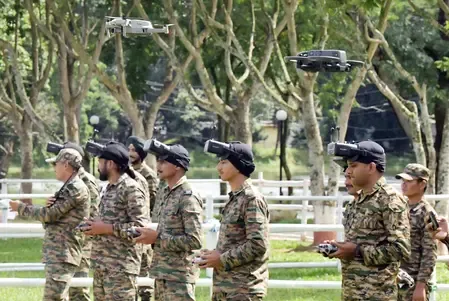
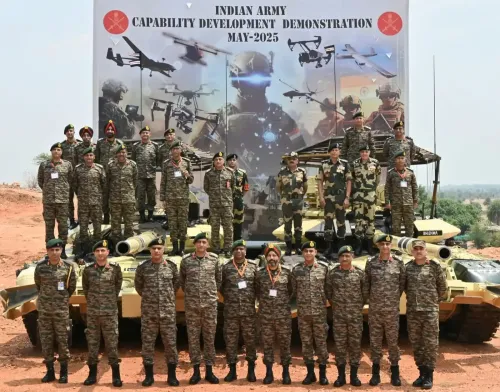
IAF launches indigenous kamikaze drone project, 5 BRD Sulur named nodal agency
Synopsis
The IAF has issued a limited tender for indigenous kamikaze drones — loitering munitions that fly to a target and detonate on impact — with 5 BRD Sulur as the nodal agency and the IAF retaining full IPR. The move is India's clearest signal yet that it is building high-attrition aerial weapons entirely in-house, from moulds to software, amid lessons from Ukraine and the Middle East.
Key Takeaways
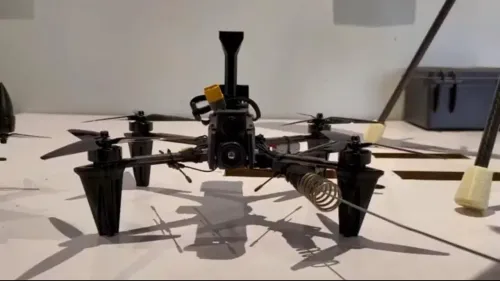
The Indian Air Force (IAF) has issued a limited tender for indigenous One-Way Attack Unmanned Aerial Systems (OWA-UAS) , commonly called kamikaze or loitering munition drones.
5 Base Repair Depot (BRD), Sulur near Coimbatore, Tamil Nadu has been designated as the nodal agency for the project.
The IAF will retain full Intellectual Property Rights (IPR) over the platform, enabling faster upgrades and customisation.
Drones must operate at up to 16,000 feet altitude in both day and night conditions per IAF specifications.
As of February 2026 , 676 start-ups, MSMEs, and innovators have joined the iDEX ecosystem; 548 contracts signed, with 45 procurement contracts worth ₹2,326 crore executed.
Defence Minister Rajnath Singh has called for component-level self-reliance, including drone moulds, software, engines, and batteries manufactured entirely in India.
The Indian Air Force (IAF) has launched a project to develop indigenous long-range loitering munitions — commonly known as kamikaze or suicide drones — in partnership with domestic industry, a Defence Ministry official confirmed on Tuesday, 16 June. The IAF has issued a limited tender to select Indian companies for One-Way Attack Unmanned Aerial Systems (OWA-UAS), marking a significant step in India's push for self-reliance in advanced aerial warfare technology.
Project Structure and Nodal Agency
The kamikaze drone programme will be anchored at the 5 Base Repair Depot (BRD) at Sulur, near Coimbatore in Tamil Nadu, which has been designated as the nodal agency for the initiative. Crucially, the IAF will retain full Intellectual Property Rights (IPR) over the drone platform, which is to be designed, developed, and manufactured entirely within India with the participation of domestic companies and start-ups.
This IPR arrangement is a departure from several past procurement models and is intended to enable faster upgrades, modifications, and customisation in line with evolving operational requirements, according to the Defence Ministry statement.
Technical Specifications
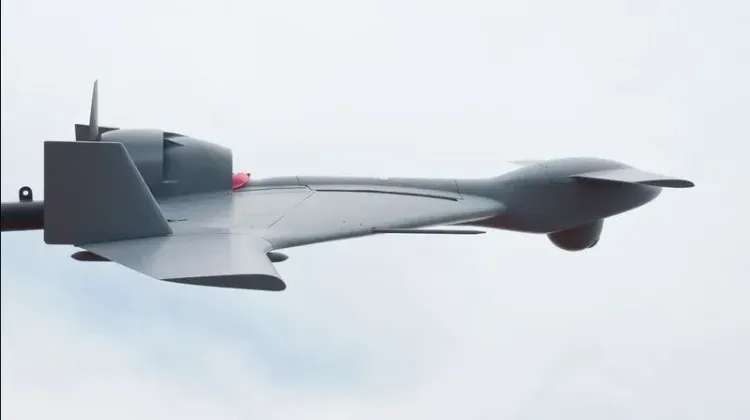
Loitering munitions — also referred to as kamikaze or suicide drones — are one-way, self-sacrificing unmanned aerial vehicles that cruise toward a target area, autonomously identify enemies, and detonate on impact. Under the IAF's specifications, the indigenous long-range variants must operate at altitudes of up to 16,000 feet and function effectively in both day and night conditions.
The ability to operate at high altitudes is particularly significant given India's contested borders in mountainous terrain, where such systems could provide a decisive tactical edge.
What Defence Minister Rajnath Singh Said
At a recent National Defence Industries Conclave, Defence Minister Rajnath Singh underlined the urgency of building indigenous drone capability, stating that India must work in 'mission mode' to emerge as a global hub of drone manufacturing within a few years.
Singh pointed to ongoing global conflicts — from the Russia-Ukraine war to tensions between Iran and Israel — as evidence that drones and counter-drone technologies will play a pivotal role in future warfare. He stressed that self-reliance must extend beyond the product level to the component level. 'From the drone's moulds to its software, engines, and batteries, everything must be manufactured in India. This is no easy task. In most countries where drones are manufactured, a significant number of critical components are currently imported from China,' Singh said.
iDEX Ecosystem and Industry Participation
The OWA-UAS project draws on a rapidly growing defence innovation base. According to Rajnath Singh, as of February 2026, nearly 676 start-ups, MSMEs, and individual innovators have joined the defence innovation ecosystem since the launch of iDEX (Innovations for Defence Excellence) in 2018. A total of 548 contracts have been signed under the initiative, with 58 prototypes cleared for procurement at a value of approximately ₹3,853 crore. Additionally, 45 procurement contracts worth nearly ₹2,326 crore have already been executed.
The minister emphasised that a robust defence industrial ecosystem requires not just large industry players but also MSMEs, start-ups, and a clear policy framework tailored to India's specific defence needs.
Strategic Context
This comes amid heightened focus on drone warfare following the demonstrated effectiveness of loitering munitions in multiple global conflict zones. India's move to develop its own OWA-UAS capability reflects a broader strategic shift: reducing dependence on imported platforms for high-attrition warfare assets, where supply chain continuity in conflict scenarios is a critical vulnerability. The IAF's decision to retain IPR also positions the platform for potential future exports under India's expanding defence diplomacy framework.
Point of View
The programme structurally breaks that pattern. The choice of 5 BRD Sulur as nodal agency also signals that the Air Force intends to embed this capability within its own maintenance and upgrade infrastructure, not outsource it entirely to industry. Whether Indian start-ups can actually deliver at the component level — batteries, engines, guidance software — without Chinese supply chains remains the hard question that neither the tender nor the minister's speech fully answers.
NationPress
15 Sept 2026
Frequently Asked Questions
What is the IAF's kamikaze drone project?
The Indian Air Force has launched a project to develop indigenous long-range loitering munitions, also called kamikaze or suicide drones, through a limited tender to Indian companies for One-Way Attack Unmanned Aerial Systems (OWA-UAS). The IAF will retain full Intellectual Property Rights over the platform, which is to be designed, developed, and manufactured entirely in India.
Where will the kamikaze drone project be based?
The project's nodal agency is the 5 Base Repair Depot (BRD) at Sulur, near Coimbatore in Tamil Nadu. This depot will oversee the development and coordination of the OWA-UAS programme.
What are the technical specifications for the IAF's indigenous loitering munitions?
According to the IAF's specifications, the long-range kamikaze drones must operate at altitudes of up to 16,000 feet and function effectively in both day and night conditions. They are designed to fly to a target area, locate enemies, and detonate on impact.
Why is India developing indigenous kamikaze drones?
Defence Minister Rajnath Singh has cited ongoing global conflicts — including the Russia-Ukraine war and Iran-Israel tensions — as proof that drones will be central to future warfare. India aims to achieve strategic autonomy and reduce dependence on imported components, many of which currently come from China in other drone-manufacturing nations.
How large is India's defence innovation ecosystem under iDEX?
As of February 2026, nearly 676 start-ups, MSMEs, and individual innovators have joined the iDEX ecosystem since its 2018 launch. A total of 548 contracts have been signed, with 58 prototypes cleared for procurement worth around ₹3,853 crore, and 45 procurement contracts worth nearly ₹2,326 crore already executed.