IIT Madras Team AgniRath wins 3rd place at Sasol Solar Challenge 2026
Synopsis
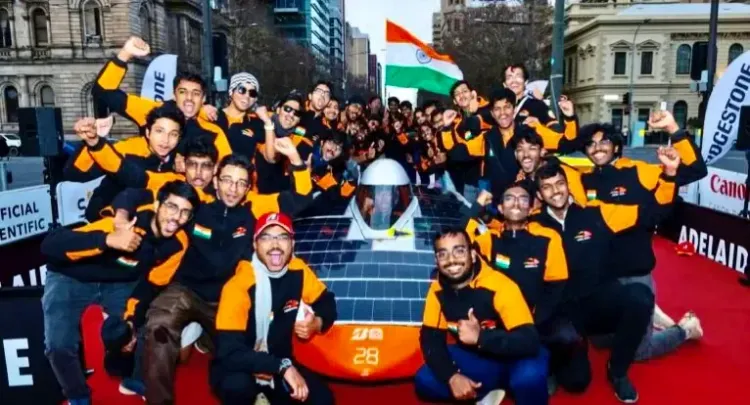
A student team from IIT Madras just made Indian solar racing history — Team AgniRath finished third at the 2026 Sasol Solar Challenge in South Africa, covering 1,192.6 km in eight days. It is the first time an Indian team has entered and podiumed at the prestigious biennial event, doing it entirely with a car they designed and built themselves.
Key Takeaways
Team AgniRath from IIT Madras secured third place overall at the Sasol Solar Challenge 2026 in South Africa .
The team drove solar car Aagneya across 1,192.6 km in eight days , from Johannesburg to Cape Town via Jeffreys Bay .
This is the first time an Indian team has participated in and won a trophy at the Sasol Solar Challenge.
AgniRath was founded in 2021 and now comprises over 45 undergraduate engineers ; Aagneya is their second-generation race car, built entirely in-house.
IIT Madras called the result a 'historic finish' and credited the team with 'putting IIT Madras and India on the global solar racing map.'
Team AgniRath from IIT Madras has claimed third place overall at the Sasol Solar Challenge 2026 in South Africa, becoming the first Indian team to compete in the biennial event and return with a podium finish. The achievement, announced on Wednesday, 8 October 2026, marks a watershed moment for Indian solar racing on the global stage.
The Race and the Record
The AgniRath team piloted their solar-powered vehicle Aagneya across 1,192.6 km of challenging South African terrain over eight days, navigating demanding weather and road conditions throughout. The race route ran from Johannesburg to Cape Town via Jeffreys Bay — one of the most gruelling solar racing circuits in the world.
No Indian team had previously competed in the Sasol Solar Challenge, let alone finished on the podium. The result places India's academic engineering community firmly on the international solar racing map.
About the Vehicle and the Team
Aagneya is the team's second-generation solar race car, designed, engineered, and built entirely in-house by student members. Team AgniRath was founded in 2021 by six students and has since grown into a multidisciplinary unit of over 45 undergraduate engineers working across aerodynamics, electrical systems, battery technology, telemetry, vehicle dynamics, manufacturing, and business operations.
'As one of the largest solar racing vehicles manufactured by a student team in India, Aagneya embodies thousands of hours of research, craftsmanship, and perseverance,' the team said. Every component — from conceptual design to final testing — was developed by students, with no outsourced engineering.
What the Institute Said
IIT Madras congratulated the team, calling it a 'historic finish.' The institute said: 'Congratulations to Team AgniRath for putting IIT Madras and India on the global solar racing map.' In a separate statement, the institute described the achievement as 'a celebration of student innovation, engineering excellence, teamwork and the relentless pursuit of sustainable mobility.'
Significance for India's Clean Energy Ambitions
The Sasol Solar Challenge is a biennial competition designed to be the ultimate test of solar vehicle technology and innovation, with local and international teams demonstrating design, manufacturing, and race-strategy skills across South Africa. This is the first time an Indian team has entered — and finished — with hardware in hand.
The result carries symbolic weight beyond motorsport. India has set ambitious renewable energy targets, and student-led programmes such as AgniRath serve as real-world validation environments for solar and battery technologies. Notably, Team AgniRath's stated mission — to 'showcase India's engineering capabilities while inspiring students, researchers, and industry leaders to embrace renewable energy' — aligns directly with the country's net-zero transition narrative.
With a third-place finish on debut, Team AgniRath is expected to return to the next edition of the Sasol Solar Challenge with a vehicle built on the lessons of 1,192.6 hard-won kilometres.
Point of View
Not a ceremonial participation trophy. What makes it striking is the entirely in-house build — no outsourced components, no industry co-development, just 45 undergraduates from a standing start in 2021. The broader context matters: as India chases net-zero targets, the credibility gap between policy ambition and on-the-ground capability is real. Student programmes like AgniRath are among the few spaces where that gap is being closed with working hardware. The question now is whether IIT Madras — and the government's clean-energy funding apparatus — will resource the team's next iteration with the same seriousness that the podium finish has earned.
NationPress
8 Oct 2026
Frequently Asked Questions
What is the Sasol Solar Challenge and why does it matter?
The Sasol Solar Challenge is a biennial solar vehicle race held in South Africa, widely regarded as one of the world's most demanding tests of solar car technology. Teams design, build, and race solar-powered vehicles across the country, competing on engineering, strategy, and endurance.
What position did IIT Madras Team AgniRath finish at Sasol Solar Challenge 2026?
Team AgniRath finished third overall at the Sasol Solar Challenge 2026, covering 1,192.6 km in eight days from Johannesburg to Cape Town via Jeffreys Bay. It is the first Indian team to compete in and win a trophy at the event.
What is Aagneya, the solar car built by Team AgniRath?
Aagneya is Team AgniRath's second-generation solar race car, designed, engineered, and built entirely by its student members at IIT Madras. The vehicle incorporates advances in aerodynamics, battery technology, and telemetry, and represents thousands of hours of in-house research and manufacturing.
Who is Team AgniRath and when was it founded?
Team AgniRath is a student-led solar racing team based at IIT Madras, founded in 2021 by six students. It has since grown to over 45 undergraduate engineers working across disciplines including aerodynamics, electrical systems, vehicle dynamics, and business operations.
Why is IIT Madras's podium at Sasol 2026 significant for India?
It is the first time an Indian team has entered the Sasol Solar Challenge and finished on the podium, making it a landmark in Indian solar racing history. Beyond motorsport, the achievement validates India's student engineering talent in clean mobility — a sector directly tied to the country's renewable energy and net-zero ambitions.