India, EU hold high-level CBAM talks; carbon market cooperation deepens
Synopsis
India and the EU met in New Delhi on 12 October to navigate a high-stakes carbon trade dispute — CBAM could force Indian steel and aluminium exporters to slash prices by up to 22% to stay competitive in Europe. With 308 GW of non-fossil capacity already online, India is pushing for recognition of its domestic carbon market, a move that could reshape the terms of its trade relationship with its largest export partner.
Key Takeaways
India and the EU held high-level CBAM talks in New Delhi on 12 October 2026 , led by Power Secretary Pankaj Agarwal and EU's Gerassimos Thomas .
India's Carbon Credit Trading Scheme (CCTS) has set emission intensity targets for 490 industrial units .
Non-fossil energy sources now account for 308 GW of India's total installed capacity of 558 GW .
Indian steel and aluminium exporters may need to cut prices by 15–22% to remain competitive under EU CBAM rules, according to the Global Trade Research Initiative .
Both sides committed to continued engagement on carbon pricing recognition, MRV systems, and capacity building.
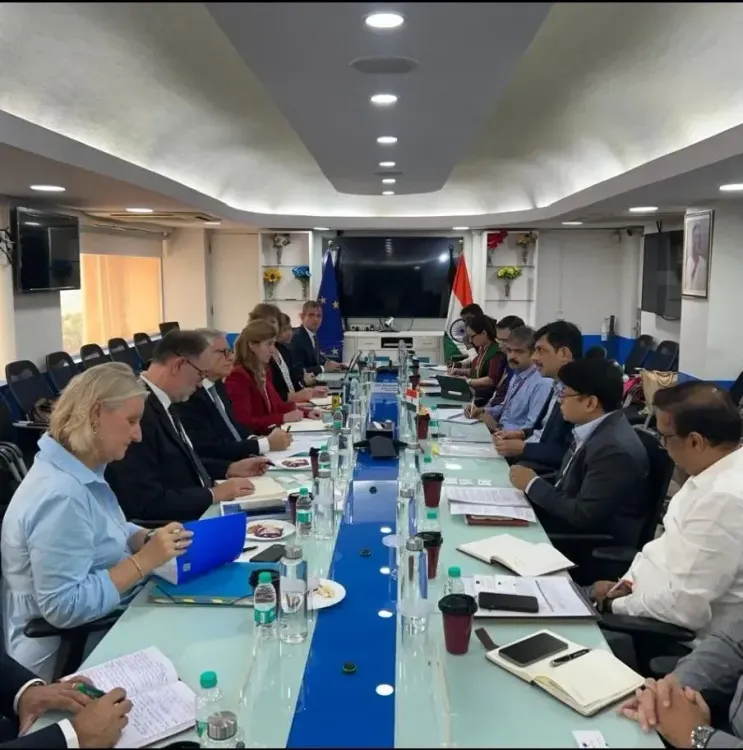
India and the European Union agreed on Monday, 12 October 2026 to deepen cooperation on carbon markets and continue structured dialogue on the Carbon Border Adjustment Mechanism (CBAM), following a high-level bilateral meeting held in New Delhi. The talks signal growing urgency for both sides to align on carbon pricing frameworks as CBAM implementation begins reshaping global trade flows.
Key Developments from the Meeting
The Indian delegation was led by Power Secretary Pankaj Agarwal, while the EU team was headed by Gerassimos Thomas, Director-General for Taxation and Customs Union at the European Commission. Discussions centred on India's carbon market development, CBAM-related methodologies, and opportunities for enhanced technical cooperation, according to an official statement released after the meeting.
Agarwal highlighted India's progress under the Carbon Credit Trading Scheme (CCTS), including the notification of emission intensity reduction targets for 490 industrial units and the development of its domestic carbon market. He further underscored India's expanding clean-energy base, noting that non-fossil sources now account for 308 GW of the country's total installed capacity of 558 GW.
What the EU Side Brought to the Table
The EU side appreciated India's carbon market progress and shared updates on CBAM implementation. Both sides expressed willingness to continue technical engagement on the recognition of carbon pricing mechanisms, monitoring, reporting and verification (MRV) systems, and capacity building, the official statement noted. This is a notable step, as recognition of India's domestic carbon pricing under CBAM rules could significantly reduce the tariff burden on Indian exporters.
Impact on Indian Exporters
Steel and aluminium are among the sectors most exposed to CBAM, as they are among the hardest to decarbonise. According to estimates from the Global Trade Research Initiative, Indian steel and aluminium exporters may need to cut prices by 15 to 22 per cent to remain competitive in European markets under the new carbon border rules. Smaller firms face a disproportionate burden, struggling particularly with the cost of measuring and reporting emissions in compliance with EU standards.
This comes amid a broader tension in global climate discourse: while Western economies continue to scrutinise India's coal-fired power plants, analysts argue that India's rapid renewable energy expansion — encompassing solar, hydel, and wind — is frequently underweighted in the debate. India is, by several metrics, building one of the largest clean-energy systems in the world while simultaneously managing energy access and industrial growth imperatives.
Historical Context and What's at Stake
Many high-income economies industrialised predominantly on coal for over a century before transitioning to cleaner energy sources. India, by contrast, is attempting both transitions simultaneously — expanding electricity access and industrial output while scaling renewable capacity. This dual challenge shapes New Delhi's negotiating posture on CBAM: it seeks recognition for the speed of its clean-energy transition, not simply a carbon tax adjusted for current emissions intensity.
Notably, the CCTS framework — with emission intensity targets now assigned to 490 industrial units — positions India to argue for equivalence or mutual recognition with the EU's own carbon market, the Emissions Trading System (ETS). Whether the EU ultimately grants such recognition will be decisive for Indian export competitiveness in the coming years.
What Comes Next
Both sides committed to continued technical engagement, though no specific timeline for follow-up talks was announced in the official statement. The trajectory suggests further working-group-level meetings on MRV harmonisation and carbon pricing equivalence. For Indian industry — particularly steel, aluminium, cement, and fertiliser exporters — the outcome of these negotiations will have direct commercial consequences as CBAM phases move toward full enforcement.
Point of View
Yet CBAM as currently structured measures absolute emissions rather than the pace of transition, placing late-industrialisers at a structural disadvantage. The 15–22% price-cut estimate for steel and aluminium exporters is commercially significant, but the deeper risk is that smaller Indian manufacturers, unable to afford MRV compliance, exit European markets entirely. Recognition of India's CCTS under CBAM — the central ask from New Delhi — is the metric that will determine whether these talks produce substance or just goodwill.
NationPress
12 Oct 2026
Frequently Asked Questions
What is the Carbon Border Adjustment Mechanism (CBAM) and how does it affect India?
CBAM is an EU policy that places a carbon price on imports of goods from countries without equivalent carbon pricing, effectively extending the EU's Emissions Trading System to foreign producers. For India, it means exporters of steel, aluminium, cement, and other carbon-intensive goods face additional costs when selling into European markets, with estimates suggesting Indian steel and aluminium exporters may need to reduce prices by 15–22% to stay competitive.
What was agreed at the India-EU CBAM meeting on 12 October 2026?
India and the EU agreed to strengthen cooperation on carbon markets and continue technical dialogue on CBAM methodologies, carbon pricing recognition, MRV systems, and capacity building. The meeting was held in New Delhi and was led by Power Secretary Pankaj Agarwal on the Indian side and Gerassimos Thomas of the European Commission on the EU side.
What is India's Carbon Credit Trading Scheme (CCTS)?
The CCTS is India's domestic carbon market framework under which emission intensity reduction targets have been notified for 490 industrial units. It is India's primary tool for carbon pricing and could, if recognised by the EU, reduce the CBAM burden on Indian exporters.
How much of India's electricity capacity comes from non-fossil sources?
As of the meeting, non-fossil sources account for 308 GW of India's total installed electricity generation capacity of 558 GW. This includes solar, hydel, and wind power, and reflects India's rapid clean-energy expansion.
Which Indian industries are most at risk from CBAM?
Steel and aluminium are among the most exposed sectors, as they are among the hardest to decarbonise. Smaller firms in these industries face the greatest challenge because of the high cost of emissions measurement and reporting required for CBAM compliance.