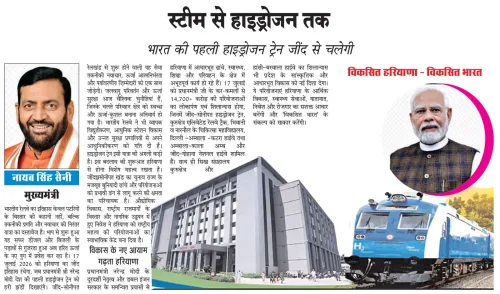
Shekhawat hails India's first hydrogen train on Jind-Sonipat route
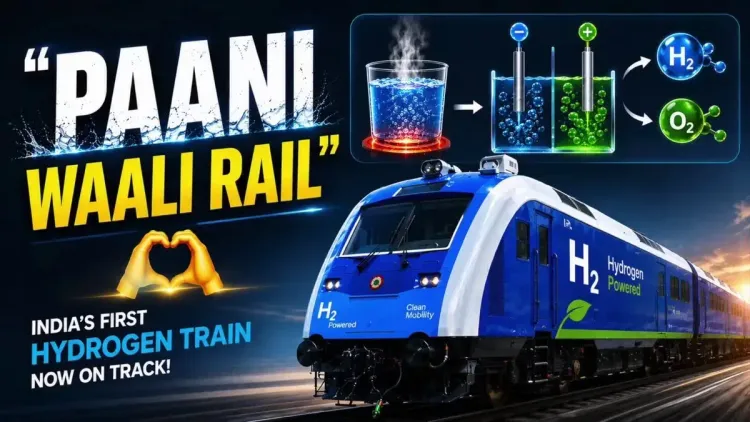
Synopsis
Union Minister Gajendra Singh Shekhawat on 19 July 2026 celebrated India's first indigenous hydrogen-powered train — a 10-coach rake built at ICF Chennai — now operating on the Jind-Sonipat route at up to 120 kmph, emitting only water vapour, under a ₹2,800 crore plan for 35 such trains.
Key Takeaways
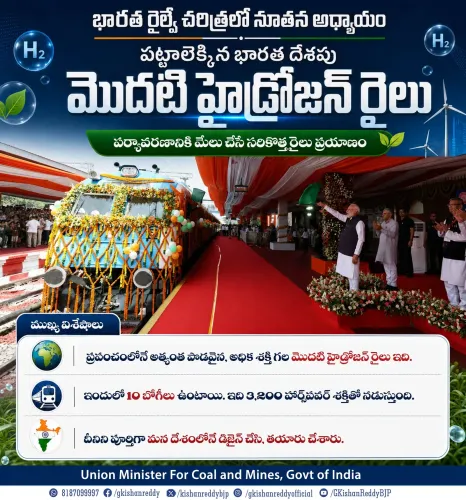
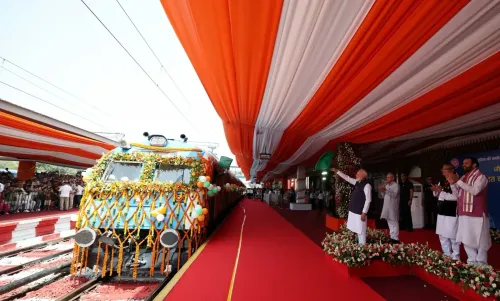
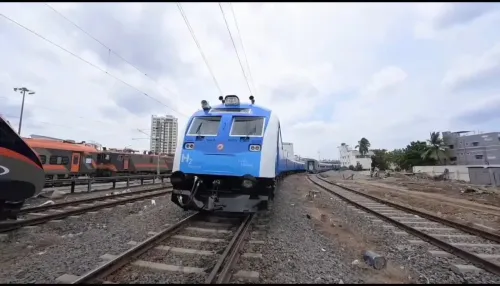
India's first indigenous hydrogen-powered train has been deployed on the Jind–Sonipat route in Haryana.
The 10-coach train was built by engineers at Integral Coach Factory, Chennai using domestic fuel-cell technology.
It is capable of speeds up to 120 kmph and emits only water vapour — zero carbon or smoke.
The project is part of a ₹2,800 crore plan targeting 35 hydrogen trains across Indian Railways.
The initiative aligns with Indian Railways' net-zero by 2030 target and the National Green Hydrogen Mission launched in January 2023.
Union Minister Gajendra Singh Shekhawat credited PM Narendra Modi's leadership and the Atmanirbhar Bharat programme for the achievement.
Union Culture and Tourism Minister Gajendra Singh Shekhawat on Sunday, 19 July 2026, celebrated the rollout of India's first indigenous hydrogen-powered train, calling it a historic milestone for Indian Railways and the Atmanirbhar Bharat mission. The minister highlighted the train's deployment on the Jind–Sonipat route in Haryana as proof that the country's green-technology ambitions have moved from policy to reality.
Context
Shekhawat's post, written in Hindi and English, declared: 'कल तक हम भविष्य की बात करते थे, आज भविष्य भारतीय पटरियों पर दौड़ रहा है!' ('Until yesterday we spoke of the future; today the future is running on Indian tracks!'). He credited the achievement to the 'visionary leadership' of Prime Minister Narendra Modi and the self-reliance drive that underpins the Atmanirbhar Bharat programme. The train, he noted, emits only water vapour — no smoke, no carbon.
The hydrogen train is a 10-coach rake built by engineers at the Integral Coach Factory (ICF) in Chennai, using advanced hydrogen fuel-cell technology developed domestically. It is designed to reach speeds of up to 120 kmph and is positioned as a cleaner alternative for non-electrified rail corridors across the country.
Policy Backdrop
The project sits at the intersection of two flagship national programmes. Indian Railways committed to achieving net-zero carbon emissions by 2030, a target announced during the 2021-22 budget cycle. That ambition was reinforced in January 2023 when the government launched the National Green Hydrogen Mission, designed to scale hydrogen production and deployment across transport and industry.
The hydrogen train initiative is budgeted at ₹2,800 crore, with a target of procuring 35 hydrogen trains in total. The Jind–Sonipat corridor in Haryana has been identified as the initial operating segment, providing a real-world testbed before broader network rollout. ICF Chennai, which already manufactures Vande Bharat express coaches, leads the fabrication effort, underscoring the government's push to keep high-technology manufacturing within India.
Stakeholders and Impact
For rail commuters on non-electrified routes, hydrogen trains offer a quieter, cleaner ride compared with diesel multiple units currently in service. The zero-emission profile — water vapour as the only by-product — directly addresses air-quality concerns in densely populated corridors. Railway engineers and ICF workers stand to gain specialised expertise in fuel-cell integration, positioning India alongside Germany, Japan and other nations that have piloted hydrogen rail services.
The ₹2,800 crore outlay also signals sustained capital commitment, which could catalyse a domestic supply chain for hydrogen storage, fuel cells and related components. If the Jind–Sonipat service performs to specification, it could accelerate inclusion of additional routes in future railway budgets and attract private-sector investment in green hydrogen infrastructure.
What's Next
The immediate focus will be on the operational performance of the first train on the Jind–Sonipat route — reliability, passenger capacity utilisation, and maintenance costs will be closely watched by railway planners. The rollout of the remaining 34 hydrogen trains under the approved plan is the logical next step, with timelines likely to feature in upcoming railway budget presentations and parliamentary committee reviews.
India's hydrogen train programme arrives as global decarbonisation pressure on the transport sector intensifies. A successful commercial deployment would strengthen the country's credentials in green mobility and could open export or technology-sharing opportunities with nations seeking similar solutions for diesel-dependent rail networks.
Point of View
Framing a railway engineering milestone as a vindication of the Modi government's twin pillars of self-reliance and green growth. By tying the hydrogen train directly to Atmanirbhar Bharat, the BJP is signalling that industrial deeptech — not just infrastructure spending — is now part of its electoral narrative. The Jind–Sonipat pilot is modest in scale, but the ₹2,800 crore commitment and the 35-train target suggest this is a programme designed to be visible across multiple budget cycles. If the operational rollout proceeds without significant delays, it could become a recurring proof-point in the government's green-economy messaging ahead of state and national elections.
NationPress
18 Oct 2026
Frequently Asked Questions
What is India's first hydrogen train and where does it run?
India's first indigenous hydrogen-powered train is a 10-coach rake built at Integral Coach Factory in Chennai. It operates on the Jind–Sonipat route in Haryana and can reach speeds of up to 120 kmph.
Who built India's hydrogen train?
The train was designed and manufactured by Indian engineers at the Integral Coach Factory (ICF) in Chennai, the same facility that produces Vande Bharat express coaches.
How much has the government spent on the hydrogen train project?
The government has approved a ₹2,800 crore plan to procure 35 hydrogen trains for Indian Railways, of which this is the first.
Is the hydrogen train environmentally friendly?
Yes. The train uses hydrogen fuel-cell technology and emits only water vapour — no smoke or carbon dioxide — making it one of the cleanest rail propulsion systems available.
What is India's target for hydrogen trains by 2030?
Under the current ₹2,800 crore plan, Indian Railways aims to induct 35 hydrogen trains. This supports the broader net-zero carbon emission target Indian Railways set for 2030.