Yadav: Surha Tal becomes India's 100th Ramsar site

Synopsis
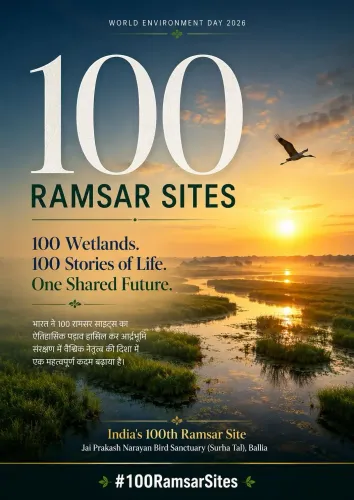
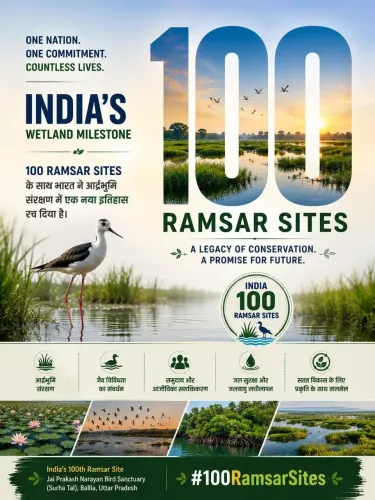
India reached a landmark century of Ramsar-designated wetlands on World Environment Day 2026 as Union Environment Minister Bhupender Yadav announced that Jaiprakash Narayan Bird Sanctuary (Surha Tal) in Ballia, Uttar Pradesh, has become the country's 100th site under the 1971 international wetlands treaty.
Key Takeaways
India now has 100 Ramsar sites , a milestone announced on World Environment Day, 5 June 2026 .
The 100th site is Jaiprakash Narayan Bird Sanctuary (Surha Tal) , a freshwater wetland in Ballia, Uttar Pradesh .
India's Ramsar network grew from 26 sites in 2014 to 100 by 2026, reflecting a sustained policy push by the Ministry of Environment, Forest and Climate Change .
India joined the Ramsar Convention in 1982 with Chilika Lake as its first designated site.
The designation supports India's commitments under the Kunming-Montreal Global Biodiversity Framework and domestic wetland conservation programmes.
A site management plan for Surha Tal and further Ramsar notifications from other states are expected as next steps.
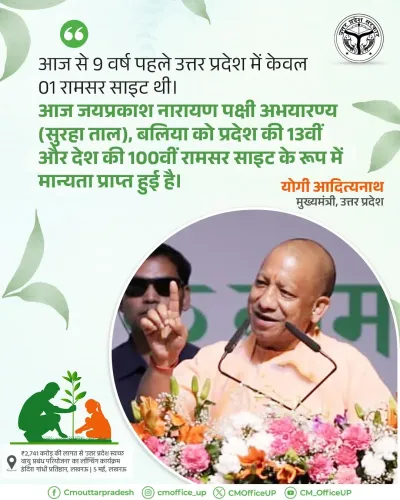
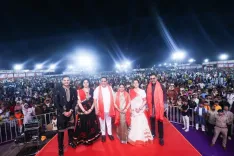
Union Environment Minister Bhupender Yadav announced on Friday, 5 June 2026 — World Environment Day — that the Jaiprakash Narayan Bird Sanctuary (Surha Tal) in Ballia, Uttar Pradesh, has been recognised as India's 100th Ramsar site, taking the country's total wetland designations under the international treaty to a landmark century.
Context
Yadav posted on X in Hindi, stating: 'Uttar Pradesh ke Ballia sthit Jaiprakash Narayan Pakshi Vihar (Surha Tal) ko Bharat ke 100ve Ramsar sthal ke roop mein manyata milne ke saath hi desh mein Ramsar sthalon ki sankhya badhkar 100 ho gayi hai.' In English: 'With the recognition of Jaiprakash Narayan Bird Sanctuary (Surha Tal) located in Ballia, Uttar Pradesh, as India's 100th Ramsar site, the number of Ramsar sites in the country has now grown to 100.' The announcement, made on World Environment Day, amplifies the symbolic weight of the milestone.
The Ramsar Convention, signed in 1971 in Ramsar, Iran, is the principal international treaty for the conservation and sustainable use of wetlands. India became a party to the Convention in 1982, with Chilika Lake in Odisha as its first designated site.
Policy Backdrop
India's Ramsar network stood at just 26 sites in 2014. The Ministry of Environment, Forest and Climate Change under successive notifications sharply accelerated designations, crossing 80 sites by 2024. A notable push came in February 2022, when 11 new sites were notified in a single tranche, taking the count to 75 — timed to India's 75th year of independence.
The expansion is underpinned by domestic frameworks including the National Plan for Conservation of Aquatic Ecosystems (NPCA), which channels funds to wetland management, restoration, and community-based conservation. Reaching 100 Ramsar sites also aligns with India's commitments under the Kunming-Montreal Global Biodiversity Framework and its broader climate pledges.
Stakeholders and Impact
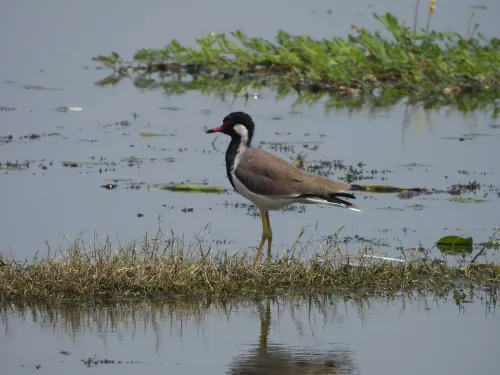
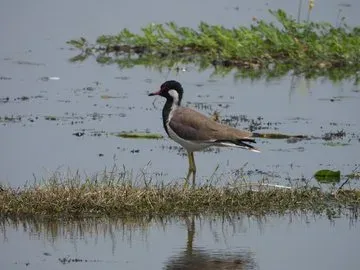
The Jaiprakash Narayan Bird Sanctuary, commonly known as Surha Tal, is a freshwater wetland that supports significant populations of migratory and resident birds in the Gangetic plains of eastern Uttar Pradesh. The Ramsar tag brings international recognition and unlocks technical and financial support for site-specific management plans, directly benefiting local fishing communities and conservation organisations working in the region.
For Uttar Pradesh, the designation adds to a growing list of Ramsar sites within the state and signals continued collaboration between the state government and the Union environment ministry on wetland protection. Conservation groups have long advocated for Surha Tal's inclusion, citing its ecological role in flood regulation and as a corridor for migratory waterfowl.
What's Next
The immediate priority will be the rollout of a formal site management plan for Surha Tal, as required under Ramsar obligations, alongside community engagement programmes. Analysts will also watch whether the Ministry of Environment moves to notify additional sites from other states in the coming months, building on the momentum of the 100-site milestone.
India's position at the next Ramsar Conference of the Parties (COP) will likely highlight this achievement as evidence of its commitment to the '30x30' global biodiversity target — protecting 30 per cent of land and water by 2030. The century mark sets a new baseline from which the government is expected to push further designations across ecologically sensitive wetland zones.
Point of View
Giving Bhupender Yadav a concrete data point for global forums. However, the real test lies in implementation: Ramsar designation without funded management plans risks becoming a numbers exercise rather than genuine ecological protection. Observers will watch whether Surha Tal receives the on-ground investment that transforms a treaty listing into measurable wetland health.
NationPress
20 Oct 2026
Frequently Asked Questions
What is India's 100th Ramsar site?
India's 100th Ramsar site is the Jaiprakash Narayan Bird Sanctuary, also known as Surha Tal, located in Ballia district, Uttar Pradesh. It was recognised under the Ramsar Convention in June 2026.
What is a Ramsar site?
A Ramsar site is a wetland designated under the 1971 Ramsar Convention as being of international importance for ecology, biodiversity, and hydrology. Designation brings international recognition and commits the host country to sustainable management of the wetland.
How many Ramsar sites does India have in 2026?
India has 100 Ramsar sites as of June 2026, following the designation of Surha Tal in Uttar Pradesh as the 100th site.
Which was India's first Ramsar site?
Chilika Lake in Odisha was India's first Ramsar site, designated in 1981 when India acceded to the Ramsar Convention in 1982.
What is Surha Tal known for?
Surha Tal is a freshwater wetland in Ballia, Uttar Pradesh, recognised as an important habitat for migratory and resident birds in the Gangetic plains. It also plays a role in flood regulation and supports local fishing communities.