Sonowal hails Surha Tal as India's 100th Ramsar Site
Synopsis
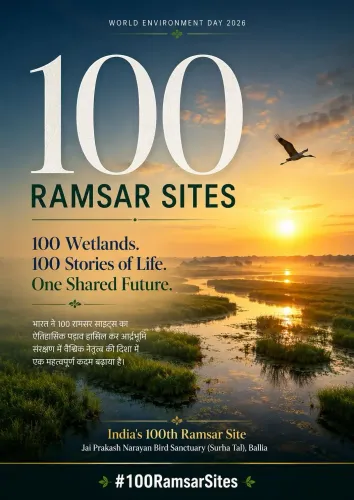
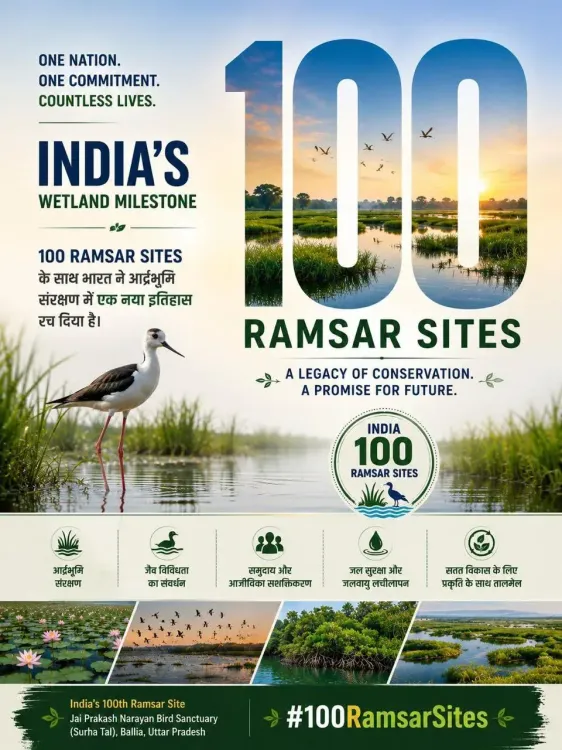
On World Environment Day 2026, Union Minister Sarbananda Sonowal announced the Jai Prakash Narayan Bird Sanctuary (Surha Tal) in Ballia, Uttar Pradesh as India's 100th Ramsar Site — marking a landmark in the country's four-decade journey of wetland conservation under the international Ramsar Convention.
Key Takeaways
India's 100th Ramsar Site is the Jai Prakash Narayan Bird Sanctuary (Surha Tal) in Ballia district, Uttar Pradesh .
The announcement was made on 5 June 2026 , coinciding with World Environment Day .
India first joined the Ramsar Convention in 1982 , with Chilika Lake as its inaugural designated site.
By early 2024, India had already notified more than 80 Ramsar sites , with the count accelerating rapidly thereafter.
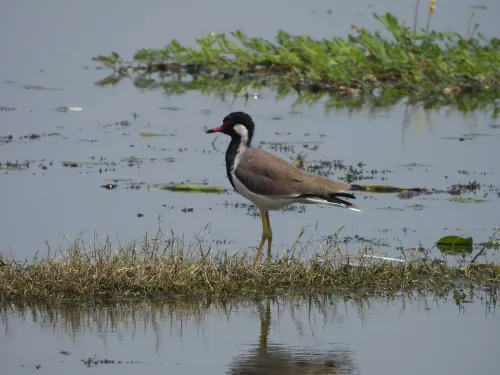
Surha Tal supports migratory and resident bird species and local fishing communities in the Ganga basin floodplain.
The Ministry of Environment, Forest and Climate Change is expected to issue a formal management framework for the newly designated site.
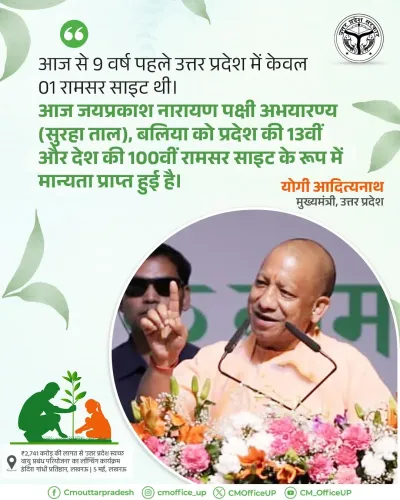
Union Minister of Ports, Shipping and Waterways Sarbananda Sonowal on Friday, 5 June 2026 — World Environment Day — celebrated the designation of the Jai Prakash Narayan Bird Sanctuary (Surha Tal) in Uttar Pradesh as India's 100th Ramsar Site, calling it a historic milestone for the country's biodiversity and conservation commitments.
Context
Posting on the occasion of World Environment Day, Sonowal wrote that the Jai Prakash Narayan Bird Sanctuary (Surha Tal) is 'officially India's 100th Ramsar Site,' describing the moment as 'a milestone celebrating our rich biodiversity and commitment to conservation.' The sanctuary is located in Ballia district, Uttar Pradesh, and is recognised for its ecological value as a wetland and bird habitat. The announcement, timed to coincide with the global environmental observance on 5 June, underscores the government's intent to link domestic conservation achievements with international awareness calendars.
Policy Backdrop
India acceded to the Ramsar Convention on Wetlands in 1982, with Chilika Lake in Odisha becoming the country's first designated site. The convention, an international treaty, obligates signatory nations to maintain the ecological character of listed wetlands and to use them sustainably. India has significantly accelerated its pace of designations in recent years, moving from a modest tally to a rapidly expanding network that now spans diverse ecosystems — from Himalayan high-altitude lakes to coastal mangroves and inland floodplain wetlands. By early 2024, the country had notified more than 80 Ramsar sites, and the trajectory has continued upward in line with commitments under the Convention on Biological Diversity and national wetland conservation rules.
The push to expand the Ramsar network aligns with India's broader environmental diplomacy goals. Successive governments have notified dozens of new sites across multiple states, with a particular focus on wetlands that support migratory bird populations, endemic biodiversity, and the livelihoods of local communities dependent on these ecosystems. Reaching the 100-site mark is being positioned as a symbolic threshold that reflects sustained institutional effort over four decades.
Stakeholders and Impact
Surha Tal is a freshwater lake and wetland complex that serves as a critical habitat for resident and migratory bird species, making it significant for ornithologists, wildlife researchers, and local fishing communities in Ballia. Ramsar designation brings with it international recognition and, in principle, access to technical guidance and best practices under the convention's framework. For Uttar Pradesh, which already hosts several Ramsar-listed wetlands, the inclusion of Surha Tal strengthens the state's conservation profile and may attract focused funding and management attention from central and state environment bodies.
Wetland conservation groups and biodiversity researchers have long advocated for formal protection of floodplain lakes in the Ganga basin, of which Surha Tal is a part. Local communities rely on the lake for fisheries and agriculture, and Ramsar status can help formalise management plans that balance ecological preservation with livelihood needs.
What's Next
The Ministry of Environment, Forest and Climate Change, which administers India's Ramsar obligations, is expected to issue a formal notification confirming the designation and outlining the management framework for Surha Tal. Further Ramsar notifications from other states are anticipated as India continues to identify eligible wetlands under its national wetland inventory. The 100-site milestone is likely to feature prominently in India's reporting to the Ramsar Convention's secretariat and in domestic policy communications ahead of forthcoming international biodiversity reviews. The broader question now is whether the pace of designation will be matched by on-ground management capacity and funding to ensure these sites retain their ecological character over time.
Point of View
Though critics in conservation circles have noted that formal listing does not automatically translate into effective on-ground protection. Sonowal's amplification of the milestone, despite his portfolio being in ports and shipping rather than environment, signals a whole-of-government approach to projecting conservation achievements. The real test will be whether the 100-site milestone prompts commensurate investment in wetland management capacity, or remains primarily a number in India's international reporting.
NationPress
20 Oct 2026
Frequently Asked Questions
What is India's 100th Ramsar site?
India's 100th Ramsar site is the Jai Prakash Narayan Bird Sanctuary, also known as Surha Tal, located in Ballia district of Uttar Pradesh. The designation was announced on World Environment Day, 5 June 2026.
Where is Surha Tal located?
Surha Tal is a freshwater lake and wetland located in Ballia district, Uttar Pradesh. It functions as a habitat for migratory and resident bird species and supports local fishing communities in the Ganga basin region.
What is the Ramsar Convention?
The Ramsar Convention is an international treaty on the conservation and sustainable use of wetlands, signed in Ramsar, Iran in 1971. India became a signatory in 1982, designating Chilika Lake in Odisha as its first Ramsar site.
How many Ramsar sites does India have?
As of World Environment Day 2026, India has 100 Ramsar-designated wetland sites, following the inclusion of the Jai Prakash Narayan Bird Sanctuary (Surha Tal) in Uttar Pradesh. India had crossed 80 sites by early 2024.
Why is World Environment Day significant for India's Ramsar announcement?
World Environment Day, observed globally on 5 June each year, focuses on environmental awareness and action. Announcing India's 100th Ramsar site on this date amplifies the conservation milestone and aligns domestic policy achievements with international environmental observances.