Giriraj Singh Hails India-New Zealand Strategic Partnership, 2030 Roadmap
Synopsis
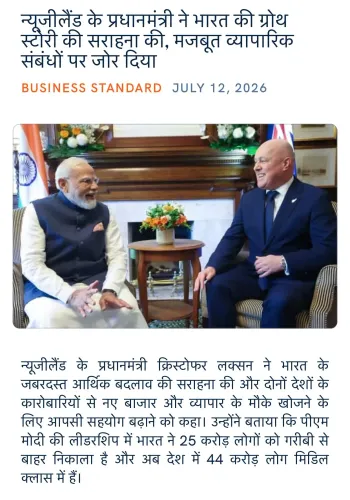
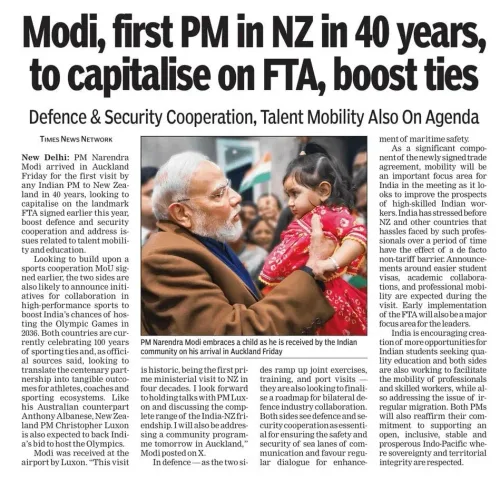
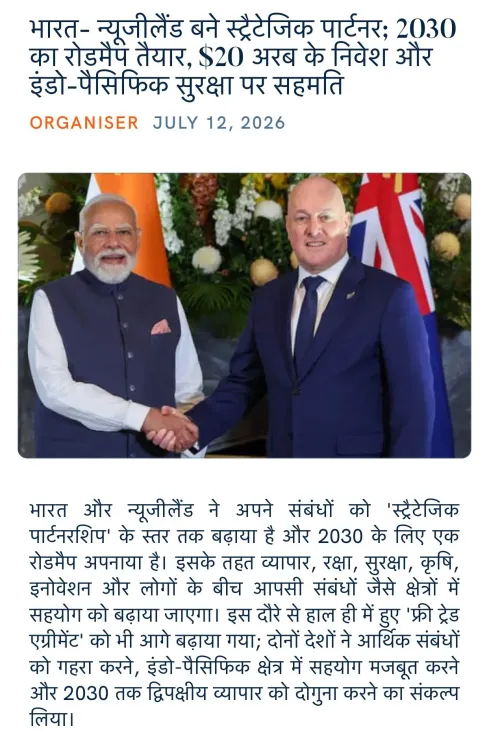
Union Textiles Minister Giriraj Singh on 12 July 2026 flagged India and New Zealand elevating their ties to a strategic partnership, anchored by a 2030 roadmap, a reported $20 billion investment target, and shared commitments on Indo-Pacific security — signalling major commercial opportunities for Indian exporters.
Key Takeaways
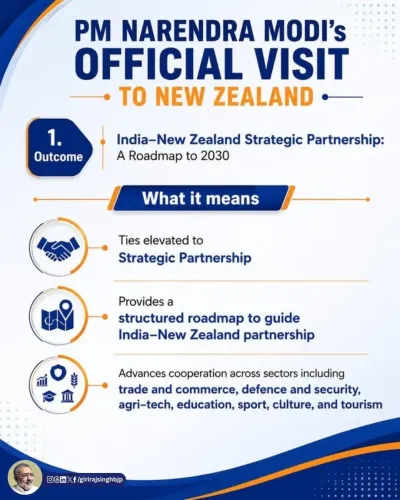
India and New Zealand have elevated bilateral ties to a strategic partnership , as highlighted by Union Textiles Minister Giriraj Singh on 12 July 2026 .
A joint 2030 roadmap has been scripted, covering economic and security cooperation.
A reported $20 billion investment target forms the commercial core of the new partnership framework.
Both sides have reached agreement on Indo-Pacific security cooperation, aligning with India's broader maritime diplomacy strategy.
India and New Zealand restarted CEPA negotiations in 2022 , providing the economic foundation for this upgraded relationship.
The announcement carries implications for Indian exporters , including the textiles sector, in terms of new market access and investment facilitation.
Union Textiles Minister Giriraj Singh on Sunday, 12 July 2026, shared news of India and New Zealand elevating their bilateral ties to a strategic partnership, highlighting a 2030 roadmap, a reported $20 billion investment target, and convergence on Indo-Pacific security.
Context
Singh's post, shared via the NaMo App, flagged what it described as a landmark upgrade in India-New Zealand relations — from a standard diplomatic relationship to a full strategic partnership. The announcement, as referenced in the shared link, covers a jointly scripted roadmap running to 2030, with economic and security pillars at its core.
The two countries have maintained diplomatic relations since 1950, but the relationship has historically been modest in scope. The elevation to strategic partnership, if confirmed through official joint statements, would mark a significant shift in the bilateral architecture.
Policy Backdrop
The move builds on momentum from 2022, when India and New Zealand restarted negotiations for a Comprehensive Economic Partnership Agreement (CEPA), aimed at expanding bilateral trade in goods and services. That process signalled a renewed political will on both sides to deepen economic integration.
India has been systematically upgrading bilateral ties with Indo-Pacific partners — combining economic roadmaps with defence dialogues and people-to-people links — as part of a broader strategy to diversify supply chains and build a rules-based maritime order. The reported $20 billion investment figure, if operationalised, would represent a substantial deepening of that commercial relationship. It should be noted that the specific investment figure and precise details of the July 2026 announcement are drawn from the post and linked report, and await formal governmental confirmation.
Stakeholders and Impact
For Indian exporters — including in the textiles sector, which Giriraj Singh oversees — a strengthened partnership with New Zealand opens potential avenues for market access and investment facilitation. New Zealand's agricultural, dairy, and clean-energy sectors, meanwhile, could benefit from enhanced engagement with India's large consumer market and manufacturing base.
On the security side, the agreement on Indo-Pacific cooperation aligns New Zealand more closely with India's vision of a free, open, and rules-based regional order — a framework that has gained urgency amid evolving maritime dynamics. Defence-sector stakeholders on both sides are expected to watch follow-up announcements on joint exercises and information-sharing frameworks closely.
What's Next
The operationalisation of the 2030 roadmap will require concrete investment facilitation mechanisms, possible parliamentary approvals, and regulatory alignment on both sides. Observers will watch for formal joint statements from the two governments, progress on the stalled CEPA negotiations, and any announced sectoral working groups. The textiles minister's decision to amplify this announcement underscores the commercial stakes Indian industry sees in the partnership's economic dimension.
Point of View
If confirmed through formal joint statements, would represent one of India's more substantive Indo-Pacific bilateral upgrades outside the Quad framework. New Zealand's alignment on Indo-Pacific security is particularly notable given Wellington's historically cautious approach to security commitments in the region. The move reflects India's broader strategy of locking in like-minded democracies into structured economic and security frameworks ahead of a potentially turbulent decade for the Indo-Pacific order.
NationPress
11 Oct 2026
Frequently Asked Questions
What is the India-New Zealand strategic partnership announced in July 2026?
India and New Zealand elevated their bilateral relationship to a strategic partnership, agreeing on a 2030 roadmap that covers a reported $20 billion investment target and cooperation on Indo-Pacific security, as highlighted by Union Textiles Minister Giriraj Singh on 12 July 2026.
What is the India-New Zealand 2030 roadmap?
The 2030 roadmap is a jointly scripted framework outlining the trajectory of India-New Zealand cooperation across economic, investment, and security dimensions over the coming years, with a reported $20 billion investment target at its core.
What is the India-New Zealand CEPA?
The Comprehensive Economic Partnership Agreement (CEPA) is a bilateral trade deal under negotiation between India and New Zealand, with talks restarted in 2022, aimed at expanding trade in goods and services between the two countries.
Why is the Indo-Pacific important to India-New Zealand ties?
The Indo-Pacific is the primary theatre for India's maritime diplomacy, and New Zealand's agreement on Indo-Pacific security cooperation aligns Wellington more closely with India's vision of a free, open, and rules-based regional order.
What does the India-New Zealand partnership mean for Indian exporters?
A strengthened strategic partnership, backed by a reported $20 billion investment target and a 2030 roadmap, opens potential avenues for Indian exporters — including in the textiles sector — to access New Zealand markets and attract investment facilitation under the new bilateral framework.