India rejects Erdogan's J&K remarks at UNGA, cites sovereignty
Synopsis
India delivered a pointed double rebuke — rejecting both Turkish President Erdogan's UNGA remarks on Jammu and Kashmir and an OIC Contact Group communique in the same week. New Delhi's message is unambiguous: the Kashmir question is a matter of territorial integrity, and no external actor, multilateral or bilateral, has standing to weigh in.
Key Takeaways
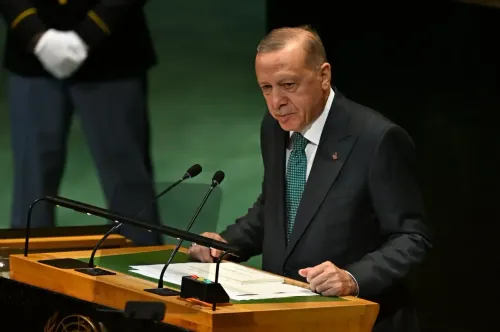
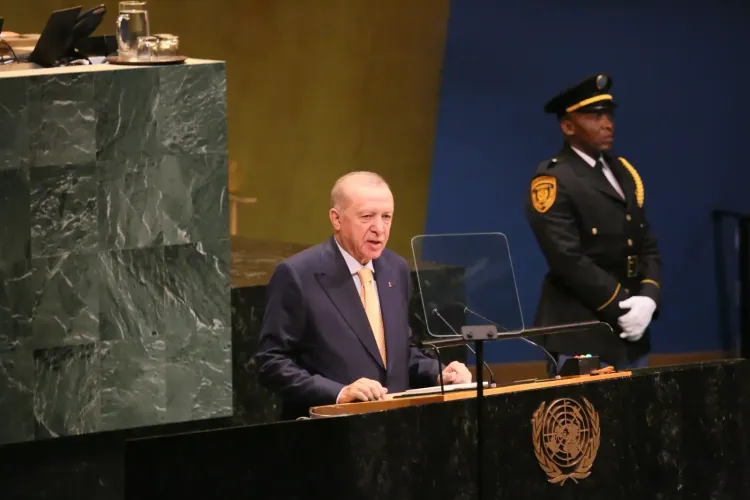
India on 29 September rejected Turkish President Recep Tayyip Erdogan's references to Jammu and Kashmir made at the UNGA .
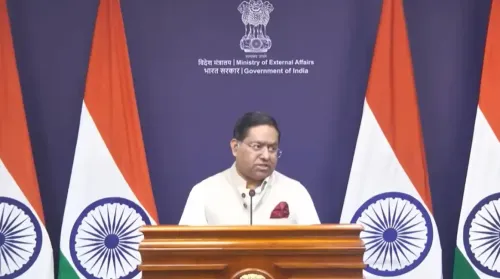
MEA spokesperson Randhir Jaiswal stated that no external party has any locus standi on India's territorial integrity and sovereignty.
Erdogan has raised the Kashmir issue at the UNGA on multiple previous occasions, drawing similar rejections from New Delhi .
India also rejected the OIC Contact Group on Jammu and Kashmir 's Joint Communique in the same week, calling it 'unwarranted and factually incorrect'.
The MEA reiterated that Jammu and Kashmir and Ladakh are an 'integral and inalienable' part of India.
India on Tuesday, 29 September formally rejected what it called 'unwarranted references' to the Union Territory of Jammu and Kashmir made by Turkish President Recep Tayyip Erdogan during his address at the United Nations General Assembly (UNGA), asserting that no external party holds any legal or moral standing on the matter.
What India's Foreign Ministry Said
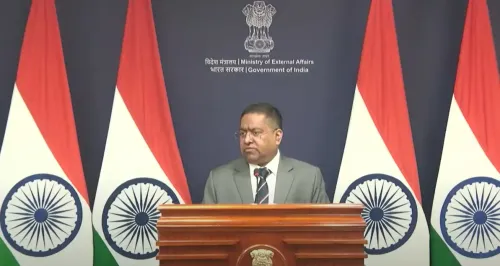
Ministry of External Affairs (MEA) spokesperson Randhir Jaiswal delivered the rebuke during a bi-weekly media briefing in New Delhi. 'India rejects the unwarranted references to the Indian Union Territory of Jammu and Kashmir made by the President of Turkey during his UNGA address. This is a matter pertaining to India's territorial integrity and sovereignty, and no external party has any locus standi on this issue,' Jaiswal stated.
A Pattern of Recurring Friction
This is not the first time Erdogan has raised the Kashmir issue from the UNGA podium, and New Delhi has responded with a near-identical formulation on each occasion. In September 2025, Jaiswal had similarly pushed back when Erdogan addressed the 80th session of the UNGA, stating: 'Our statement on Kashmir is clear. Everyone is aware of our position on Kashmir over the past few years.' India's consistent position rules out any scope for third-party intervention or mediation on the issue.
OIC Contact Group Also Rejected
The diplomatic pushback comes just days after India rejected references to the country in the Joint Communique of the Organisation of Islamic Cooperation (OIC)'s so-called 'Contact Group on Jammu and Kashmir'. The MEA termed those references 'unwarranted and factually incorrect' and reiterated that the OIC has no locus standi to comment on matters it described as strictly internal to India.
'India categorically rejects the unwarranted and factually incorrect references to India in the Joint Communique of the so-called OIC Contact Group on Jammu and Kashmir. The OIC has no locus standi to pronounce on matters that are strictly internal to India,' the MEA had said in that statement.
India's Stated Position on Kashmir
The MEA has consistently maintained that the entire Union Territories of Jammu and Kashmir and Ladakh are an 'integral and inalienable' part of India. Officials have added that 'no amount of repetition of politically motivated propaganda can change this reality.' This comes amid a broader pattern of Turkey and Pakistan-aligned multilateral groupings periodically raising the Kashmir issue at international forums, drawing firm rejections from New Delhi each time.
What This Means Going Forward
India's twin rejections — of both Erdogan's UNGA remarks and the OIC communique — signal that New Delhi intends to maintain a zero-tolerance posture on any internationalisation of the Kashmir question. Diplomatic observers note that India-Turkey relations have remained strained over this recurring friction point, even as both countries maintain formal ties. How Ankara responds, and whether the issue resurfaces at the next UNGA session, will be closely watched.
Point of View
Even as India insists otherwise. The back-to-back rejections of both the UNGA remarks and the OIC communique within days of each other suggest New Delhi is increasingly alert to this pattern. The more consequential question is whether India's reactive posture is sufficient, or whether a more proactive diplomatic strategy is needed to foreclose these forums altogether.
NationPress
29 Sept 2026
Frequently Asked Questions
Why did India reject Erdogan's remarks on Jammu and Kashmir?
India rejected Turkish President Recep Tayyip Erdogan's references to Jammu and Kashmir at the UNGA, calling them 'unwarranted' and asserting that the issue pertains to India's territorial integrity and sovereignty. New Delhi's position is that no external party has any locus standi on the matter.
What did MEA spokesperson Randhir Jaiswal say about the Kashmir remarks?
Jaiswal stated at a bi-weekly media briefing in New Delhi that 'India rejects the unwarranted references to the Indian Union Territory of Jammu and Kashmir made by the President of Turkey during his UNGA address.' He added that no external party has any locus standi on this issue.
Has Erdogan raised the Kashmir issue at the UNGA before?
Yes, Erdogan has raised the Kashmir issue at the UN General Assembly on multiple previous occasions. India has responded with a similar rejection each time, including in September 2025 during the 80th UNGA session.
What is India's position on the OIC Contact Group on Jammu and Kashmir?
India categorically rejected the OIC Contact Group's Joint Communique on Jammu and Kashmir, calling its references 'unwarranted and factually incorrect' and asserting that the OIC has no locus standi to comment on matters that are strictly internal to India.
What is India's official stance on Jammu and Kashmir's status?
India maintains that the Union Territories of Jammu and Kashmir and Ladakh are an 'integral and inalienable' part of India. The government has ruled out any third-party role or mediation, and the MEA has stated that 'no amount of repetition of politically motivated propaganda can change this reality.'