Giriraj Singh Highlights India's Rise as Global Dried Flower Export Leader
Synopsis
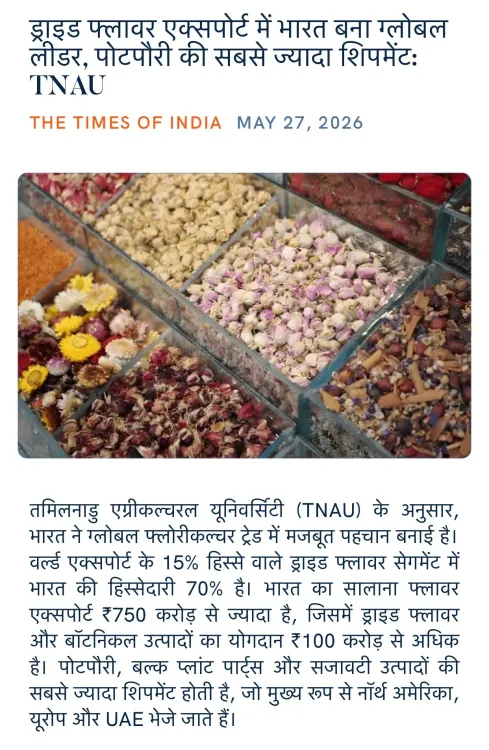
Union Textiles Minister Giriraj Singh shared TNAU findings on 27 May 2026 declaring India the global leader in dried flower exports, with potpourri topping shipment volumes — reflecting India's growing strength in value-added horticultural trade.
Key Takeaways
Union Textiles Minister Giriraj Singh shared on 27 May 2026 that India has become the global leader in dried flower exports, citing TNAU research.
Potpourri leads India's dried flower shipment volumes, according to the TNAU findings highlighted by the minister.
India's floriculture export push is underpinned by the Agricultural Export Policy of 2018 , which promoted high-value horticultural diversification.
Tamil Nadu Agricultural University (TNAU), Coimbatore , has played a key role in developing processing techniques that support year-round dried flower exports.
Key beneficiaries include floriculture exporters and Tamil Nadu farmers who gain stable, premium-price outlets through dried flower processing.
Analysts will watch for updated APEDA and Ministry of Commerce data and any new state-level processing cluster announcements to confirm and build on India's claimed global leadership.
Union Textiles Minister Giriraj Singh on Wednesday, 27 May 2026, shared findings from Tamil Nadu Agricultural University (TNAU) highlighting that India has emerged as a global leader in dried flower exports, with potpourri leading shipment volumes — underscoring the country's growing footprint in value-added horticultural trade.
Context
The minister shared the development via the NaMo App, citing TNAU research that positions India at the top of global dried flower export rankings. The post, in Hindi, reads: 'Dried flower export mein Bharat bana global leader, potpourri ki sabse zyada shipment: TNAU' — ('India becomes global leader in dried flower exports, highest shipments of potpourri: TNAU'). The spotlight on TNAU's findings signals institutional recognition of floriculture processing as a strategic export segment.
Policy Backdrop
India's push into non-traditional agricultural exports gained formal momentum when the government notified the Agricultural Export Policy in 2018, which explicitly promoted diversification into high-value horticultural products including floriculture. The Ministry of Textiles, which oversees handicrafts and decorative products alongside conventional textiles, has a stake in the upstream value chain of dried and preserved floral goods that feed into home décor and fragrance markets globally. Research institutions such as TNAU, Coimbatore, have contributed processing techniques that enable year-round, export-grade dried flower production.
This trajectory is part of a broader national shift toward premium, value-added agricultural exports that command higher prices in European, North American, and East Asian markets. Linking state agricultural universities with export promotion bodies has been a recurring instrument in this strategy.
Stakeholders and Impact
Floriculture exporters and Tamil Nadu farmers stand to benefit most directly from India's consolidation of its global leadership position. Potpourri — a blend of dried petals, herbs, and spices — is among the highest-value dried flower products, and its dominance in shipment volumes points to a mature, organised supply chain rather than incidental trade. Farmers who supply raw flowers to drying and processing units gain a more stable, premium-price outlet compared with fresh flower markets, which are highly perishable and price-volatile.
The Ministry of Textiles' attention to this segment also suggests possible convergence with handicraft and home-furnishing export schemes, where dried floral products are used as decorative inputs — broadening the policy support ecosystem beyond pure agriculture.
What's Next
Observers will watch for updated floriculture export data from APEDA (Agricultural and Processed Food Products Export Development Authority) and the Ministry of Commerce to validate and quantify India's claimed leadership position. Announcements of new state-level processing clusters under horticulture missions — particularly in Tamil Nadu, Karnataka, and Rajasthan, which have strong floriculture bases — would be the next concrete policy signal. Minister Giriraj Singh's public amplification of TNAU's findings may also presage a formal policy initiative or export target under the textiles or agriculture ministries, as India seeks to capture a larger share of the global decorative floral market.
Point of View
Value-added goods. If followed by concrete budget allocations or processing-cluster announcements, this post could mark the beginning of a formal floriculture export push; absent that, it remains symbolic cheerleading for a sector that has grown largely organically.
NationPress
23 Sept 2026
Frequently Asked Questions
Is India really the global leader in dried flower exports?
According to research cited by Tamil Nadu Agricultural University (TNAU), India has emerged as the global leader in dried flower exports, with potpourri accounting for the highest shipment volumes. Independent verification of specific figures awaits updated data from APEDA or the Ministry of Commerce.
What is TNAU and why does its research matter for exports?
TNAU, or Tamil Nadu Agricultural University based in Coimbatore, is a premier state agricultural research institution. Its work on floriculture processing technologies has helped Indian exporters develop year-round, export-grade dried flower production capabilities.
What is potpourri and why does India export it?
Potpourri is a blend of dried flower petals, herbs, and spices used as a home fragrance and decorative product. India exports it to European, North American, and East Asian markets, where it commands premium prices compared with fresh flowers.
What government policy supports India's dried flower exports?
The Agricultural Export Policy notified in 2018 promoted diversification into high-value horticultural products including floriculture. The Ministry of Textiles also has a stake in decorative floral goods that feed into home décor export segments.
Why is the Union Textiles Minister commenting on flower exports?
The Ministry of Textiles oversees handicrafts and decorative export products alongside conventional textiles, giving it a policy interest in dried floral goods used in home furnishings and décor — a segment that overlaps with both agriculture and textiles trade.