India's govt health spending triples to ₹4.14 lakh crore in 10 years, out-of-pocket costs fall
Synopsis
India's government health spending has tripled in a decade to ₹4.14 lakh crore, and the share of costs borne directly by households has dropped from 64.2% to 42.7%. It is a structural shift in how the country finances healthcare — but whether the gains are equally distributed across states and income groups remains an open question the data does not yet answer.
Key Takeaways
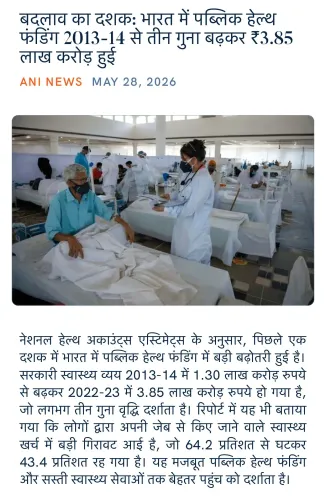
India's government health expenditure rose from ₹1.30 lakh crore in 2013–14 to ₹4.14 lakh crore in 2023–24 — a threefold increase.
Out-of-pocket expenditure as a share of total health spending fell from 64.2% to 42.7% over the same period.
Per capita government health spending rose approximately 2.8 times , from ₹1,042 to ₹2,959 .
Data sourced from a factsheet issued by the Ministry of Health and Family Welfare on 15 November 2026 .
Experts note India's out-of-pocket share, while declining, still lags WHO benchmarks and comparator middle-income economies.
India's government health expenditure has tripled over the past decade — rising from approximately ₹1.30 lakh crore in 2013–14 to ₹4.14 lakh crore in 2023–24 — while the share of out-of-pocket expenditure borne directly by households fell sharply from 64.2% to 42.7%, according to a factsheet released by the Ministry of Health and Family Welfare on 15 November 2026. The data signal a structural shift in how India finances healthcare, with public resources absorbing a significantly larger share of total health spending.
Key Numbers at a Glance
The headline figures mark a substantial reorientation of healthcare financing. Public expenditure on health more than tripled in nominal terms over the decade, while per capita government health spending rose from ₹1,042 in 2013–14 to ₹2,959 in 2023–24 — an increase of approximately 2.8 times. The simultaneous decline in out-of-pocket costs, from nearly two-thirds to under half of total health expenditure, reflects the expanding footprint of publicly funded health services and financial protection schemes.
What Is Driving the Shift
According to the Ministry's factsheet, the sustained downward trend in household health payments is linked to a broader set of government interventions — including expanded access to free treatment, subsidised medicines, diagnostics, and hospitalisation services. The factsheet attributes the gains, in part, to sustained efforts under Prime Minister Narendra Modi's government to strengthen primary healthcare delivery and roll out financial protection mechanisms across the country. Notably, the period under review coincides with the scaling up of flagship programmes aimed at universal health coverage and essential medicines access at public facilities.
Why This Matters for Households
Out-of-pocket health spending has long been identified as a leading driver of household impoverishment in India, pushing millions below the poverty line each year. A decline from 64.2% to 42.7% in its share of total health expenditure represents meaningful relief, though experts note that the absolute burden on households can still be substantial, particularly for catastrophic or chronic illness episodes. The data, as stated in the factsheet, underscore progress toward a more accessible and financially protective healthcare system — though the gap to global benchmarks for public health financing remains a subject of ongoing policy discussion.
Context and Caveats
India's out-of-pocket health expenditure share, while declining, still compares unfavourably with many middle-income economies and the World Health Organization's benchmarks for health system performance. The figures cited are from the government's own factsheet and have not yet been independently verified by external researchers. Critics have previously argued that expanding insurance-linked schemes, while reducing immediate cash payments, can mask cost-shifting to premiums or administrative exclusions. The ministry's data, however, frames the trend as evidence of a maturing public health financing architecture.
What Comes Next
The factsheet does not detail forward projections or specific programme-level allocations, but the Ministry's framing suggests the government views the decade-long trend as a foundation for further expansion. Health economists and civil society organisations are likely to scrutinise whether the per capita gains are evenly distributed across states, income groups, and rural-urban divides — a dimension the factsheet does not address in granular terms.
Point of View
But the out-of-pocket figure deserves closer scrutiny. Falling from 64.2% to 42.7% is genuine progress — yet 42.7% still means Indian families are absorbing nearly half of all health costs directly, a share that remains among the higher ones globally. The factsheet does not disaggregate by state, income quintile, or urban-rural split, which is precisely where the story of equity — or its absence — lives. Insurance-linked schemes can also mask cost-shifting rather than eliminate it. The government deserves credit for the trajectory, but the destination is still some distance away.
NationPress
15 Nov 2026
Frequently Asked Questions
How much has India's government health expenditure increased in 10 years?
India's government health expenditure rose from approximately ₹1.30 lakh crore in 2013–14 to ₹4.14 lakh crore in 2023–24, according to a Ministry of Health and Family Welfare factsheet. This represents a roughly threefold increase in nominal terms over the decade.
What has happened to out-of-pocket health spending in India?
Out-of-pocket expenditure as a share of total health spending declined from 64.2% in 2013–14 to 42.7% in 2023–24, according to the Ministry's factsheet. This means households are now financing a smaller proportion of total healthcare costs directly, though the share remains high by global standards.
How has per capita government health spending changed?
Per capita government health expenditure increased from ₹1,042 in 2013–14 to ₹2,959 in 2023–24 — a rise of approximately 2.8 times. This reflects both higher overall government allocations and expanded coverage of publicly funded health services.
Why does out-of-pocket health spending matter for Indian families?
High out-of-pocket health costs are a leading cause of household impoverishment in India, pushing families below the poverty line during medical emergencies. A sustained decline in this share indicates that government-funded services and financial protection schemes are absorbing a greater proportion of health costs, reducing the financial shock on households.
What is the source of these healthcare expenditure figures?
The figures are drawn from a factsheet released by the Ministry of Health and Family Welfare on 15 November 2026. They have not yet been independently verified by external researchers, and the factsheet does not provide state-level or income-group breakdowns of the data.