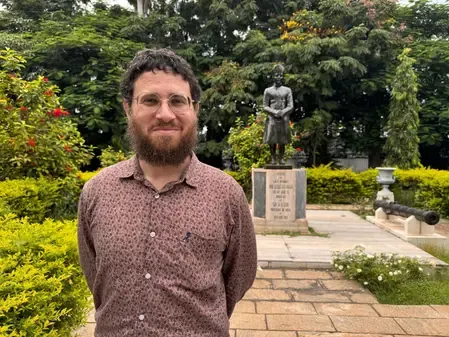
RSS has no caste or privilege, only merit: Israeli researcher Yeshaya Rosenman
Synopsis
An Israeli researcher featured in the RSS centenary book says the organisation has no room for caste or privilege — only merit and hard work — and cites PM Modi's rise as living proof. His call for Western audiences to engage directly with RSS members rather than relying on second-hand accounts adds a rare outside-in perspective to the debate over the organisation's global image.
Key Takeaways
Israeli researcher Yeshaya Rosenman called his experience with the RSS 'positive', praising its culture of merit, dedication, and social service.
Rosenman is featured among 18 young achievers in the centenary book 'Hundred Years Young: Rashtriya Swayamsevak Sangh' .
He cited Prime Minister Narendra Modi as an example of the RSS principle that progress is earned through hard work, not caste or privilege.
He described Modi as an 'international brand' whose global recognition has raised India's prestige abroad.
Rosenman urged Western audiences to engage directly with RSS members and study India's civilisational heritage without prejudice.
Israeli researcher Yeshaya Rosenman on Sunday, 18 October described his experience with the Rashtriya Swayamsevak Sangh (RSS) as 'positive', praising the century-old organisation for its emphasis on hard work, dedication, and social service. Rosenman, featured among 18 young achievers in the centenary book 'Hundred Years Young: Rashtriya Swayamsevak Sangh', said the RSS judges progress by merit and effort — not by caste or economic background.
A Researcher's First-Hand Account
Rosenman spoke candidly about his personal engagement with RSS members, offering a perspective rarely heard from outside India. 'The people there are friendly and welcome you with an open heart. I have friends in the organisation whom I continue to meet. What impresses me the most is the dedication of its members towards their purpose,' he said.
According to him, RSS volunteers work not for material gain or personal recognition but with what he described as sincere commitment to their cause — a quality he found striking compared to his prior expectations.
PM Modi as a Symbol of Meritocracy
Rosenman pointed to Prime Minister Narendra Modi as a concrete example of the RSS ethos of merit-based advancement. 'In the RSS, a person's progress should be based on hard work and merit. Prime Minister Modi is an example of this. He has advanced through his work style and achievements,' he said.
He further noted that Modi's global recognition speaks for itself. 'Generally, people in the West know very little about India; they only know the Taj Mahal, Mahatma Gandhi and Narendra Modi. So they recognise that he is an international brand, and that itself says a lot. Along with this comes respect. With the Prime Minister's global identity, India's prestige has also risen,' Rosenman said.
He added that understanding Modi's domestic support requires looking beyond ideology to measurable governance outcomes — clean drinking water, sanitation, cooking gas, bank accounts, and infrastructure development. 'The changes in these areas affect the lives of ordinary people. For many Indians, development and better administration matter more than ideology,' he observed.
Social Work and Cultural Preservation
Beyond politics, Rosenman highlighted the RSS's extensive social service activities, arguing that the organisation's footprint extends well beyond ideological work. 'The organisation plays a role in preserving and promoting Indian cultural identity,' he said, describing this as a dimension often overlooked in international coverage.
He stressed that Western perceptions of the RSS are frequently shaped by second-hand information rather than direct engagement, and urged observers to interact with members personally and study the organisation's history within its broader social context.
A Call for Cross-Civilisational Dialogue
Rosenman appealed to Western audiences to approach India's civilisational heritage — its mathematics, literature, philosophy, and history — without prejudice. He argued that Indian and Western civilisations share common values, and that structured dialogue between the two can deepen mutual cultural understanding.
His remarks come as the RSS marks its centenary year, a milestone that has prompted renewed international interest in the organisation's reach, ideology, and global diaspora networks. How Western academic and policy circles respond to outreach efforts like Rosenman's book feature will likely shape the next phase of the RSS's international perception-management.
Point of View
But a single positive foreign account does not resolve the substantive international concerns about the organisation's ideology. More notable is his framing of Modi as a meritocracy symbol — a narrative that conflates the RSS's internal culture with broader governance outcomes in ways that deserve scrutiny. The centenary book's choice to include foreign voices signals a deliberate outreach strategy; whether that translates into genuine reputational shift in Western academic and policy circles is a separate, harder question.
NationPress
18 Oct 2026
Frequently Asked Questions
Who is Yeshaya Rosenman and why is he associated with the RSS?
Yeshaya Rosenman is an Israeli researcher featured among 18 young achievers in 'Hundred Years Young: Rashtriya Swayamsevak Sangh', a book published to mark the organisation's centenary. His inclusion reflects the RSS's effort to document international perspectives on the organisation as it completes 100 years.
What did Rosenman say about caste and merit within the RSS?
Rosenman said that in the RSS, a person's progress is based on hard work and merit rather than caste or economic background. He cited Prime Minister Narendra Modi's rise as a prime example of this principle in action.
How did Rosenman describe PM Modi's global standing?
He described Modi as an 'international brand', noting that in Western countries where knowledge of India is limited, Modi is one of the few Indian names widely recognised alongside the Taj Mahal and Mahatma Gandhi. Rosenman argued this recognition has elevated India's global prestige.
What is the RSS centenary book 'Hundred Years Young' about?
'Hundred Years Young: Rashtriya Swayamsevak Sangh' is a book published to commemorate the RSS's 100th anniversary, featuring accounts from 18 young achievers — including international figures like Rosenman — who have engaged with the organisation.
What did Rosenman say about Western perceptions of the RSS?
Rosenman said Western perceptions of the RSS are often based on second-hand information and urged people to interact directly with members and study the organisation's history in its social context. He also called for cross-civilisational dialogue, arguing that Indian and Western civilisations share common values.