Jaishankar at UNGA: Nations must control their own AI, back multipolar world
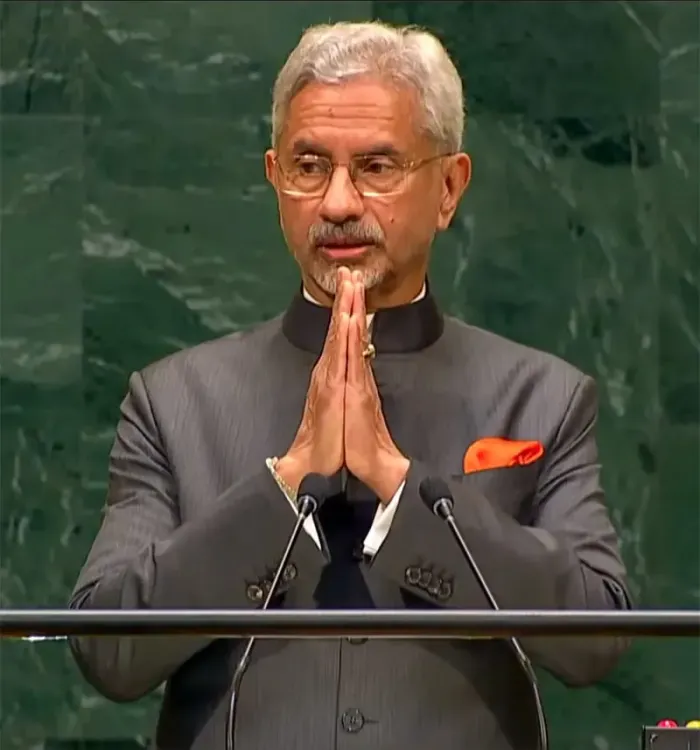
Synopsis
At the UN General Assembly, Jaishankar made AI sovereignty the centrepiece of India's foreign policy pitch — arguing that every nation must be free to build its own AI ecosystem, not follow a single global template. Paired with a sharp call for post-1945 order reform and UN Security Council restructuring, the speech positions India as the leading voice for a multipolar technology and governance order.
Key Takeaways
External Affairs Minister S.
Jaishankar addressed the UN General Assembly on 26 September 2026 , calling for national sovereignty over AI development.
He declared that every nation has the right to shape its own AI ecosystem, framing the issue as one of self-determination.
India hosted an AI Impact Summit in February and plans to embed AI cooperation into Global South partnerships.
Jaishankar warned that AI misuse could sharpen bias and weaken mutual respect, even as it holds transformative potential.
He called for reform of multilateral institutions, arguing the post-1945 order must give way to new realities in a multipolar world.
He closed with Mahatma Gandhi's words: 'There is no way to peace.
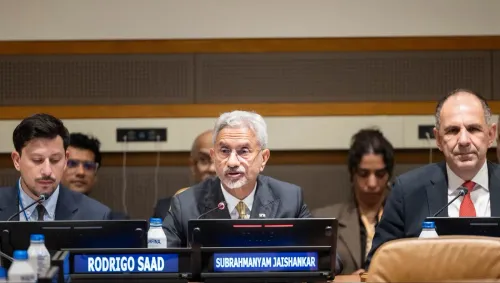
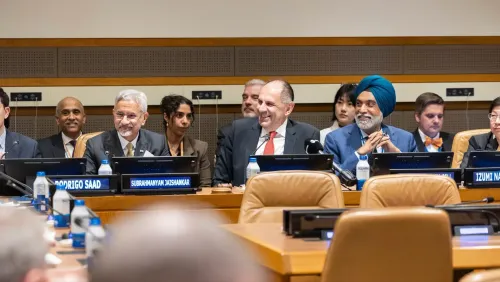
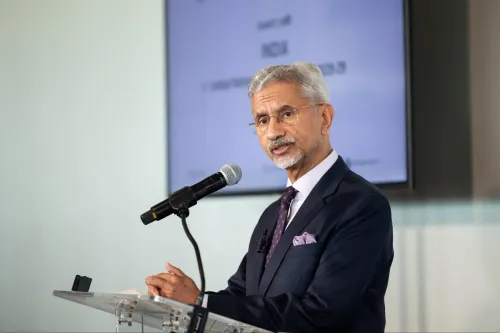
External Affairs Minister S. Jaishankar on Saturday, 26 September 2026, told the UN General Assembly in New York that every country must retain the freedom to develop and deploy artificial intelligence systems in line with its own national priorities — a pointed argument for technological sovereignty at a moment of deepening great-power competition over AI governance.
India's Core Position on AI Sovereignty
'We believe in the right of each nation to shape its ecosystem,' Jaishankar said, framing AI development as inseparable from national self-determination. He described artificial intelligence as a force capable of empowering citizens, accelerating economic growth, and solving complex problems at scale — but warned that its misuse could 'sharpen bias and weaken mutual respect.'
Jaishankar noted that India hosted an AI Impact Summit in February and intends to embed AI cooperation into its partnerships with the Global South. His remarks signal that New Delhi views AI not merely as a domestic technology agenda but as a geopolitical instrument for south-south engagement.
The Multipolar World Argument
'We are now well on our way towards a multipolar world,' Jaishankar told the assembly. 'The post-1945 order is giving way to new realities.' He linked present-day global turbulence to the difficulty of accommodating a more diverse international order — one in which emerging economies demand a larger say in decisions that shape global norms, including on technology.
He argued that peace in such a world depends on civil discussion, broad consultation, and transparent decision-making. 'Large sections of humanity cannot be excluded from that process,' he said. His remarks connected India's AI stance directly to its long-standing push for UN Security Council reform, where New Delhi has sought a permanent seat since the council's composition was fixed after World War II.
Culture, Heritage and Global Decision-Making
Jaishankar also called on nations to give greater weight to one another's cultures, heritage, and traditions as economic and political power shifts globally. He argued that cultural change must follow economic and political change — not lag behind it. He thanked UN Secretary-General Antonio Guterres for his work, specifically highlighting Guterres's support for India's Mission LiFE initiative on sustainable lifestyles.
The Case for Reforming Multilateral Institutions
While Jaishankar did not put forward a specific reform proposal in his address, he argued that international decision-making structures must reflect contemporary realities rather than the power configurations of 1945. The call for multilateral reform is a consistent thread in India's foreign policy, but its pairing with the AI sovereignty argument marks a notable evolution — positioning technology governance as the next frontier in the reform debate.
He closed his address with the words of Mahatma Gandhi: 'There is no way to peace. Peace is the way.' India is expected to carry these positions into upcoming multilateral forums as it continues to press for a permanent UN Security Council seat and a leadership role in shaping global AI governance norms.
Point of View
New Delhi is implicitly pushing back against Western-dominated regulatory frameworks like the EU AI Act and US export controls. The pairing with Security Council reform is deliberate: technology governance and institutional power are now the same debate, and India wants a seat at both tables. What remains untested is whether the Global South coalition India is courting has the cohesion to translate shared rhetoric into binding multilateral outcomes.
NationPress
27 Sept 2026
Frequently Asked Questions
What did Jaishankar say about AI at the UN General Assembly?
Jaishankar told the UN General Assembly on 26 September that every country must be free to develop AI systems aligned with its own priorities. He described AI as a tool for empowerment and growth, but warned that its misuse could sharpen bias and weaken mutual respect.
Why is India pushing for AI sovereignty at the UN?
India argues that a single global template for AI development would disadvantage countries with different economic needs and cultural contexts. New Delhi views national control over AI as an extension of its broader push for a multipolar world order in which emerging economies set their own technological and governance agendas.
What is the AI Impact Summit that Jaishankar mentioned?
India hosted an AI Impact Summit in February 2026, which Jaishankar cited as evidence of India's commitment to shaping AI governance. He said India intends to make AI cooperation a key element of its partnerships with Global South nations.
What did Jaishankar say about UN reform and the multipolar world?
Jaishankar argued that the post-1945 order is giving way to new realities and that multilateral institutions must be reformed to reflect the world as it is today. He linked the argument to India's long-standing demand for a permanent seat on the UN Security Council.
What was the broader message of Jaishankar's UNGA address?
Beyond AI, Jaishankar called for civil discussion, broad consultation, and transparent decision-making in global affairs, saying large sections of humanity cannot be excluded from that process. He also urged respect for diverse cultures and heritage, closing with Mahatma Gandhi's words: 'There is no way to peace. Peace is the way.'