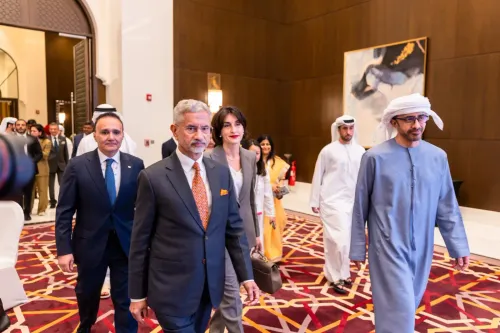
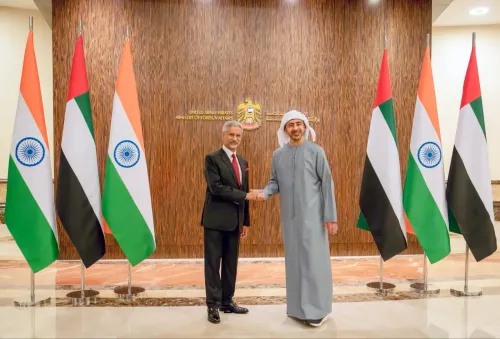
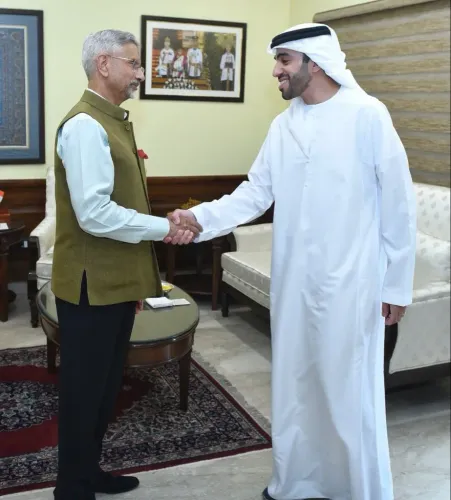
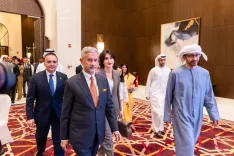
Jaishankar meets UAE DPM Abdullah bin Zayed in bilateral talks
Synopsis
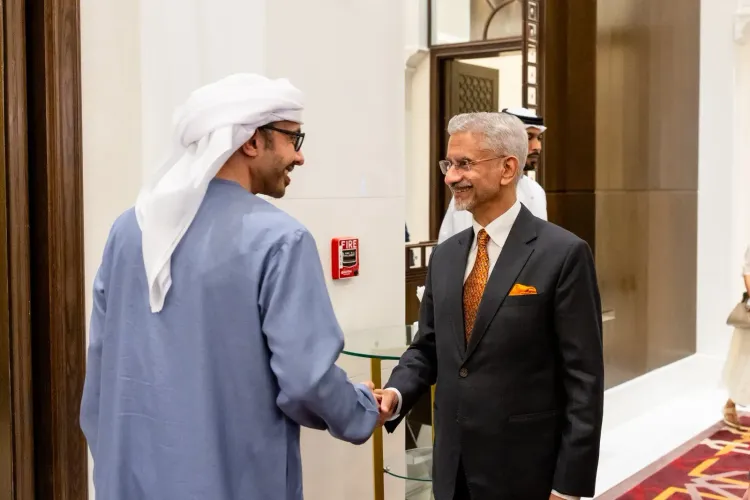
Union External Affairs Minister Dr. S. Jaishankar held a 'warm and productive' meeting with UAE Deputy Prime Minister and FM Abdullah bin Zayed on 15 October 2026, discussing bilateral and global issues under the framework of India-UAE Comprehensive Strategic Partnership, which was established in 2015.
Key Takeaways
Jaishankar met UAE DPM and FM Abdullah bin Zayed Al Nahyan on 15 October 2026 .
Talks covered bilateral and global issues under the Comprehensive Strategic Partnership framework established in 2015 .
India and the UAE signed a Comprehensive Economic Partnership Agreement in February 2022 , boosting non-oil trade significantly.
The UAE hosts over 3 million Indian expatriates , the largest foreign-national community in the country.
The meeting advances India's broader Gulf engagement strategy covering energy, investment, diaspora welfare and regional security.
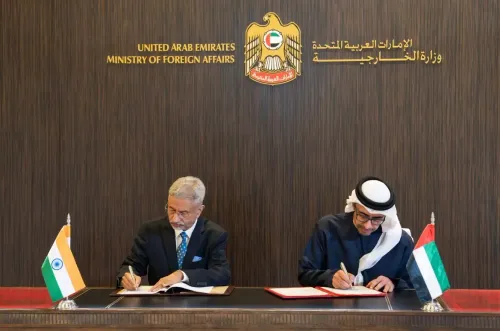
India's diplomatic tempo with the Gulf's most consequential partner held firm on Thursday, 15 October 2026, as Union External Affairs Minister Dr. S. Jaishankar sat down with United Arab Emirates Deputy Prime Minister and Foreign Minister Sheikh Abdullah bin Zayed Al Nahyan for what he described as a 'warm and productive' exchange — two words that, in diplomatic shorthand, signal both personal rapport and substantive progress.
What was on the table between Jaishankar and Abdullah bin Zayed
Dr. Jaishankar confirmed the talks ranged across bilateral and global issues, framed explicitly within the Comprehensive Strategic Partnership — the elevated architecture India and the UAE have been building since 2015, when Prime Minister Narendra Modi's landmark visit to Abu Dhabi first formalised that framework. The meeting covered the full sweep of a partnership that has grown to encompass political, economic, defence and cultural dimensions.
The backdrop is a relationship that has moved well beyond oil and remittances. The India-UAE Comprehensive Economic Partnership Agreement, signed in February 2022, triggered a sharp acceleration in non-oil bilateral trade — a structural shift that both sides have worked to deepen since.
Why the UAE anchor matters for India's Gulf calculus
The United Arab Emirates is not just India's largest trading partner in the Gulf — it is home to more than 3 million Indian expatriates, the single largest foreign-national community in the country. That human link alone gives every high-level meeting a constituency that stretches from Kerala to Punjab. Layer on top of that the UAE's role as a sovereign investment conduit and a key node in India's energy diversification strategy, and the strategic weight of a conversation like this one becomes clear.
Sheikh Abdullah bin Zayed — brother of UAE President Mohamed bin Zayed Al Nahyan — is the Gulf's most senior foreign-policy operator on the Indian dossier, making him the indispensable interlocutor for any discussion that touches regional security, West Asia's shifting fault lines, or emerging multilateral formats like the I2U2 grouping that brings together India, Israel, the UAE and the United States.
Jaishankar's Gulf diplomacy and the bigger pattern
This meeting fits a deliberate pattern in New Delhi's foreign policy: using high-frequency ministerial contact with Gulf capitals to lock in gains from a decade of relationship-building. For Dr. Jaishankar — a career diplomat who has navigated Washington, Beijing and Singapore before taking the ministerial chair — the Gulf is a theatre where India's economic interests, diaspora welfare and regional security imperatives converge in a single conversation.
The specific outcomes of Thursday's talks remain to be formally announced, but the explicit invocation of the Comprehensive Strategic Partnership signals that both sides are benchmarking progress against an ambitious, long-term architecture — not treating this as a courtesy call.
With West Asia navigating its own pressures and the India-UAE economic corridor gaining momentum, the next chapter of this partnership is being written in exactly these rooms.
Point of View
High-level ministerial engagement rather than relying solely on summit-level moments. For Dr. Jaishankar, the explicit framing around the Comprehensive Strategic Partnership is a signal that India intends to operationalise — not merely celebrate — the bilateral architecture. With the I2U2 grouping and the India-Middle East-Europe corridor both demanding UAE cooperation, this kind of sustained ministerial contact is less courtesy and more pipeline maintenance. The relationship's trajectory since 2015 suggests both sides are invested in translating warm optics into binding economic and security outcomes.
NationPress
15 Oct 2026
Frequently Asked Questions
Why did Jaishankar meet Abdullah bin Zayed in October 2026?
Dr. Jaishankar met UAE Deputy PM and FM Abdullah bin Zayed to exchange perspectives on bilateral and global issues under the framework of the India-UAE Comprehensive Strategic Partnership.
What is the India-UAE Comprehensive Strategic Partnership?
The Comprehensive Strategic Partnership is the formal bilateral framework established during PM Narendra Modi's 2015 visit to Abu Dhabi, covering political, economic, defence and cultural cooperation between India and the UAE.
What is the India-UAE CEPA and why does it matter?
The India-UAE Comprehensive Economic Partnership Agreement was signed in February 2022 and led to a sharp rise in non-oil bilateral trade, making the UAE one of India's most significant economic partners.
How many Indians live in the UAE?
Over 3 million Indian expatriates live in the UAE, making them the single largest foreign-national community there and a key factor in the depth of India-UAE ties.
Who is Abdullah bin Zayed Al Nahyan?
Sheikh Abdullah bin Zayed Al Nahyan is the UAE's Deputy Prime Minister and Minister of Foreign Affairs, and a brother of UAE President Mohamed bin Zayed Al Nahyan. He is India's primary interlocutor for Gulf diplomacy.