Jal Shakti Minister Paatil Backs 3 New Townships for Varanasi
Synopsis
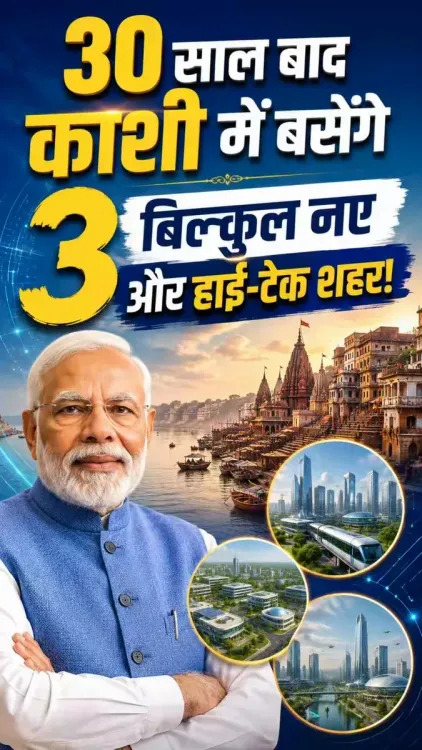
Union Jal Shakti Minister C. R. Paatil announced that the Varanasi Development Authority will build three high-tech townships — Anand Kashi, Rudra Vihar, and a Sports City in Ganjari — under PM Modi's vision and the Land Pooling scheme, marking the city's first major urban expansion in nearly three decades.
Key Takeaways
The Varanasi Development Authority (VDA) is planning three new townships: Anand Kashi , Rudra Vihar , and Sports City in Ganjari — the first major expansion in approximately three decades .
Anand Kashi will be Varanasi's first culture-themed gated township, built around the city's heritage identity with world-class infrastructure and green spaces.
The projects are being developed under the Land Pooling scheme , which gives farmers direct participation in urban development rather than displacing them through conventional land acquisition.
The initiative is linked to Prime Minister Narendra Modi's broader vision for Varanasi, which has previously included the Kashi Vishwanath Corridor inaugurated in 2021 and the city's inclusion in the Smart Cities Mission from 2015 .
Master-plan approvals, farmer consent rates, and integration with existing Smart City projects remain key milestones before construction can advance.
Union Jal Shakti Minister C. R. Paatil on Monday, 22 June 2026 highlighted a major urban expansion plan for Varanasi, announcing that the Varanasi Development Authority (VDA) is set to develop three large, high-tech townships in the ancient city — the first such expansion in nearly three decades.
Context
In his post, Minister Paatil asked: 'क्या आप जानते हैं कि हमारी काशी अब सिर्फ पुरानी गलियों तक सीमित नहीं है' ('Did you know that our Kashi is no longer confined to its old lanes alone?'). He announced that the VDA is planning three distinct townships: 'Anand Kashi', 'Rudra Vihar', and a 'Sports City' in the Ganjari area of Varanasi. The minister credited the initiative to Prime Minister Narendra Modi's vision and the Land Pooling scheme, which enables direct participation of farmers in urban development projects.
Anand Kashi is described as the city's first culture-themed gated township, designed around Kashi's heritage identity and promising world-class infrastructure, wide roads, and extensive green cover. The post closed with the invocation 'Har Har Mahadev', a traditional salutation associated with Varanasi's presiding deity.
Policy Backdrop
Varanasi was among the first 20 cities selected under the Smart Cities Mission launched in 2015, which targeted integrated urban redevelopment. The city subsequently saw the inauguration of the Kashi Vishwanath Corridor in 2021, a flagship project that expanded the precinct around the historic temple and transformed the surrounding urban fabric.
The Land Pooling model being applied here draws on frameworks promoted nationally, including experience from Gujarat, where similar schemes were implemented during the 2000s to reduce land-acquisition disputes and bring landowners in as stakeholders rather than displaced parties. The approach aligns with the broader AMRUT (Atal Mission for Rejuvenation and Urban Transformation) framework that emphasises participatory urban planning.
Stakeholders and Impact
The primary beneficiaries of the Land Pooling mechanism are Varanasi's farming communities, who are being offered a direct stake in the new townships rather than a one-time compensation under traditional land acquisition. This model is intended to reduce litigation and improve consent rates — a persistent challenge in large urban infrastructure projects across India.
For urban residents, the three townships represent a significant addition of planned residential and sporting infrastructure to a city whose core is constrained by its historic density. The proposed Sports City in Ganjari signals an intent to build dedicated recreational and athletic facilities, a category that has historically been underserved in Tier-2 pilgrimage cities.
What's Next
Key milestones to watch include the VDA master-plan approval process, the pace of land-pooling consent from farmers, and how the new townships will be integrated with ongoing Varanasi Smart City projects already underway. The specifics of timelines, final layouts for Anand Kashi, Rudra Vihar, and Sports City, as well as the current status of farmer agreements, are yet to be officially confirmed by the VDA.
The announcement positions Varanasi's urban expansion as a template for blending cultural identity with modern planning — a model that, if successfully executed, could inform similar efforts in other heritage cities across India.
Point of View
Positioning the state as a partner rather than an acquirer. The cultural branding of 'Anand Kashi' also signals a deliberate strategy of embedding heritage identity into urban planning, making it harder for opponents to frame modernisation as an erasure of Varanasi's character. Taken together, the announcement extends a now well-established pattern of using Varanasi as a laboratory for the BJP's integrated development-plus-culture political brand.
NationPress
22 Jun 2026
Frequently Asked Questions
What are the three new townships planned for Varanasi?
The three proposed townships are 'Anand Kashi', 'Rudra Vihar', and a 'Sports City' in the Ganjari area, all planned by the Varanasi Development Authority (VDA).
What is the Land Pooling scheme being used for Varanasi townships?
The Land Pooling scheme allows farmers and landowners to contribute their land directly to urban development projects and receive a stake in the developed area, rather than being paid a one-time compensation under conventional land acquisition laws.
What is Anand Kashi and what will it offer?
Anand Kashi is planned as Varanasi's first culture-themed gated township, designed around the city's heritage and identity, with world-class infrastructure, wide roads, and green cover.
When was the last major urban expansion in Varanasi before this?
According to Minister Paatil's announcement, the VDA's new township plan is the first major urban expansion in Varanasi in approximately three decades.
How does this Varanasi expansion connect to PM Modi's development agenda?
Varanasi, PM Modi's parliamentary constituency, has been a focal point of central urban development schemes including the Smart Cities Mission from 2015 and the Kashi Vishwanath Corridor inaugurated in 2021. The new townships are described as an extension of the Prime Minister's vision for the city.