Jharkhand CMO deploys AI drones, face recognition at Baba Dham
Synopsis
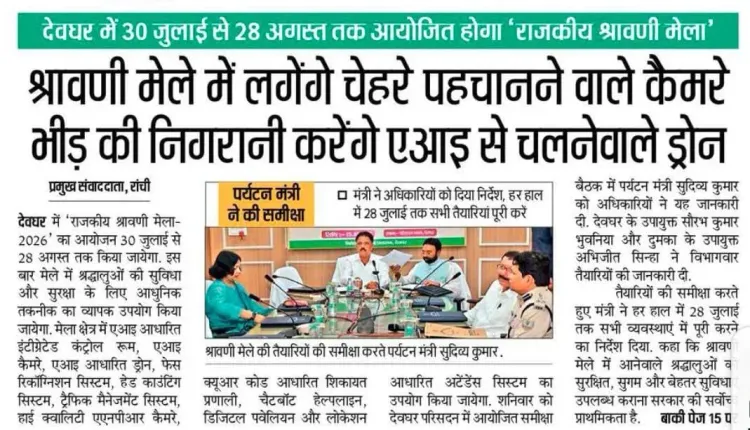
The Chief Minister's Office of Jharkhand has announced AI-based drones, facial-recognition cameras, head-counting tools and an integrated control room for the Shravan Mela at Baba Dham, Deoghar — aiming to deliver safe, seamless access for millions of pilgrims.
Key Takeaways
The Jharkhand CMO announced AI-based crowd surveillance for the Shravan Mela at Baba Dham, Deoghar on 27 July 2026 .
Technologies deployed include AI-powered drones , facial-recognition cameras , a head-counting system , and a traffic-management system .
All feeds will be aggregated in a single integrated control room for real-time monitoring.
The stated goal is a safe and accessible experience for every pilgrim visiting Baba Dham .
The deployment mirrors AI-surveillance models used at large religious gatherings such as the Kumbh Mela in other states.
Outcomes could set a template for AI-enabled crowd management at other Jharkhand pilgrimage sites.
The Chief Minister's Office of Jharkhand announced on Sunday, 27 July 2026 that this year's Shravan Mela at Baba Dham, Deoghar will be monitored through an integrated suite of artificial-intelligence-based technologies — including drones, facial-recognition cameras, and real-time crowd-counting systems — to ensure the safety and smooth movement of pilgrims.
Context
The official post from @JharkhandCMO states: 'is baar mela kshetra mein AI-aadharit drone, face recognition kaamere, integrated control room, head counting aur traffic management system ke zariye bheed ki paini nigrani ki jaayegi' — ('This time, the mela grounds will be under sharp surveillance through AI-based drones, face-recognition cameras, an integrated control room, head-counting and traffic-management systems'). The stated objective is to give every devotee visiting Baba Dham a 'safe and accessible experience.'
The post tags @kumarsudivya and the state's official tourism handle @VisitJharkhand, signalling coordinated communication between the administration and Jharkhand's tourism promotion machinery.
Policy Backdrop
Baba Dham — centred on the Baidyanath Jyotirlinga temple in Deoghar — is one of the twelve Jyotirlingas and draws millions of pilgrims every year during the Shravan month, when devotees undertake the Kanwar Yatra carrying holy water from the Ganga to offer at the shrine. The sheer density of footfall has historically posed crowd-management challenges for the Deoghar district administration.
Across India, state governments have progressively adopted AI-enabled surveillance, drone monitoring, and integrated command-and-control infrastructure at high-footfall religious events to reduce the risk of stampedes and improve pilgrim flow — a model first scaled at events such as the Kumbh Mela. Jharkhand's announcement aligns with this broader national pattern of applying smart-city-style tools to large-scale public gatherings.
Stakeholders and Impact
The primary beneficiaries are the lakhs of pilgrims who converge on Deoghar during the Shravan season. An integrated control room aggregating drone feeds, facial-recognition alerts, and head-count data gives administrators a real-time operational picture that manual monitoring cannot provide.
The Deoghar district administration and local law-enforcement agencies will be the operational anchors for the system. By tagging @VisitJharkhand, the CMO's office also frames the deployment as part of a broader effort to position the state's pilgrimage circuit as a well-managed, visitor-friendly destination — with implications for religious tourism revenues.
What's Next
Operational performance data from the 2026 Shravan Mela deployment will be closely watched by administrators and policy observers. If the integrated AI-surveillance model proves effective at Baba Dham, it could serve as a template for replication at other high-footfall pilgrimage sites across Jharkhand. The government's willingness to publish post-event crowd and safety metrics will determine how transparently the system's outcomes are assessed.
Point of View
Not just manpower. By announcing the measure through the CMO's handle and tagging the tourism promotion account, the government is simultaneously addressing a genuine safety imperative and projecting administrative competence ahead of the Shravan season. The move fits a broader pattern in which Indian states compete to demonstrate smart-governance credentials at visible public events. The real test will come in the post-mela audit: whether the systems reduced congestion and whether the government publishes transparent performance data.
NationPress
26 Jul 2026
Frequently Asked Questions
What technology is being used at Baba Dham Shravan Mela 2026?
The Jharkhand CMO has announced AI-based drones, facial-recognition cameras, a head-counting system, a traffic-management system and an integrated control room to monitor crowds at the Shravan Mela in Deoghar.
Where is Baba Dham located?
Baba Dham refers to the Baidyanath Jyotirlinga temple complex in Deoghar, Jharkhand , one of the twelve Jyotirlingas and a major Hindu pilgrimage site.
Why is crowd management important at the Shravan Mela?
The Shravan Mela draws millions of pilgrims — particularly Kanwar Yatris — to Deoghar every year, creating extremely high crowd density that has historically posed risks of stampedes and traffic congestion.
Has India used AI surveillance at religious events before?
Yes. Indian states have progressively deployed AI-enabled drones, facial recognition and integrated command systems at major religious gatherings; similar technology has been used at events such as the Kumbh Mela.
What is the Jharkhand government's goal for the Baba Dham mela?
According to the Chief Minister's Office, the goal is to provide every devotee visiting Baba Dham with a 'safe and accessible experience' through real-time AI-powered crowd monitoring.