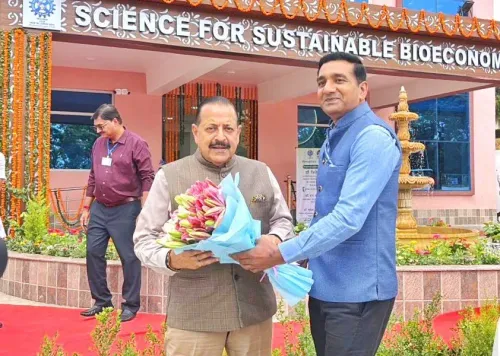
Dr. Jitendra Singh pitches 'Himalayan Economy' as India's next growth frontier
Synopsis
Science Minister Dr. Jitendra Singh told CSIR-IHBT Palampur faculty that the 'Himalayan Economy' is an under-exploited growth engine for India's 2047 vision, citing the Aroma Mission, Floriculture Mission, a 1.5-lakh-visitor Tulip Garden, and a breakthrough in indigenous Heeng cultivation as evidence of accelerating momentum.
Key Takeaways
Jitendra Singh addressed faculty at CSIR-IHBT, Palampur on 28 May 2026 , framing the 'Himalayan Economy' as a major future growth contributor for India.
The Aroma Mission and Floriculture Mission , initiated in the last decade under PM Modi , are generating livelihoods for farmers, women, startups, and youth across Himalayan states and UTs.
A Tulip Garden supported by CSIR-IHBT and grown with locally cultivated bulbs attracted over 1.5 lakh visitors this year, linking bioresource science with tourism.
Successful flowering and seed production of Heeng (asafoetida) in Lahaul and Spiti has opened a path to indigenous cultivation, reducing import dependence.
Floriculture activities backed by the institute benefit thousands of farmers across Himachal Pradesh, Ladakh, Uttarakhand, Punjab, and Haryana .
The minister called for AI-integrated technology applications at CSIR labs to drive next-level market linkages for Himalayan bioresources.
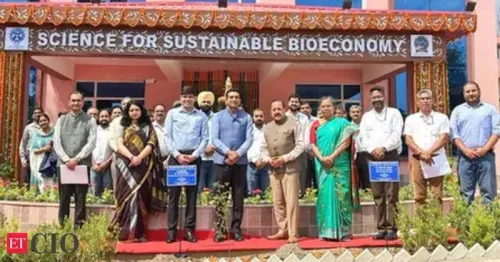
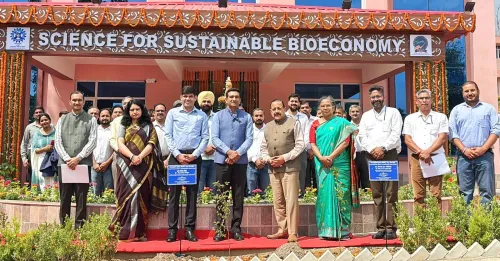
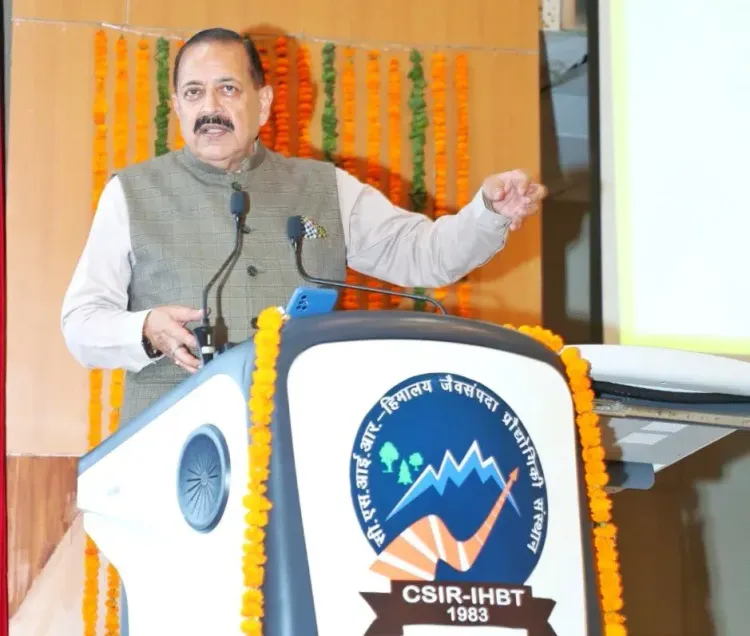
Union Science and Technology Minister Dr. Jitendra Singh on Thursday, 28 May 2026 addressed faculty at the Institute of Himalayan Bioresources Technology (IHBT) in Palampur, Himachal Pradesh, calling the 'Himalayan Economy' a major untapped contributor to India's growth trajectory towards 2047.
Context
Speaking to IHBT faculty, Dr. Singh framed the Himalayan region as a largely unrealised economic asset, stating that 'the next phase of India's economic expansion will increasingly emerge from sectors and resources that remained unexplored or under-explored for decades.' He pointed to the Himalayan belt as one such frontier, arguing its commercial potential has only recently begun to be systematically unlocked.
The minister credited the past decade of policy action under Prime Minister Narendra Modi for initiating structured programmes — notably the Aroma Mission and the Floriculture Mission — that are now generating livelihoods for farmers, women, startups, youth, and entrepreneurs across Himalayan states and Union Territories.
Policy Backdrop
The CSIR Aroma Mission, launched in 2016, expanded cultivation of aromatic and medicinal plants across Himalayan and other states, creating value chains that connect smallholder farmers to commercial markets. The Floriculture Mission has similarly deployed CSIR laboratory support to stimulate rural employment in hill states.
CSIR-IHBT Palampur, established in 1983, operates as the nodal laboratory converting Himalayan bioresources into commercially viable products for sectors including tourism, medicine, wellness, nutraceuticals, cosmetics, floriculture, and agri-biotechnology. Dr. Singh noted that a 'Tulip' Garden developed with bulbs cultivated by local farmers and supported by the institute attracted over 1.5 lakh visitors this year, illustrating the scale of public interest in bioresource-linked tourism.
A significant scientific development highlighted by the minister was the successful flowering and seed production of 'Heeng' (asafoetida) in the high-altitude regions of Lahaul and Spiti. India has historically depended on imports for Heeng; indigenous cultivation at altitude now opens possibilities for domestic supply chains.
Stakeholders and Impact
Floriculture activities supported by CSIR-IHBT are currently benefiting thousands of farmers across Himachal Pradesh, Ladakh, Uttarakhand, Punjab, and Haryana. Women entrepreneurs and youth-led startups in these regions are among the direct beneficiaries of the institute's technology-transfer programmes.
The minister's address underlines a federal strategy of linking central S&T infrastructure — CSIR laboratories — with state-level agricultural and livelihood missions, distributing the gains of scientific research to remote and economically marginal communities in the Himalayan belt.
What's Next
Dr. Singh called for 'integrated AI-linked technology applications for next-level outcomes and market linkages,' signalling that the government intends to layer artificial intelligence tools onto existing CSIR-IHBT programmes to improve supply-chain efficiency and market access for Himalayan produce.
Expansion of the Aroma and Floriculture Missions to additional Himalayan districts, alongside deeper AI integration at CSIR laboratories, is expected to define the next phase of the 'Himalayan Economy' push as India advances its Viksit Bharat 2047 agenda. The Heeng cultivation breakthrough in Lahaul and Spiti may also serve as a template for introducing other high-value import-substitution crops at altitude.
Point of View
Not merely a conservation or tourism corridor. The emphasis on AI integration at CSIR laboratories suggests the next phase will attempt to bridge the persistent gap between laboratory breakthroughs and commercial market access — a gap that has historically blunted the impact of India's S&T investments in remote regions. The Heeng cultivation milestone is politically significant too, offering a tangible import-substitution narrative at a time when domestic agricultural self-reliance is a recurring government theme. Taken together, the minister's remarks map a coherent arc: mission-driven cultivation, institute-backed technology transfer, and now AI-enabled market linkages — each layer building on the last toward a regionally balanced growth story.
NationPress
11 Oct 2026
Frequently Asked Questions
What is the 'Himalayan Economy' that Dr. Jitendra Singh spoke about?
The 'Himalayan Economy' refers to the commercial and livelihood potential of the Himalayan region's bioresources — including aromatic plants, flowers, medicinal herbs, and high-value crops — which Dr. Jitendra Singh described as largely unrealised and central to India's next phase of economic expansion toward 2047.
What is CSIR-IHBT Palampur and what does it do?
The Institute of Himalayan Bioresources Technology (IHBT) is a CSIR laboratory in Palampur, Himachal Pradesh, established in 1983. It converts Himalayan plant resources into commercially viable products for sectors such as medicine, wellness, nutraceuticals, cosmetics, floriculture, and agri-biotechnology.
What is the Aroma Mission and who launched it?
The CSIR Aroma Mission was launched in 2016 under the Modi government to expand cultivation of aromatic and medicinal plants across Himalayan and other Indian states, creating value chains that link smallholder farmers to commercial markets.
Has India successfully grown Heeng (asafoetida) domestically?
Yes, CSIR-IHBT has demonstrated successful flowering and seed production of Heeng in the high-altitude regions of Lahaul and Spiti in Himachal Pradesh, opening possibilities for indigenous cultivation and reducing India's dependence on imports of the spice.
How many people visited the IHBT-supported Tulip Garden this year?
According to Dr. Jitendra Singh's address, the Tulip Garden developed with bulbs cultivated by local farmers and supported by CSIR-IHBT attracted over 1.5 lakh visitors this year.