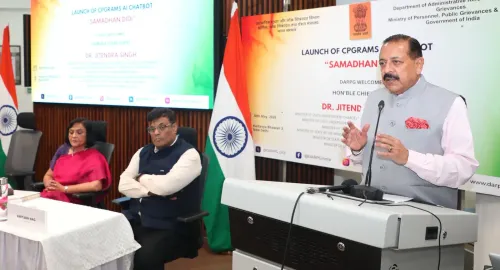
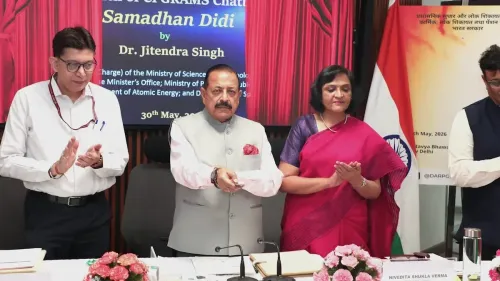
Dr. Jitendra Singh flags AI bot Samadhan Didi for grievances
Synopsis
Union Science and Technology Minister Dr. Jitendra Singh spotlighted Samadhan Didi, an AI chatbot piloted in NCR to simplify online complaint registration for citizens, advancing India's AI-in-governance agenda under the Digital India and National AI Strategy frameworks.
Key Takeaways
Samadhan Didi is an AI chatbot launched to help citizens register complaints online, currently piloted in the NCR region.
Jitendra Singh , Union Minister for Science and Technology, flagged the initiative on 31 May 2026 , lending it ministerial visibility.
The tool aligns with India's National Strategy for AI (#AIFORALL, 2018) and the Digital India programme launched in 2015 .
India's existing national grievance platform, CPGRAMS , has operated since 2007 ; Samadhan Didi could complement or integrate with it.
Potential expansion to additional states and integration with national portals is the key policy development to watch.
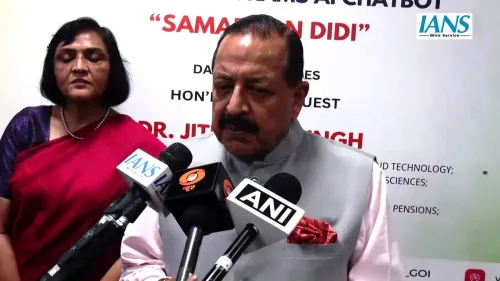
Union Science and Technology Minister Dr. Jitendra Singh on Sunday, 31 May 2026 shared a report highlighting the launch of Samadhan Didi, an AI chatbot designed to help citizens register complaints online, signalling the government's push to embed artificial intelligence into everyday public grievance redressal.
Context
The post, shared from Dr. Singh's official X account, flagged a development under the headline 'बदलाव: एआई बॉट समाधान दीदी दर्ज करेंगी आमजनों की शिकायत' ('Change: AI bot Samadhan Didi will register the grievances of common people'). The tool is reported to have been piloted in the National Capital Region (NCR), offering residents a conversational, AI-driven interface to log complaints without navigating complex bureaucratic portals.
The initiative represents a shift from form-based complaint submission to a dialogue-led model, lowering the barrier for citizens — particularly those less comfortable with conventional e-governance interfaces — to seek administrative redress.
Policy Backdrop
India's grievance redressal architecture has been evolving since the launch of the Centralised Public Grievance Redress and Monitoring System (CPGRAMS) in 2007, which created a unified platform for citizens to raise issues with central and state government departments. CPGRAMS has processed millions of petitions over the years but has often been criticised for its procedural complexity and uneven response rates.
The government's National Strategy for Artificial Intelligence (#AIFORALL), released in 2018, explicitly identified governance and citizen services as priority sectors for AI deployment. Samadhan Didi fits squarely within that roadmap, representing a practical application of the strategy's ambition to make AI work for ordinary Indians. Both initiatives sit under the broader Digital India programme, launched in 2015, which has served as the policy umbrella for technology-led administrative reform across successive governments.
Stakeholders and Impact
The most immediate beneficiaries are NCR residents and, potentially, citizens across India if the model is scaled. For the urban poor, daily-wage workers, and elderly citizens who struggle with English-language or form-heavy portals, a vernacular AI chatbot that can converse in Hindi and guide complaint registration step-by-step could meaningfully reduce friction in accessing government services.
Civil servants and grievance officers stand to benefit from better-structured, categorised incoming complaints, which could improve routing and resolution times. Technology and e-governance practitioners will be watching whether Samadhan Didi's architecture is built to integrate with existing national systems such as CPGRAMS, which would determine its long-term administrative footprint.
What's Next
The critical question is whether the NCR pilot will be expanded to other states and eventually integrated with the national CPGRAMS portal, creating a seamless, AI-assisted grievance pipeline at scale. Parliamentary scrutiny of AI deployment in public administration — including questions of data privacy, algorithmic accountability, and accessibility for non-smartphone users — is likely to intensify as such tools proliferate.
If Samadhan Didi demonstrates measurable improvements in complaint registration rates and resolution turnaround, it could become a template for AI-assisted citizen services well beyond grievance redressal, accelerating India's broader experiment with intelligent e-governance.
Point of View
Blunting criticism that high-tech governance bypasses ordinary citizens. If the NCR pilot yields credible data, it will strengthen the case for integrating conversational AI into the national CPGRAMS architecture, a move that would represent one of India's most consequential e-governance upgrades in years. The broader arc here is clear: the government is systematically building a portfolio of citizen-facing AI use cases that can be showcased as tangible Digital India dividends.
NationPress
15 Oct 2026
Frequently Asked Questions
What is Samadhan Didi?
Samadhan Didi is an AI chatbot designed to help Indian citizens register complaints and grievances online through a conversational interface, currently piloted in the National Capital Region (NCR).
Who launched Samadhan Didi AI chatbot?
The Samadhan Didi AI chatbot was launched as part of an e-governance initiative in the NCR region. Union Science and Technology Minister Dr. Jitendra Singh highlighted the tool on social media on 31 May 2026.
How does Samadhan Didi help citizens?
Samadhan Didi guides citizens through the complaint registration process using a conversational AI interface, making it easier for people who find conventional government portals complex or difficult to navigate.
Is Samadhan Didi connected to CPGRAMS?
As of the available information, Samadhan Didi is a pilot project in NCR. Whether it will be integrated with the national CPGRAMS grievance portal is a key policy question being watched by governance observers.
What is India's policy on AI in governance?
India released its National Strategy for Artificial Intelligence (#AIFORALL) in 2018, identifying governance and citizen services as priority sectors. Initiatives like Samadhan Didi are practical applications of that strategy under the Digital India umbrella.