Dr. Jitendra Singh Shares AI Tool 'Samadhan Didi' Launch
Synopsis
Union Minister Dr. Jitendra Singh has highlighted the launch of 'Samadhan Didi', an AI-powered assistant designed to help citizens across India file grievances more easily. The tool is expected to complement the existing CPGRAMS infrastructure under the Digital India programme.
Key Takeaways
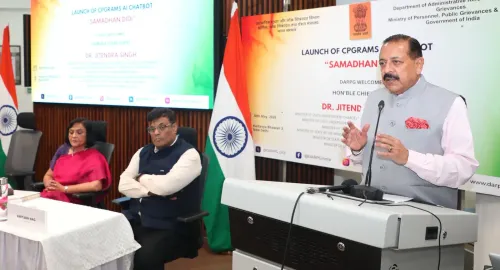
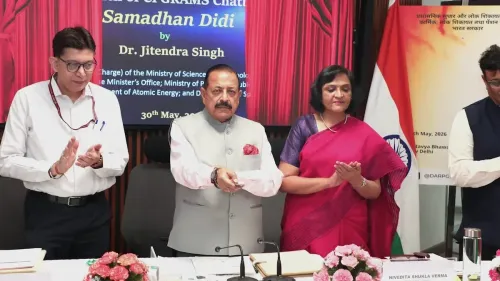
Jitendra Singh , Union Minister holding the Public Grievances portfolio, shared the launch of AI tool 'Samadhan Didi' on May 31, 2026 .
Samadhan Didi is designed to simplify the process of filing citizen grievances with the government across India.
The tool is positioned as an AI-powered layer over existing infrastructure such as CPGRAMS , the central government's online grievance portal.
The initiative aligns with the Digital India programme, launched in July 2015 , which promotes technology-enabled public service delivery.
Rollout metrics — including state-level adoption and resolution rates — will be key indicators of the tool's real-world impact.
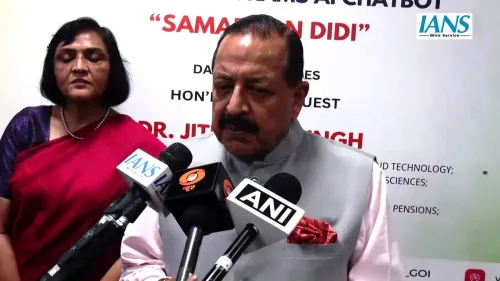
Union Science and Technology Minister Dr. Jitendra Singh on Sunday, May 31, 2026, shared news of the launch of an AI-powered grievance-filing assistant called 'Samadhan Didi', highlighting its potential to simplify how citizens across India submit and track complaints to the government.
Context
The tool, described as AI-powered, is positioned to make the process of filing grievances more accessible to ordinary citizens. The name 'Samadhan Didi' — loosely translating to 'Solution Sister' — signals an intent to give the interface a familiar, approachable identity for users who may be unfamiliar with formal complaint mechanisms. Dr. Jitendra Singh, who holds the portfolio of Personnel, Public Grievances and Pensions in addition to his science and technology brief, has a direct ministerial stake in the functioning of citizen redressal systems.
Policy Backdrop
India's primary digital grievance infrastructure is the Centralized Public Grievance Redress and Monitoring System (CPGRAMS), operated by the Department of Administrative Reforms and Public Grievances. The portal allows citizens to lodge complaints against central government departments and track their resolution online. Despite its reach, the system has historically faced criticism for low resolution quality, long pendency periods, and limited accessibility for citizens with low digital literacy.
The introduction of an AI layer into this ecosystem fits within the broader arc of the Digital India programme, launched in July 2015, which has progressively pushed government departments to adopt technology for citizen-facing services. Integrating conversational AI into grievance filing could reduce the friction of navigating bureaucratic forms, particularly for first-time users or those filing in regional languages.
Stakeholders and Impact
The most direct beneficiaries of Samadhan Didi would be common citizens — especially those in semi-urban and rural areas — who find existing grievance portals complex or intimidating. If the AI assistant supports multiple Indian languages, it could meaningfully expand the effective user base of platforms like CPGRAMS. Government departments, in turn, stand to receive better-structured, more complete complaint submissions, which could improve resolution timelines.
Civil society groups and digital rights advocates have long called for grievance systems that are not only digitally accessible but also comprehensible to users with limited formal education. An AI-guided filing process, if designed inclusively, could address part of that gap. The success of the tool will ultimately depend on backend integration with existing redressal workflows and the quality of responses citizens receive.
What's Next
Attention will now turn to the rollout metrics for Samadhan Didi — how many states and union territories adopt it, the volume of grievances filed through the platform, and resolution rates compared to the conventional CPGRAMS interface. Parliamentary questions on AI adoption in public administration are likely to follow as legislators seek accountability on outcomes. Dr. Jitendra Singh's ministerial oversight of both science and technology and public grievances positions him as the key figure to watch as the government scales this initiative.
Point of View
Who straddles both the science and technology and public grievances portfolios, championing such a tool is a natural convergence of his ministerial briefs. The broader pattern here is significant: successive administrations have invested in digitising grievance systems, but AI-assisted filing marks a qualitative shift from access to comprehension. Whether the initiative delivers measurable improvement in resolution quality — rather than just filing volume — will determine its lasting policy value.
NationPress
14 Oct 2026
Frequently Asked Questions
What is Samadhan Didi?
'Samadhan Didi' is an AI-powered assistant launched to help citizens across India file grievances with the government more easily, reducing the complexity of existing online complaint systems.
Who launched Samadhan Didi?
The tool was highlighted by Union Minister Dr. Jitendra Singh , who holds charge of Science and Technology as well as Public Grievances and Pensions, making it directly relevant to his ministerial portfolio.
How is Samadhan Didi related to CPGRAMS?
CPGRAMS (Centralized Public Grievance Redress and Monitoring System) is the existing central government portal for citizen complaints. Samadhan Didi is positioned as an AI layer intended to simplify the filing process on such platforms.
What is the Digital India programme?
Digital India is a national programme launched in July 2015 to expand digital infrastructure and enable online delivery of government services to citizens. AI-based tools like Samadhan Didi fall under its broader mandate.
What will determine the success of Samadhan Didi?
Key indicators will include the number of states adopting the tool, grievance volumes filed through it, resolution rates, and whether it supports regional Indian languages to serve users with limited digital literacy.