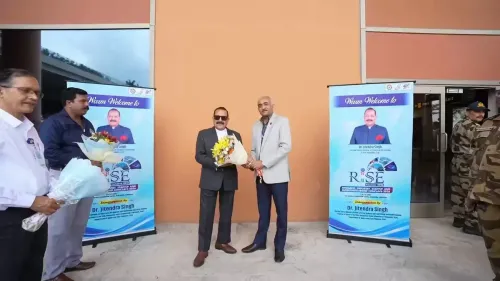
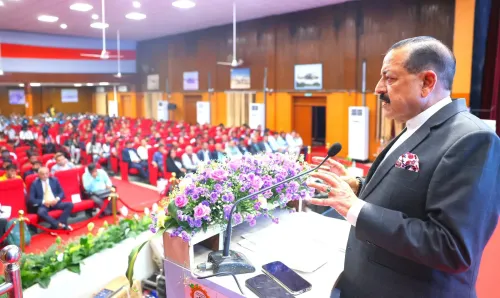
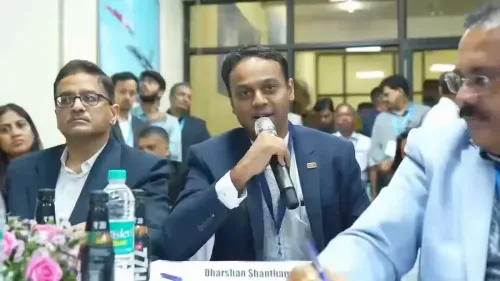
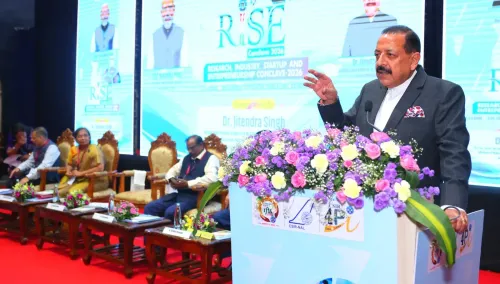
Dr. Jitendra Singh arrives for RISE Conclave 2026 in Bengaluru
Synopsis
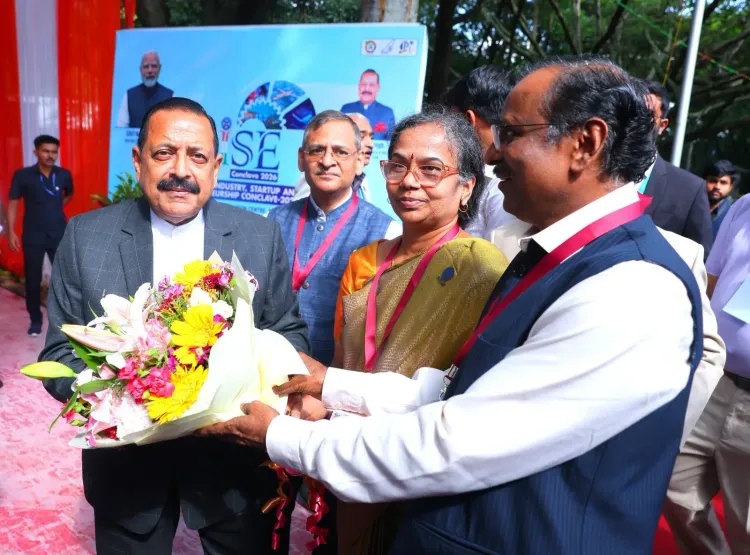
Union Science and Technology Minister Dr. Jitendra Singh arrived in Bengaluru on 13 June 2026 for the two-day RISE Conclave 2026, focused on bridging research, industry, and entrepreneurship, and was received by the heads of CSIR and ISRO.
Key Takeaways
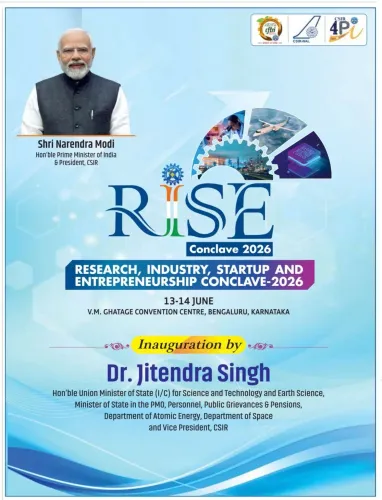
Jitendra Singh arrived in Bengaluru on 13 June 2026 for the two-day RISE (Research, Industry, StartUp, Entrepreneurship) Conclave 2026 .
The minister was welcomed by CSIR Director General Dr.
Kalaiselvi and ISRO Chairman Dr.
Narayanan , among other senior officials.
CSIR-NAL Director Dr.
Pashilkar and CSIR-CFTRI Director Dr.
Giridhar Parvatam were also part of the welcome delegation.
The conclave is designed to strengthen linkages between public research institutions, industry, and the startup ecosystem under the Atmanirbhar Bharat framework.
Bengaluru hosts the event owing to its concentration of aerospace, biotech, and IT clusters, making it a recurring venue for science-industry integration initiatives.
Follow-up announcements on joint CSIR-ISRO incubation programmes or technology transfer guidelines are expected after the two-day deliberations.
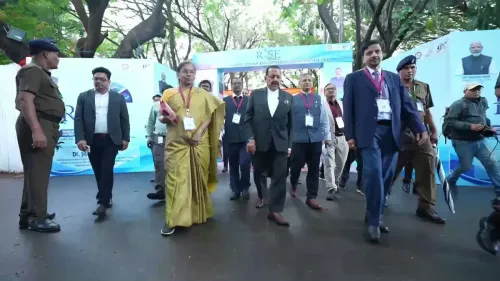
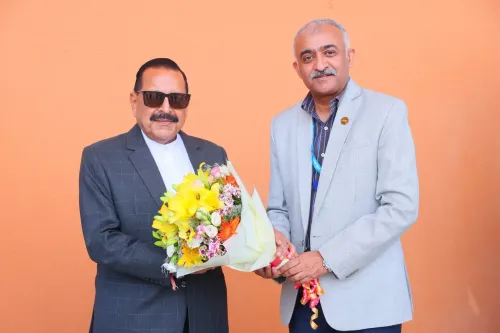
Union Minister of State (Independent Charge) for Science and Technology Dr. Jitendra Singh arrived in Bengaluru on Saturday, 13 June 2026 for the two-day RISE (Research, Industry, StartUp, Entrepreneurship) Conclave 2026, a national platform designed to strengthen linkages between public research institutions, industry, and the startup ecosystem.
The minister was received by a high-profile scientific leadership that included Dr. N. Kalaiselvi, Director General of the Council of Scientific and Industrial Research (CSIR); Dr. V. Narayanan, Chairman of the Indian Space Research Organisation (ISRO); Dr. Abhay A. Pashilkar, Director of CSIR-NAL; and Dr. Giridhar Parvatam, Director of CSIR-CFTRI, along with senior faculty, officials and distinguished dignitaries.
Context
The RISE Conclave 2026 brings together stakeholders from research institutions, industry, and the startup community under a single roof in Bengaluru — a city that serves as India's foremost hub for aerospace, biotechnology, and information technology. The conclave's four-pillar framework — Research, Industry, StartUp, and Entrepreneurship — reflects a deliberate policy intent to close the gap between laboratory discoveries and market-ready products.
The presence of both CSIR, India's largest public R&D network, and ISRO, the national space agency, at the welcoming committee signals the breadth of institutional participation expected at the two-day deliberations.
Policy Backdrop
The conclave sits within a decade-long policy architecture aimed at commercialising publicly funded science. The Startup India initiative (2016) introduced tax incentives and a fund-of-funds to connect research outputs with early-stage ventures, while the Atal Innovation Mission, also launched in 2016 under NITI Aayog, expanded incubators and tinkering labs to scale technologies emerging from CSIR and ISRO laboratories.
The Science, Technology and Innovation Policy 2013 had earlier set targets for raising gross expenditure on R&D and deepening public-private partnerships — goals that successive governments have continued to pursue through platforms such as RISE. The broader Atmanirbhar Bharat agenda has further elevated technology transfer and startup scaling in strategic sectors as national priorities.
Stakeholders and Impact
CSIR operates laboratories across disciplines spanning aerospace, food technology, and materials science, making its participation central to any initiative linking research with industry. CSIR-NAL (National Aerospace Laboratories) and CSIR-CFTRI (Central Food Technological Research Institute) — both represented at the welcome — are among the network's most commercially active units.
ISRO's involvement adds a strategic dimension, given the organisation's expanding role in enabling private-sector participation in space through the Indian National Space Promotion and Authorisation Centre (IN-SPACe). For startups and entrepreneurs attending the conclave, direct engagement with leadership from both bodies represents a significant access opportunity.
What's Next
The two-day format of the RISE Conclave 2026 leaves room for substantive announcements. Observers will watch for follow-up directives on joint CSIR-ISRO incubation programmes or updated technology transfer guidelines that could emerge from the deliberations. Any new frameworks linking public R&D outputs to startup funding pipelines would mark a concrete policy outcome from the event.
As India continues to position itself as a global science and innovation destination, conclaves of this kind increasingly serve as both policy-signalling moments and operational platforms for the research-to-market pipeline that the government has prioritised across multiple budget cycles.
Point of View
Rather than remaining a platform for policy reaffirmation.
NationPress
14 Sept 2026
Frequently Asked Questions
What is the RISE Conclave 2026?
The RISE Conclave 2026 is a two-day national event held in Bengaluru focused on Research, Industry, StartUp, and Entrepreneurship, bringing together public research institutions like CSIR and ISRO with industry and startup stakeholders to strengthen technology commercialisation linkages.
Why did Dr. Jitendra Singh attend the RISE Conclave 2026?
Dr. Jitendra Singh attended the RISE Conclave 2026 in his capacity as Union Minister of State (Independent Charge) for Science and Technology, as the event falls directly under the policy domain of his ministry and aligns with the government's Atmanirbhar Bharat goals.
Who welcomed Dr. Jitendra Singh at the RISE Conclave 2026?
Dr. Jitendra Singh was welcomed by CSIR Director General Dr. N. Kalaiselvi, ISRO Chairman Dr. V. Narayanan, CSIR-NAL Director Dr. Abhay A. Pashilkar, CSIR-CFTRI Director Dr. Giridhar Parvatam, and other senior officials and dignitaries.
What is CSIR and why is it important for India's startup ecosystem?
CSIR, the Council of Scientific and Industrial Research, is India's largest public R&D network with laboratories spanning aerospace, food technology, materials science and more. It is central to technology transfer initiatives that convert publicly funded research into commercial products and startup ventures.
What outcomes are expected from the RISE Conclave 2026?
Observers are watching for announcements on joint CSIR-ISRO incubation programmes and updated technology transfer guidelines that could create new pathways for startups to access and commercialise publicly funded research.