Joshi addresses Bharat Renewable Energy Summit 2026
Synopsis
Union Minister Pralhad Joshi addressed the Bharat Renewable Energy Summit & Expo 2026 alongside PM Modi, highlighting over 110 GW added in two years, Surya Sarovar Yojana, Green Energy Corridor 3.0, green hydrogen advances, and India's pledge to 500 GW non-fossil capacity by 2030.
Key Takeaways
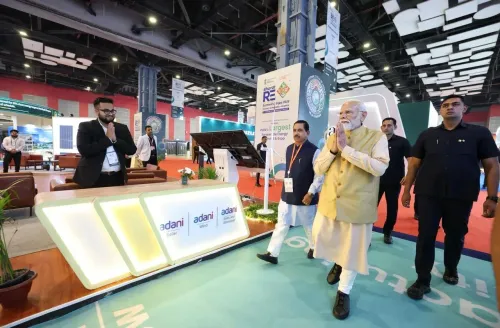
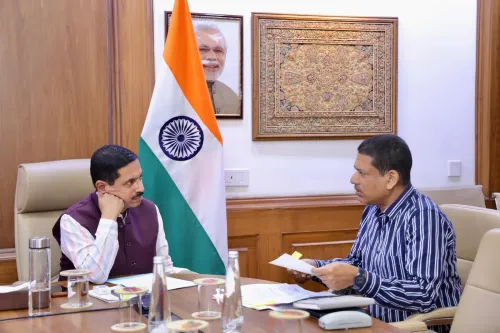
Union Minister Pralhad Joshi addressed the inaugural ceremony of Bharat Renewable Energy Summit & Expo 2026 on 2 November 2026 , with PM Modi present alongside chief ministers, ministers, and international delegates.
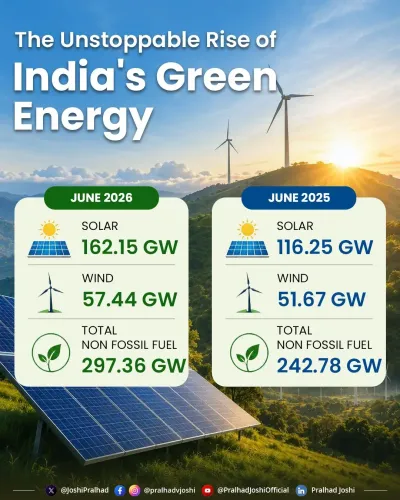
Joshi cited the addition of over 110 GW of renewable energy capacity in just two years as evidence of India's accelerating green transition.
Solar power is currently being extended to one lakh households every six days , reflecting rapid decentralised deployment.
Surya Sarovar Yojana and Green Energy Corridor 3.0 were highlighted as key ongoing initiatives supporting grid integration and distributed solar.
Progress in green hydrogen and domestic manufacturing under PLI-linked schemes was cited as a pillar of India's clean-energy industrial strategy.
India's commitments — 500 GW non-fossil fuel capacity by 2030 and net-zero by 2070 — frame the policy urgency behind every announcement at the summit.
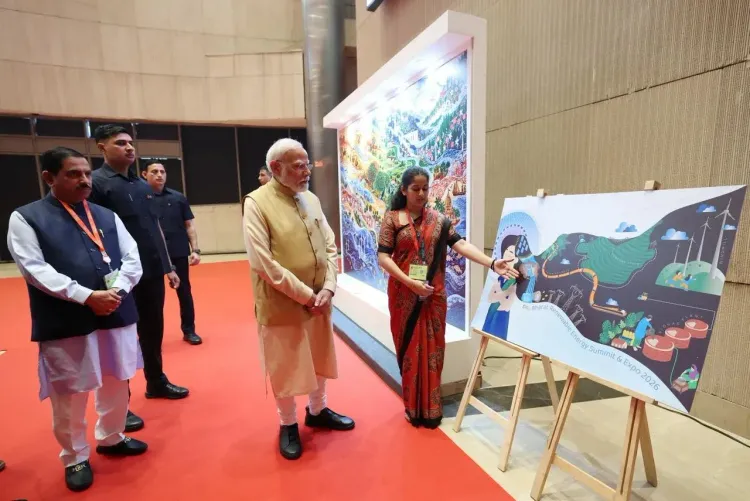
India's green energy transition took centre stage on Monday, 2 November 2026, as Union Minister of New and Renewable Energy Pralhad Joshi addressed the inaugural ceremony of the Bharat Renewable Energy Summit & Expo 2026 (#BRESummit2026) — a gathering that brought together Prime Minister Narendra Modi, chief ministers, Union ministers, international delegates, and industry leaders under one roof.
Speaking at the summit, Joshi underscored the pace of India's energy transformation. In his address — delivered in Kannada — he stated that under PM Modi's visionary leadership, India has added over 110 gigawatts of renewable energy capacity in just two years, and that solar power is now reaching one lakh households every six days. Those are not incremental numbers. That is a structural shift in how India powers itself.
Surya Sarovar Yojana and Green Energy Corridor 3.0 in the spotlight
Joshi specifically cited the progress of Surya Sarovar Yojana and Green Energy Corridor 3.0 as markers of the transition's breadth. The Green Energy Corridor — a dedicated transmission infrastructure programme that has been rolling out in phases since 2015 — is designed to evacuate renewable power from resource-rich states and push it to demand centres across the country. Phase 3.0 represents the latest expansion of that grid backbone.
The Surya Sarovar Yojana adds to a broader push for decentralised solar deployment, complementing the Centre's flagship PM Surya Ghar Muft Bijli Yojana — launched in 2024 — which targets rooftop solar installations on one crore households with subsidised electricity.
Green hydrogen and domestic manufacturing enter the frame
Beyond solar, Joshi pointed to advances in green hydrogen and domestic clean-energy manufacturing as further proof of the sector's momentum. India's National Green Hydrogen Mission, approved in 2023, aims to build out domestic production and end-use capacity — reducing fossil fuel import dependence while positioning India as a potential global supplier. Production-linked incentive schemes are running in parallel to anchor supply chains at home rather than offshore.
The minister framed India's clean-energy ambition in terms of three principles: Oorja Swaraj (energy self-rule), Jana Kalyana (public welfare), and Vishwa Kalyana (global welfare) — drawing on India's cultural heritage to articulate a mission that is simultaneously domestic and multilateral. This aligns directly with India's updated Nationally Determined Contributions submitted at COP26 in 2021, which commit India to 500 GW of non-fossil fuel capacity by 2030 and net-zero by 2070.
A summit, a signal, and a deadline on the horizon
The Bharat Renewable Energy Summit & Expo 2026 serves as more than a showcase — it is a diplomatic and investment signal. Events like this, framed around the International Solar Alliance ecosystem and bilateral clean-energy partnerships, have historically been used to draw long-horizon capital into India's grid. With 2030 — and its 500 GW target — now under four years away, the pressure to accelerate state-level rollouts of Surya Sarovar Yojana and Green Energy Corridor 3.0 moves from aspiration to urgency.
The clock is ticking, and India's energy ministers are no longer just making promises — they are presenting receipts.
Point of View
Not merely imported climate diplomacy. The simultaneous push on green hydrogen and domestic manufacturing through PLI schemes suggests the government is trying to move India from clean-energy consumer to clean-energy exporter. With fewer than four years to the 500 GW deadline, the summit's real test will be whether state-level execution can match the ministerial momentum.
NationPress
2 Nov 2026
Frequently Asked Questions
What is the Bharat Renewable Energy Summit 2026?
The Bharat Renewable Energy Summit & Expo 2026 (#BRESummit2026) is a government and industry gathering focused on renewable technologies, green hydrogen, and domestic clean-energy manufacturing, inaugurated in November 2026 in the presence of Prime Minister Narendra Modi.
What is India's renewable energy target by 2030?
India has committed under its updated Nationally Determined Contributions — submitted at COP26 in 2021 — to achieving 500 GW of non-fossil fuel energy capacity by 2030 and reaching net-zero emissions by 2070.
What is the PM Surya Ghar Muft Bijli Yojana?
Launched in 2024, the PM Surya Ghar Muft Bijli Yojana is a central government scheme to install rooftop solar panels on one crore households across India, providing subsidised electricity to beneficiaries.
What is Green Energy Corridor 3.0?
Green Energy Corridor 3.0 is the latest phase of India's dedicated renewable transmission infrastructure programme, which began in 2015, designed to carry electricity from renewable-rich states to high-demand regions of the country.
What is India's National Green Hydrogen Mission?
Approved in 2023, the National Green Hydrogen Mission aims to develop domestic production, storage, and end-use capacity for green hydrogen in India, reducing fossil fuel dependency and positioning the country as a potential global clean-fuel supplier.