Joshi addresses Mercom India Renewables Summit 2026 in Delhi

Synopsis
Union Minister Pralhad Joshi addressed the 6th Mercom India Renewables Summit in New Delhi on 1 July 2026, outlining India's clean energy roadmap spanning solar, wind, energy storage, green hydrogen and domestic manufacturing, and felicitated sector award winners for their contributions to the energy transition.
Key Takeaways
Pralhad Joshi participated in the 6th Mercom India Renewables Summit 2026 in New Delhi on 1 July 2026 .
The minister addressed the gathering on India's renewable energy roadmap, covering solar, wind, energy storage, green hydrogen and domestic manufacturing .
Award winners were felicitated for outstanding contributions to the renewable energy sector.
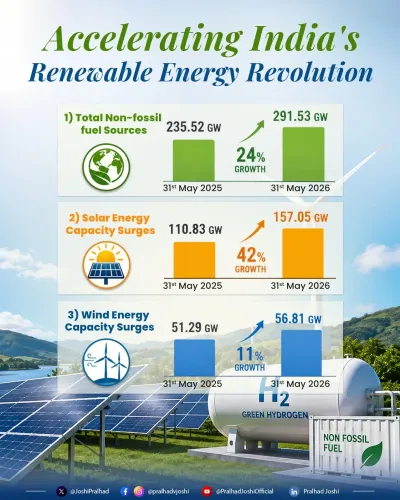
India's clean energy ambitions are anchored in Panchamrit commitments including 500 GW non-fossil capacity by 2030 and net-zero by 2070 .
The National Green Hydrogen Mission (approved 2023 ) and the PLI scheme for solar PV manufacturing (notified 2021 ) form key pillars of the policy framework.
Industry stakeholders are awaiting clarity on viability gap funding disbursements and energy storage policy guidelines.
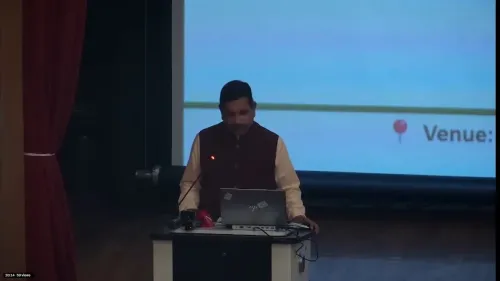
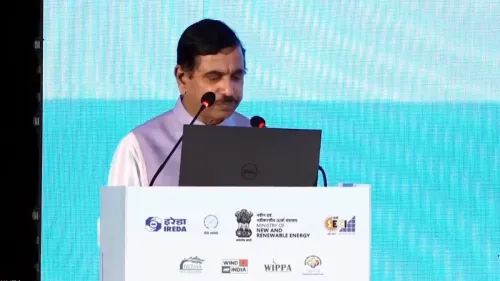
Union Minister of New and Renewable Energy Pralhad Joshi on Wednesday, 1 July 2026 participated in the 6th Mercom India Renewables Summit in New Delhi, interacting with industry stakeholders on the sidelines and delivering an address on India's renewable energy roadmap. The minister also felicitated award winners recognised for outstanding contributions to the renewable energy sector.
Context
Joshi used the summit platform to engage directly with renewable energy companies, developers, and technology providers, underscoring the government's continued outreach to private sector players driving India's energy transition. In his address, he highlighted opportunities in solar, wind, energy storage, green hydrogen, and domestic manufacturing as India works toward becoming a global clean energy leader.
Speaking about the award winners, the minister said their achievements 'reflect the innovation, commitment and entrepreneurial spirit driving India's energy transition.' The felicitation underscored the government's intent to recognise industry contributions alongside setting policy direction.
Policy Backdrop
India's renewable energy ambitions are anchored in the Panchamrit commitments announced at COP26 in 2021, which include achieving 500 GW of non-fossil fuel-based electricity capacity by 2030 and reaching net-zero emissions by 2070. These targets have been backed by a series of central schemes designed to accelerate both generation and manufacturing.
The Production Linked Incentive (PLI) scheme for solar PV manufacturing, notified in 2021, aims to reduce import dependence and build domestic supply chains. More recently, the National Green Hydrogen Mission, approved in 2023, has introduced viability gap funding and pilot projects to scale electrolyser production and green hydrogen offtake — a segment Joshi specifically highlighted at the summit.
Energy storage has emerged as a critical policy frontier as India integrates higher shares of variable renewable power into the grid, making industry forums such as the Mercom Summit important venues for aligning government priorities with investment planning.
Stakeholders and Impact
The Mercom India Renewables Summit, now in its sixth edition, serves as one of the sector's key annual gatherings, bringing together project developers, equipment manufacturers, financiers, and policymakers. Joshi's presence and bilateral interactions on the sidelines signal continued high-level political attention to the sector at a time when India is scaling up capacity additions.
Domestic manufacturers stand to benefit from the government's push to localise solar module production and electrolyser manufacturing under existing incentive frameworks. Green hydrogen developers are particularly watching for clarity on viability gap funding disbursements under the National Green Hydrogen Mission, which remains a key enabler for commercial-scale projects.
What's Next
The renewable energy sector will watch for follow-through on the policy signals Joshi articulated at the summit, particularly the rollout of viability gap funding under the Green Hydrogen Mission and any new guidelines on grid-scale energy storage. With India's 2030 capacity targets requiring sustained acceleration in project commissioning and domestic manufacturing, industry stakeholders will look to translate summit-level engagement into concrete policy timelines in the coming fiscal year.
Point of View
Next-generation energy narrative — not just capacity additions but industrial policy. With the 2030 deadline for 500 GW non-fossil capacity approaching, such high-profile engagements also serve a political function: demonstrating that India's climate commitments remain on track despite execution challenges in storage and green hydrogen. The felicitation of award winners adds a soft-power dimension, incentivising private sector participation in a sector where government-industry alignment is essential.
NationPress
2 Jul 2026
Frequently Asked Questions
What did Pralhad Joshi say at the Mercom India Renewables Summit 2026?
Joshi addressed the gathering on India's renewable energy roadmap, highlighting opportunities in solar, wind, energy storage, green hydrogen and domestic manufacturing as India aims to become a global clean energy leader.
What is the Mercom India Renewables Summit?
The Mercom India Renewables Summit is an annual industry conference on renewable energy held in India; the 2026 edition in New Delhi was its sixth instalment, bringing together developers, manufacturers, financiers and policymakers.
What is India's renewable energy target for 2030?
India has committed under its Panchamrit goals to achieving 500 GW of non-fossil fuel-based electricity capacity by 2030 and reaching net-zero emissions by 2070 .
What is the National Green Hydrogen Mission?
The National Green Hydrogen Mission, approved in 2023 , is a central government scheme to scale domestic production and use of green hydrogen through viability gap funding, pilot projects and support for electrolyser manufacturing.
What is the PLI scheme for solar manufacturing in India?
The Production Linked Incentive scheme for solar PV manufacturing, notified in 2021 , provides financial incentives to domestic producers of solar modules to reduce import dependence and build local supply chains.