Joshi: Centre hikes onion procurement price 13% to ₹2,125/qtl
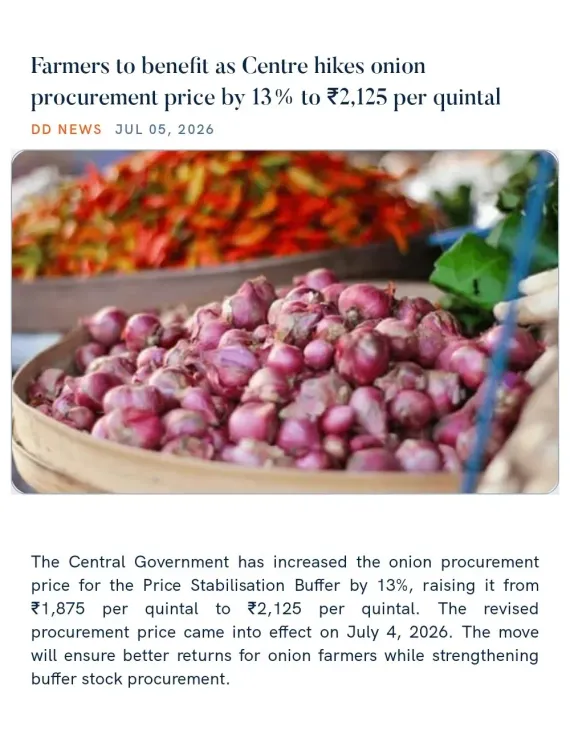
Synopsis
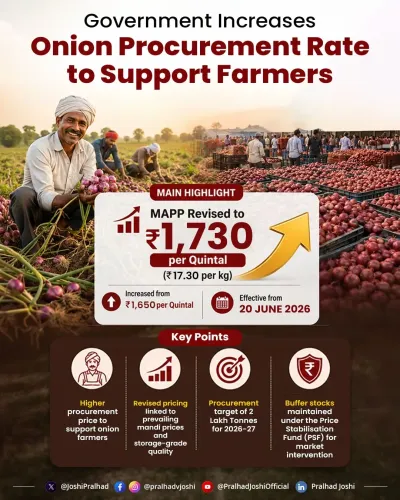
The Centre has raised the onion procurement price by 13 per cent to ₹2,125 per quintal, Union Minister Pralhad Joshi announced on 5 July 2026. The revision, executed under the Price Stabilisation Fund via NAFED, aims to improve farm-gate realisations for onion growers while maintaining buffer stocks to check retail price volatility.
Key Takeaways
The Central government has hiked the onion procurement price by 13 per cent to ₹2,125 per quintal .
Union Minister Pralhad Joshi announced the revision on 5 July 2026 , calling it a direct benefit to farmers.
Procurement is typically carried out by NAFED under the Price Stabilisation Fund (PSF) to build government buffer stocks.
Major onion-producing states including Maharashtra, Madhya Pradesh, Karnataka, and Rajasthan stand to benefit from improved farm-gate prices.
Buffer stocks accumulated through procurement are released during retail price spikes, balancing farmer and consumer interests.
Roll-out of procurement operations and subsequent retail price movement will be key indicators of the policy's on-ground impact.
Union Consumer Affairs Minister Pralhad Joshi on Sunday, 5 July 2026, announced that the Central government has raised the onion procurement price by 13 per cent to ₹2,125 per quintal, a move the minister said would directly benefit onion farmers across the country.
Context
Sharing the development on his official X account, Joshi highlighted the revised procurement rate as a welfare measure for the farming community. The hike represents a meaningful step up in the government-set floor at which agencies purchase onions from producers, shielding growers from distress sales during harvest season.
Onion procurement in India is typically carried out by NAFED (National Agricultural Cooperative Marketing Federation of India) under the Price Stabilisation Fund (PSF), a mechanism designed to build buffer stocks that can be released when retail prices spike, protecting both farmers and consumers.
Policy Backdrop
The Centre has periodically revised onion procurement prices in previous seasons to support producer incomes while keeping a check on urban retail inflation — a politically sensitive balance given that onion prices have historically triggered sharp public reactions. The Price Stabilisation Fund, managed under the Ministry of Consumer Affairs, Food and Public Distribution, is the primary instrument for these interventions.
Buffer stocks accumulated through procurement operations are released into wholesale and retail markets when prices rise sharply, acting as a supply-side dampener. The dual mandate — supporting farmers through floor prices while protecting consumers through stock releases — places the ministry at the centre of one of India's most closely watched commodity policy areas.
Stakeholders and Impact
The primary beneficiaries of the revised rate are onion farmers, concentrated in states such as Maharashtra, Madhya Pradesh, Karnataka, and Rajasthan, who will now receive a higher guaranteed price when selling to government procurement agencies. A 13 per cent increase in the procurement price directly improves farm-gate realisations, particularly for growers who had faced price pressure in recent seasons.
For urban consumers, the immediate impact will depend on how procurement operations are scaled and whether buffer stocks are adequate to moderate any future retail price spikes. Procurement agencies and state-level nodal bodies will be responsible for translating the revised price into on-ground purchase operations in major producing districts.
What's Next
The key variables to watch are the speed and scale of procurement operations in major onion-growing states and whether the revised price is accompanied by an expanded procurement target under the Price Stabilisation Fund. Any subsequent movement in wholesale and retail onion prices — upward or downward — will be closely tracked as an indicator of how effectively the buffer-stock mechanism is functioning. Joshi's ministry is also likely to monitor retail price data through the Department of Consumer Affairs price-monitoring dashboard, which tracks daily commodity prices across cities, to calibrate stock releases if needed.
Point of View
The government signals solidarity with the farming constituency ahead of what could be a demanding procurement season, while retaining the buffer-stock lever to contain retail inflation. For Minister Joshi, the announcement reinforces his ministry's dual mandate: producer welfare and consumer protection. The real test, however, will be in the pace and reach of actual procurement operations on the ground, not the announcement itself.
NationPress
5 Jul 2026
Frequently Asked Questions
What is the new onion procurement price set by the Central government?
The Central government has set the new onion procurement price at ₹2,125 per quintal , an increase of 13 per cent over the previous rate.
Who announced the onion procurement price hike?
Union Minister Pralhad Joshi , who heads the Ministry of Consumer Affairs, Food and Public Distribution, announced the hike on 5 July 2026 .
Which agency procures onions on behalf of the government?
NAFED (National Agricultural Cooperative Marketing Federation of India) is the primary agency that procures onions on behalf of the Central government under the Price Stabilisation Fund .
How does the onion procurement price hike benefit farmers?
A higher procurement price means farmers can sell their produce to government agencies at a better farm-gate rate, reducing dependence on volatile open-market prices and protecting against distress sales.
Will the onion price hike affect retail prices for consumers?
The immediate retail impact depends on how procurement operations are scaled. Buffer stocks built through procurement are released when retail prices rise sharply, which typically helps moderate consumer prices over time.