Joshi fires back at Rahul Gandhi over CRPF jawan concern
Synopsis
Union Minister Pralhad Joshi publicly challenged Rahul Gandhi on November 10, 2026, citing BJP-era defence reforms including the CDS creation and a claimed 12-month CRPF fatality-free record, while accusing Congress of questioning the 2019 Balakot airstrikes.
Key Takeaways
Pralhad Joshi addressed Rahul Gandhi directly on X on November 10, 2026 , questioning the Congress leader's credibility on soldier welfare.
Joshi invoked the 2019 Balakot airstrikes , accusing Congress leaders of casting doubt on the operation after the Pulwama attack killed 40 CRPF personnel .
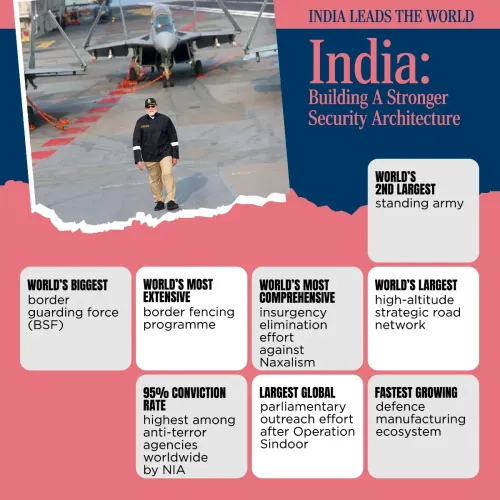
The minister cited post- 2014 defence reforms: creation of the Chief of Defence Staff in December 2019 , CRPF modernisation, border infrastructure upgrades, and defence indigenisation.
Joshi claimed the CRPF has gone 12 consecutive months without a single operational fatality — a feat he says was last achieved 47 years ago (this figure is unverified).
The post signals BJP intent to pre-emptively reframe any Congress critique of paramilitary welfare ahead of the approaching winter parliamentary session .
A sharp political volley landed on Tuesday, November 10, 2026, when Union Consumer Affairs and New and Renewable Energy Minister Pralhad Joshi addressed Rahul Gandhi directly on X, challenging the Congress leader to defend his party's record on national security before questioning Prime Minister Narendra Modi's credentials on nationalism.
The Balakot barb and the Congress credibility question
Joshi's post cuts straight to the fault line that has defined BJP-Congress exchanges on defence since February 2019. That month, the Indian Air Force struck a Jaish-e-Mohammed training camp in Balakot, Pakistan, days after a suicide bombing in Pulwama killed 40 CRPF personnel. What followed was an acrimonious national debate in which several Congress leaders publicly questioned the government's account of the strikes — a flashpoint the BJP has not let the opposition forget. 'The country has not forgotten how the sacrifices of our jawans were questioned,' Joshi wrote, framing Gandhi's current sympathy for CRPF jawans as convenient and belated.
Modi-era defence reforms: the BJP's scorecard
Joshi anchors his rebuttal in a list of structural changes his party credits to the post-2014 government. The most significant was the creation of the Chief of Defence Staff (CDS) post in December 2019 — India's first tri-service military chief, designed to end decades of inter-service siloing. Alongside it, the government has pushed Atmanirbhar Bharat indigenisation in defence production, aiming to reduce import dependency, and invested in border infrastructure across difficult terrain. 'These are actions, not hollow claims,' Joshi wrote pointedly.
He also invoked a specific operational statistic — that the CRPF has recorded '12 consecutive months without a single operational fatality', a milestone he said has not been achieved in 47 years. That figure, if accurate, would mark a historic low in the force's casualty record and represent a significant benchmark for internal security management. The claim has not been independently confirmed, but it forms the centrepiece of Joshi's challenge to Gandhi.
Joshi's direct challenge — and what it signals politically
The tone is combative but calculated. Joshi does not merely defend the government; he issues a structured dare: 'If you have the courage, debate your own party's record first.' This rhetorical move — asking the opposition to answer for its own history before critiquing the present — is a well-worn BJP tactic, but its deployment here on the specific terrain of CRPF and paramilitary welfare signals that the ruling party sees Gandhi's outreach to security forces as a political threat worth engaging, not ignoring.
The post arrives as parliament's winter session approaches, when opposition benches are expected to press the government on CRPF modernisation funding and broader defence readiness. Joshi's pre-emptive social media salvo effectively reframes that likely debate: any Congress question on soldier welfare will now carry the weight of Balakot as a counter-argument waiting in the chamber.
India's paramilitary forces remain both a genuine policy responsibility and a potent political symbol. When the country's most combative political voices argue over who truly protects the men and women in uniform, the jawans themselves are watching — and so is the electorate.
Point of View
The party pivots immediately to Balakot, turning a welfare question into a credibility test. The specific invocation of a 12-month CRPF fatality-free record — whether or not it withstands scrutiny — is a deliberate attempt to shift the terms of debate from 'are you funding the forces adequately' to 'who can even claim to speak for them.' With the winter session approaching, the BJP appears keen to inoculate itself against opposition questions on CRPF modernisation budgets by pre-positioning Gandhi as a bad-faith actor. The long-running Balakot rift remains the sharpest wedge in Indian civil-military politics, and both sides know it.
NationPress
10 Nov 2026
Frequently Asked Questions
Why did Pralhad Joshi target Rahul Gandhi over CRPF?
Joshi accused Gandhi of showing 'sudden concern' for CRPF jawans while Congress leaders had previously questioned the government's account of the 2019 Balakot airstrikes, which came after a suicide bombing killed 40 CRPF personnel in Pulwama.
What is the Balakot airstrike controversy in Indian politics?
The Indian Air Force struck a Jaish-e-Mohammed camp in Balakot, Pakistan, in February 2019. Several Congress leaders publicly questioned the government's claims about the operation, a position the BJP has since used repeatedly to challenge Congress on defence credibility.
What defence reforms did Pralhad Joshi credit to the Modi government?
Joshi cited the creation of the Chief of Defence Staff post in December 2019, modernisation of the CRPF, stronger border infrastructure, and the Atmanirbhar Bharat push for indigenous defence manufacturing.
What is the CRPF fatality record claim Joshi made?
Joshi claimed the CRPF has achieved 12 consecutive months without a single operational fatality, saying this had not happened in 47 years. This specific figure has not been independently verified.
What is the Chief of Defence Staff and when was it created?
The Chief of Defence Staff is India's first tri-service military chief, created in December 2019 to improve integration and jointness among the Army, Navy, and Air Force. It was a long-pending structural reform that the Modi government implemented.