Pralhad Joshi gifts PM Modi shawl woven on solar charkha
Synopsis
Union Minister Pralhad Joshi presented PM Narendra Modi with a handwoven shawl made by local artisans on a solar-powered charkha, framing it as a symbol of India's traditional craftsmanship, renewable energy innovation and the Aatmanirbhar Bharat mission.
Key Takeaways
Union Minister Pralhad Joshi gifted PM Narendra Modi a shawl woven on a solar-powered charkha by local artisans.
The gesture was presented as a symbol of Aatmanirbhar Bharat , sustainability and traditional craftsmanship.
Aatmanirbhar Bharat was launched by PM Modi in May 2020 to promote domestic production and artisan sectors.
Joshi holds both the New and Renewable Energy and Consumer Affairs portfolios, making the solar-charkha gift a direct reflection of his dual ministerial mandate.
The post was shared in three languages — English, Kannada and Hindi — and tagged #BRESummit2026 , suggesting a larger official event context.
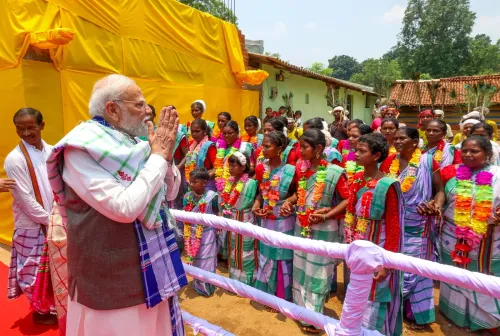
A handwoven shawl stitched together two of India's most powerful policy symbols in a single gesture. Union Consumer Affairs and New and Renewable Energy Minister Pralhad Joshi presented Prime Minister Narendra Modi with a shawl crafted by local artisans using a solar-powered charkha — spinning wheel — calling it a confluence of traditional craftsmanship and the spirit of #AatmanirbharBharat.
The moment was shared by Joshi on Monday, 2 November 2026 in a trilingual post — English, Kannada and Hindi — reflecting both his Karnataka roots and the national scope of the message. In his words, it was a moment that 'brought together the richness of our traditional craftsmanship and the spirit of innovation, sustainability and #AatmanirbharBharat.'
The solar charkha: where Gandhi-era symbolism meets clean energy
The charkha has been one of India's most potent cultural and political symbols since the independence movement — a tool of self-reliance long before that phrase became government policy. Pairing it with solar power is a deliberate rhetorical and practical leap: the same tool that once symbolised freedom from colonial dependence now signals freedom from fossil-fuel dependence.
Joshi, who holds the New and Renewable Energy portfolio alongside Consumer Affairs, is positioned at exactly this intersection. The solar-powered charkha directly marries his two ministerial mandates — promoting artisan livelihoods and accelerating India's renewable energy adoption at the grassroots level.
Aatmanirbhar Bharat's artisan thread
Aatmanirbhar Bharat, launched by Prime Minister Modi in May 2020, was conceived as a broad economic self-reliance drive spanning manufacturing, agriculture and traditional crafts. Handloom and handicraft sectors were explicitly identified as pillars of domestic production and rural employment, with schemes aimed at reducing import dependence while reviving indigenous skills.
The gifting of a solar-charkha shawl to the Prime Minister is consistent with this messaging — a living demonstration, not just a policy document. Local weavers, often among India's most economically vulnerable artisans, become the visible face of a national agenda when their craft reaches the Prime Minister's hands.
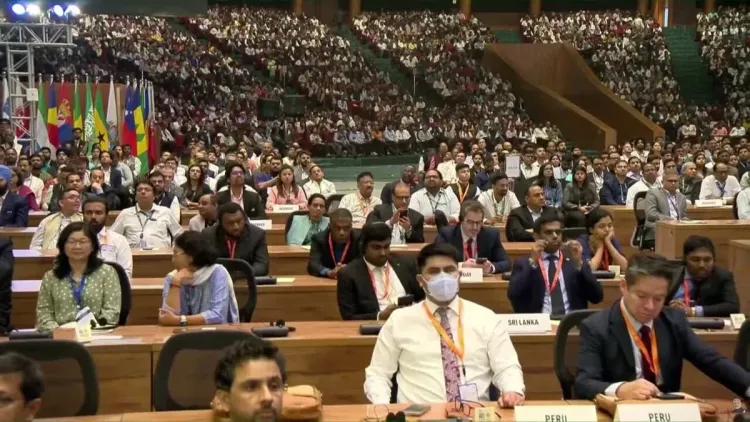
The post was tagged #BRESummit2026, suggesting the presentation took place at a larger official gathering, though specific details of that event were not confirmed in the minister's post.
A shawl woven by hand, powered by the sun, presented to the country's top leader — the artisans who made it may not have been in the room, but their work was the whole point.
Point of View
Giving both narratives a human, artisanal face. For Pralhad Joshi, whose portfolio spans renewable energy and consumer welfare, the gesture is also a subtle assertion of ministerial coherence — one shawl, two mandates. More broadly, it fits a well-established BJP pattern of using ceremonial occasions to reinforce Aatmanirbhar Bharat branding at high-visibility moments, keeping the 2020 initiative alive as an aspirational frame well into the decade.
NationPress
2 Nov 2026
Frequently Asked Questions
What did Pralhad Joshi gift PM Modi?
Pralhad Joshi gifted PM Narendra Modi a handwoven shawl made by local artisans using a solar-powered charkha, symbolising traditional craftsmanship and Aatmanirbhar Bharat.
What is a solar-powered charkha?
A solar-powered charkha is a traditional Indian spinning wheel adapted to run on solar energy, combining the iconic symbol of self-reliance with modern renewable energy technology.
What is Aatmanirbhar Bharat?
Aatmanirbhar Bharat is a government initiative launched by PM Modi in May 2020 to promote India's self-reliance in manufacturing, agriculture and traditional crafts, reducing dependence on imports.
What portfolios does Pralhad Joshi hold?
Pralhad Joshi is Union Minister for Consumer Affairs, Food and Public Distribution, and also Minister for New and Renewable Energy. He is a senior BJP leader from Karnataka.
What event was the shawl gifted at?
The post was tagged #BRESummit2026, indicating the presentation took place at an official summit, though the minister's post did not confirm further details of the event.