Pralhad Joshi Flags India's Clean Energy Leap in Solar, Wind
Synopsis
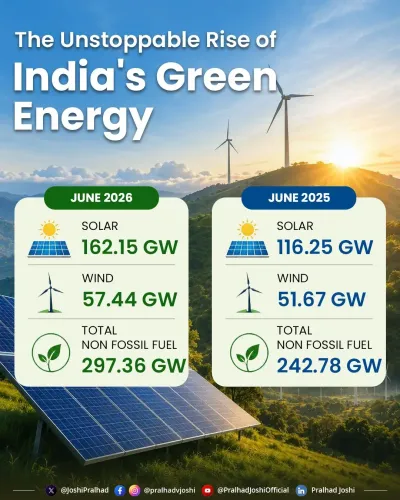
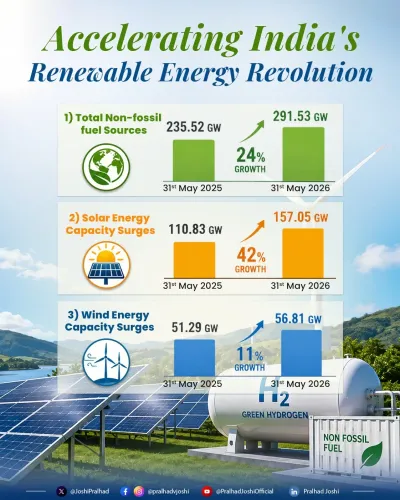
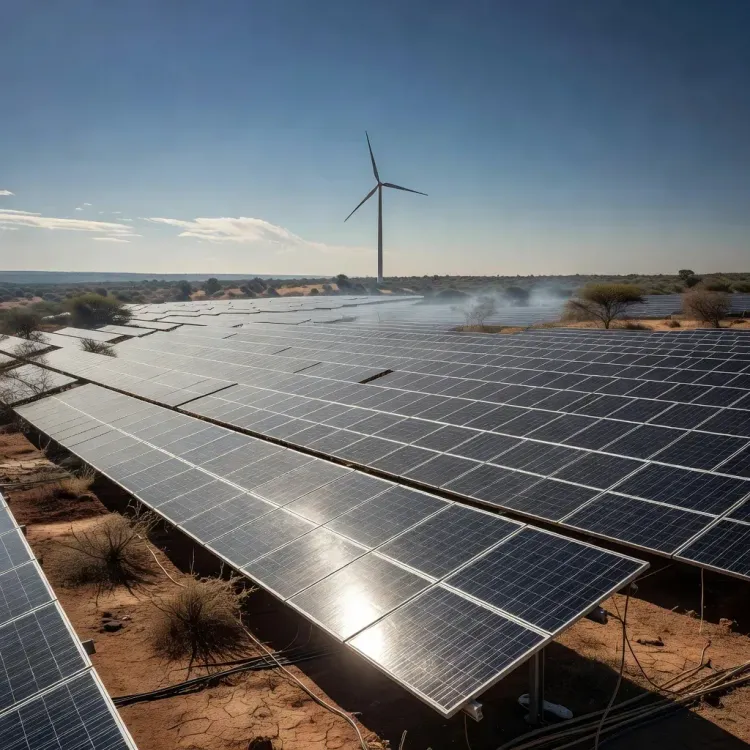
Union Minister Pralhad Joshi highlighted India's significant solar, wind, and non-fossil fuel capacity expansion between October 2025 and October 2026, linking the gains to PM Modi's Viksit Bharat vision and India's 500 GW renewable target by 2030.
Key Takeaways
Union Minister Pralhad Joshi flagged 'significant expansion' in India's solar, wind, and non-fossil fuel capacity on November 11, 2026 .
The progress window cited spans October 2025 to October 2026 , framed as a year-on-year benchmark.
India committed to 500 GW of non-fossil fuel capacity by 2030 under the Panchamrit strategy at COP26 in 2021 .
The National Green Hydrogen Mission , approved in 2023 , underpins the next phase of India's energy transition beyond solar and wind.
India is the world's third-largest energy consumer and has consistently ranked among the top five countries for annual renewable installations since 2015 .
The Central Electricity Authority's next quarterly report will provide verified figures to substantiate the gains cited by the minister.
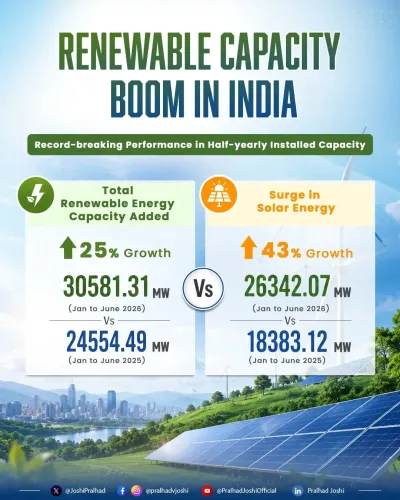
India's clean energy story is moving faster than ever — and Union Minister Pralhad Joshi wants the country to take stock of exactly how far it has come. On Wednesday, November 11, 2026, the Minister for New and Renewable Energy took to X to highlight what he called 'significant expansion' in solar, wind, and overall non-fossil fuel capacity recorded between October 2025 and October 2026, framing the progress as a direct reflection of the government's push toward energy self-reliance.
A year of gains across solar, wind, and non-fossil fuel capacity
Joshi's post points to a full twelve-month window of capacity additions — October to October — as the benchmark for measuring momentum. While specific figures from that period are yet to be independently compiled in a public quarterly report, the minister characterised the gains as 'substantial,' spanning solar and wind installations as well as the broader non-fossil fuel base. India has ranked among the top five countries globally for annual renewable installations every year since 2015, and the government's internal tracking appears to reflect that trajectory continuing through 2026.
The 500 GW target and the Panchamrit promise
The strategic backdrop here is not new, but it is formidable. At COP26 in 2021, India unveiled the Panchamrit (five-nectar) climate commitments — anchored by a pledge to reach 500 GW of non-fossil fuel capacity by 2030 and achieve net-zero emissions by 2070. Every capacity update since then is, in effect, a progress report against that promise to the world. The National Green Hydrogen Mission, approved in 2023, added another layer to this architecture, targeting clean fuel production as the next frontier beyond wind and solar.
India is also the world's third-largest energy consumer, which makes the scale of this transition doubly consequential — both for domestic energy security and for reducing the import bill on fossil fuels that weighs on the current account.
Viksit Bharat as the unifying frame
Joshi explicitly linked the renewables push to Prime Minister Narendra Modi's Viksit Bharat (Developed India) vision — the government's organising goal of positioning India as a fully developed economy by 2047, the centenary of independence. Clean energy is increasingly central to that frame: reliable, affordable, and domestically sourced power is presented as both an economic foundation and a geopolitical asset. State power utilities and renewable energy developers are the primary executors of this agenda at the ground level, translating national targets into actual grid additions across states.
The next granular data point to watch is the Central Electricity Authority's quarterly capacity report, which will put hard numbers to the trajectory Joshi has flagged — and test whether the October-to-October window holds up as a genuine inflection year for Indian renewables.
Point of View
The BJP is weaving energy security into its core development pitch rather than treating it as a standalone environment story. India's clean energy rollout has genuine structural tailwinds — falling solar tariffs, rising state-level procurement, and global capital chasing green assets — but the government's credibility on the 500 GW target will increasingly depend on grid integration and transmission investment keeping pace with generation additions. The absence of specific figures in the minister's post, pending the next CEA quarterly report, leaves the narrative strong on direction but light on granular accountability.
NationPress
11 Nov 2026
Frequently Asked Questions
What is India's renewable energy target by 2030?
India has committed to achieving 500 GW of non-fossil fuel electricity capacity by 2030 as part of its Panchamrit climate pledges announced at COP26 in 2021.
What did Pralhad Joshi say about India's clean energy progress?
On November 11, 2026 , Minister Pralhad Joshi stated that India recorded significant expansion in solar, wind, and overall non-fossil fuel capacity between October 2025 and October 2026 , calling it a reflection of the government's focus on the clean energy transition.
What is the Viksit Bharat vision and how does it relate to clean energy?
Viksit Bharat (Developed India) is PM Modi's goal of making India a fully developed economy by 2047 . Clean, domestically produced renewable energy is a central pillar of this vision, underpinning both economic growth and energy security.
What is India's Green Hydrogen Mission?
The National Green Hydrogen Mission was approved by the Indian government in 2023 to scale up production of green hydrogen as a clean fuel, complementing India's solar and wind expansion.
Where does India rank globally in renewable energy installations?
India has consistently ranked among the top five countries globally for annual renewable energy installations every year since 2015 , driven by rapid solar and wind capacity additions.