Joshi Highlights Record 29 GW Solar, Wind Addition in H1 2026
Synopsis
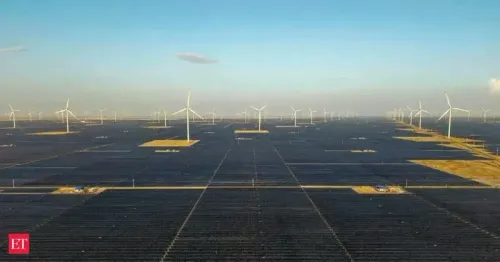
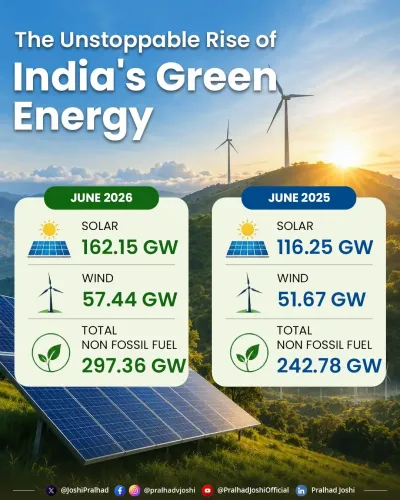
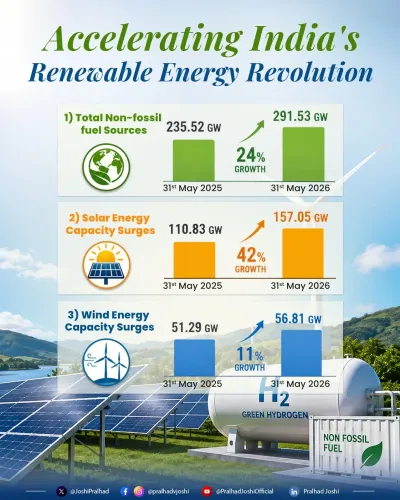
India added a record 29 GW of solar and wind capacity in the first half of 2026, a milestone flagged by Union Minister Pralhad Joshi. The figure marks the highest ever half-year renewable installation in the country and advances India's push toward its 500 GW non-fossil fuel target by 2030.
Key Takeaways
India added a record 29 GW of solar and wind capacity in the first half of 2026 (January–June), the highest ever for a single half-year period.
Union Minister Pralhad Joshi of the Ministry of New and Renewable Energy shared the milestone on 16 July 2026 .
India's current renewable energy target stands at 500 GW of non-fossil fuel capacity by 2030 , committed under the Panchamrit strategy at COP26 in 2021 .
The policy lineage runs from the Jawaharlal Nehru National Solar Mission (2010) through successive upward revisions of national targets in 2015 , 2019 , and 2021 .
Grid integration, transmission infrastructure, and storage investment remain key challenges alongside the record generation capacity additions.
The Central Electricity Authority quarterly reports will provide official confirmation and the full-year trajectory of capacity additions.
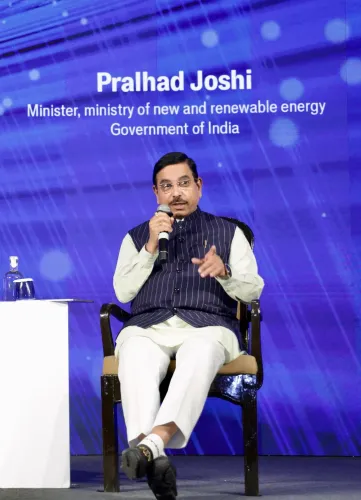
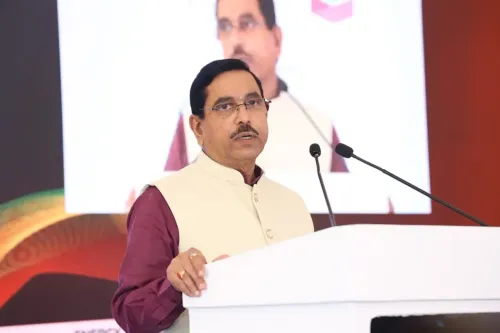
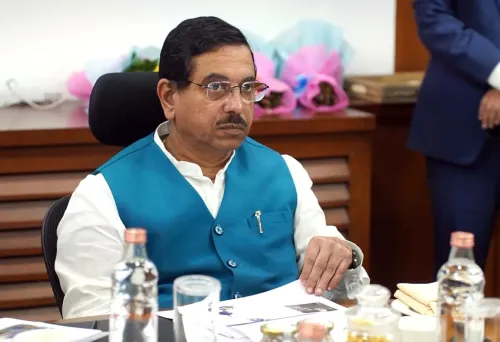
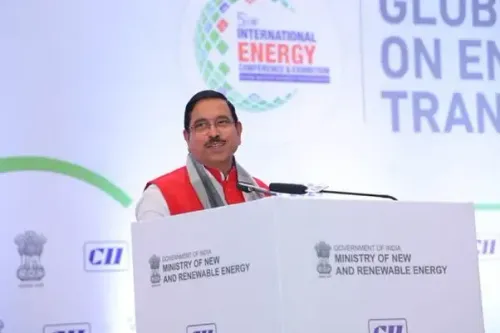
Union Consumer Affairs and New and Renewable Energy Minister Pralhad Joshi on Thursday, 16 July 2026, shared a report indicating that India added a record 29 gigawatts (GW) of solar and wind capacity in the first half of 2026, marking what the minister flagged as a landmark milestone in the country's clean energy expansion.
Context
The post, shared via the NaMo App, linked to coverage noting that India's solar and wind installations in the January–June 2026 period reached 29 GW — the highest ever recorded for a single half-year period. Minister Joshi, who oversees the Ministry of New and Renewable Energy (MNRE), highlighted the figure as evidence of accelerating momentum in India's clean energy buildout.
The 29 GW addition in six months is significant when measured against India's historical annual installation rates, which only crossed 15 GW per year consistently in the early 2020s. A single half-year surpassing that cumulative pace signals a structural shift in the pace of capacity commissioning.
Policy Backdrop
India's renewable energy ambitions have been progressively scaled upward over the past decade. The country's initial commitment under its 2015 Nationally Determined Contribution (NDC) set a target of 175 GW of renewable capacity by 2022. That was revised to 450 GW by 2030 in 2019, and then further elevated at COP26 in 2021, when Prime Minister Narendra Modi announced the Panchamrit strategy — committing India to 500 GW of non-fossil fuel capacity by 2030 and net-zero emissions by 2070.
The Jawaharlal Nehru National Solar Mission, launched in 2010, laid the early institutional groundwork for solar deployment, establishing targets and financing frameworks that subsequent governments built upon. Central schemes, viability gap funding, and sharply falling technology costs have together driven the acceleration visible in recent years.
Solar and wind installations have been concentrated in resource-rich states, with Rajasthan, Gujarat, Tamil Nadu, Andhra Pradesh, and Karnataka accounting for a disproportionate share of commissioned capacity. State renewable purchase obligations and competitive bidding guidelines administered by MNRE and the Solar Energy Corporation of India (SECI) have been key levers.
Stakeholders and Impact
The primary beneficiaries of accelerated capacity addition include renewable energy developers, state power utilities that gain access to cheaper generation, and rural households increasingly brought onto the grid through solar-powered distribution. For developers, a high-installation environment signals policy continuity and bankable demand.
Faster capacity addition also carries implications for coal import dependence. India has consistently sought to reduce its fuel import bill, and every GW of domestic renewable capacity commissioned displaces a corresponding quantum of thermal generation, easing pressure on foreign exchange reserves and energy security calculations.
Grid integration, however, remains a parallel challenge. Rapid solar and wind addition requires commensurate investment in transmission infrastructure, battery storage, and grid balancing mechanisms — areas where regulatory and investment timelines have historically lagged behind generation targets.
What's Next
The Central Electricity Authority (CEA) publishes quarterly capacity addition reports that will confirm and contextualise the 29 GW figure within the full fiscal and calendar year trajectory. Analysts and state utilities will watch whether the second half of 2026 sustains a comparable pace, which would put India on course to significantly close the gap with its 500 GW by 2030 target well ahead of schedule.
Updates to renewable purchase obligations and fresh bidding guidelines for the upcoming fiscal year are also expected from MNRE, which will shape developer pipelines and determine whether the record first-half pace can be institutionalised rather than treated as a one-off surge.
Point of View
If confirmed by official CEA data, would represent a genuine inflection point in India's energy transition — not merely incremental progress. It also implicitly builds the case that the 500 GW by 2030 target, once considered aspirational, is now operationally within reach. The broader arc here is a government seeking to reconcile its coal-dependent energy base with credible climate leadership, and record half-year additions are its strongest argument on both fronts.
NationPress
16 Jul 2026
Frequently Asked Questions
How much solar and wind capacity did India add in the first half of 2026?
India added a record 29 GW of solar and wind capacity between January and June 2026, the highest ever for a single half-year period.
What is India's renewable energy target by 2030?
India has committed to achieving 500 GW of non-fossil fuel electricity capacity by 2030 under the Panchamrit strategy announced by Prime Minister Narendra Modi at COP26 in 2021.
What did Pralhad Joshi say about India's renewable energy progress?
Minister Pralhad Joshi shared a report on 16 July 2026 highlighting that India had achieved a record 29 GW of solar and wind additions in the first half of 2026, signalling strong momentum in the country's clean energy buildout.
Which ministry oversees India's solar and wind energy policy?
The Ministry of New and Renewable Energy (MNRE), currently headed by Union Minister Pralhad Joshi, is responsible for policy, targets, and programmes promoting solar, wind, and other renewable sources across India.
What was India's original renewable energy target and how has it changed?
India's original target was 175 GW of renewable capacity by 2022, set under its 2015 NDC. It was revised to 450 GW by 2030 in 2019, and then further raised to 500 GW of non-fossil fuel capacity by 2030 at COP26 in 2021.