Pralhad Joshi Hails India as IOR First Responder
Synopsis
Union Minister Pralhad Joshi invoked the Indian Ocean's 70-million-sq-km scale to assert India's standing as a global maritime first responder, tying the message to the ruling party's #12YearsOfSurakshitBharat campaign on 17 June 2026.
Key Takeaways
Minister Pralhad Joshi posted in Kannada on 17 June 2026 , framing the Indian Ocean as larger than three Europes, two Americas, and two Chinas combined.
The Indian Ocean Region spans 70 million square kilometres , making it the world's third-largest ocean and a critical artery for global trade.
Joshi declared India the region's 'first responder', citing growing defence capabilities and responsible leadership.
India's SAGAR doctrine (2015) and post-2004 tsunami naval deployments form the policy foundation for this first-responder posture.
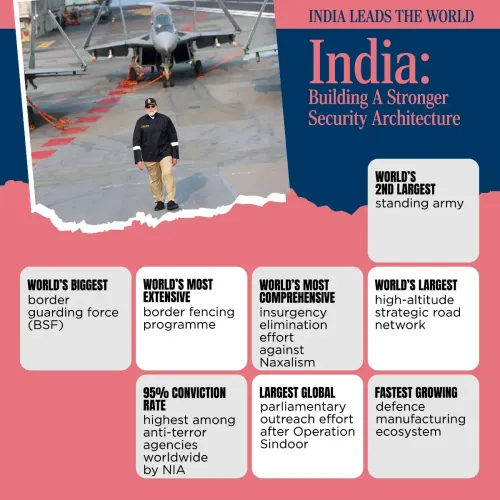
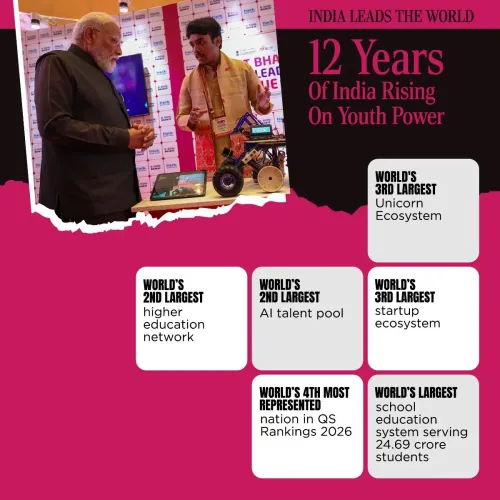
The post was tagged #12YearsOfSurakshitBharat , indicating a coordinated government communications campaign.
Upcoming Malabar and Milan naval exercises and the next IORA Council of Ministers meeting are key near-term milestones for India's maritime agenda.
Union Consumer Affairs Minister Pralhad Joshi on Wednesday, 17 June 2026 invoked the sheer scale of the Indian Ocean Region (IOR) to underline India's growing stature as a maritime first responder, sharing his remarks on X under the hashtag #12YearsOfSurakshitBharat.
Context
Writing in Kannada, Joshi noted that the Indian Ocean, spanning 70 million square kilometres, is larger than three Europes, two Americas, and two Chinas combined — 'ಮೂರು ಯುರೋಪ್, ಎರಡು ಅಮೆರಿಕ ಮತ್ತು ಎರಡು ಚೀನಾಗಳನ್ನು ಒಟ್ಟುಗೂಡಿಸುವುದಕ್ಕಿಂತ ದೊಡ್ಡದಾಗಿದೆ' (bigger than three Europes, two Americas, and two Chinas put together). Against that backdrop, he asserted that India stands proudly as the world's 'first responder' in this vast maritime expanse, driven by its expanding defence capabilities and responsible leadership.
Policy Backdrop
India's self-conception as a net security provider in the Indian Ocean Region has deepened over the past decade. Prime Minister Narendra Modi formalised this outlook in 2015 through the SAGAR doctrine — Security and Growth for All in the Region — which commits India to cooperative maritime engagement with littoral states. The doctrine built on a template established after the 2004 Indian Ocean tsunami, when the Indian Navy rapidly deployed assets for humanitarian assistance and disaster relief (HADR), demonstrating a capacity that has since been institutionalised.
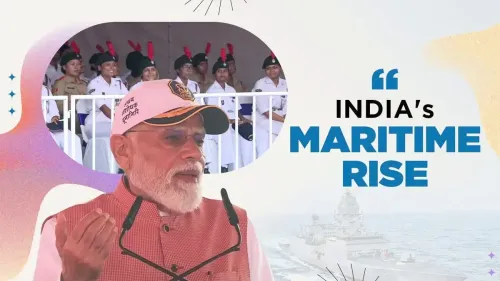
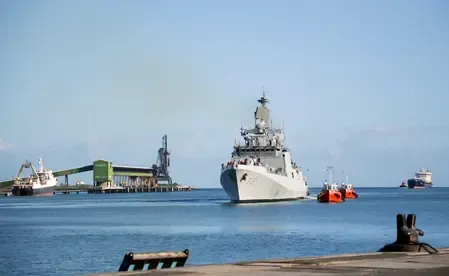
The Indian Navy today serves as the primary agency executing this vision, conducting hydrographic surveys, capacity-building partnerships, and HADR missions across the region. Successive governments have expanded the Navy's footprint to reinforce India's profile as the preferred security partner for Indian Ocean littoral states and to promote a rules-based maritime order.
Stakeholders and Impact
The Indian Ocean Region is home to critical global trade routes; a credible first-responder role directly benefits the 36 littoral states that depend on these sea lanes for commerce and connectivity. For India, the strategic dividend is significant: deeper security partnerships, greater diplomatic influence, and a counterbalance to expanding extra-regional naval activity in the ocean.
The Indian Navy's multilateral engagements — including exercises such as Malabar and Milan — operationalise this commitment, building interoperability with partner navies and signalling sustained regional presence. Civilian populations across the littoral benefit most directly during natural disasters, where India's rapid-response deployments have repeatedly set the pace for international relief efforts.
What's Next
Upcoming multilateral naval exercises and the next Indian Ocean Rim Association (IORA) Council of Ministers meeting are expected to provide fresh platforms for India to articulate its HADR commitments and maritime security partnerships. The hashtag #12YearsOfSurakshitBharat signals a broader government communications push, suggesting that India's maritime first-responder narrative will feature prominently in the ruling party's outreach in the weeks ahead.
As India's defence capabilities continue to grow, the question for policymakers and partner nations alike is how this first-responder role will be institutionalised through formal bilateral and multilateral agreements — moving from a posture to a binding architecture of regional security.
Point of View
Using the #12YearsOfSurakshitBharat hashtag to draw a direct line between a decade of BJP governance and India's elevated maritime stature. The invocation of geographic scale — comparing the Indian Ocean to multiples of Europe, America, and China — is a rhetorical device designed to communicate strategic ambition to a domestic audience in accessible terms. It also signals that the ruling party intends to make maritime security a centrepiece of its governance record ahead of future electoral cycles. The framing dovetails with India's long-running effort to position itself as an indispensable regional power rather than merely a South Asian actor.
NationPress
16 Sept 2026
Frequently Asked Questions
What is India's role as a first responder in the Indian Ocean?
India acts as the primary provider of humanitarian assistance, disaster relief, and maritime security in the Indian Ocean Region, deploying Indian Navy assets rapidly during crises — a role formalised through the SAGAR doctrine in 2015.
What is the SAGAR doctrine?
SAGAR stands for 'Security and Growth for All in the Region,' a maritime policy framework articulated by Prime Minister Modi in 2015 that commits India to cooperative engagement, capacity-building, and security partnerships with Indian Ocean littoral states.
Why did Pralhad Joshi post about the Indian Ocean?
Pralhad Joshi shared the post on 17 June 2026 under the hashtag #12YearsOfSurakshitBharat , as part of what appears to be a coordinated BJP government campaign highlighting India's security achievements over the past 12 years.
How big is the Indian Ocean?
The Indian Ocean covers approximately 70 million square kilometres , making it larger than three Europes, two Americas, or two Chinas combined, and the third-largest ocean on Earth.
What naval exercises does India conduct in the Indian Ocean?
India participates in multilateral exercises including Malabar (with the US and Japan) and Milan (a broader multilateral exercise), both of which build interoperability with partner navies and reinforce India's first-responder posture in the region.