Joshi: India's Green Energy Push Buffered Global Crisis Shocks
Synopsis
Union Minister Pralhad Joshi credited PM Modi's green energy strategy with protecting India from global energy market shocks, pointing to the country's scaled-up renewable capacity and its 2021 COP26 Panchamrit commitments as the foundation of that resilience.
Key Takeaways
Union Minister Pralhad Joshi posted on 3 November 2026 that India's green energy shift has shielded it from global crises, attributing the achievement to PM Narendra Modi .
India's renewable diversification has reduced dependence on imported crude and natural gas, lowering exposure to global supply-shock-driven price spikes.
At COP26 in Glasgow in 2021 , India announced the Panchamrit strategy, targeting 500 GW of non-fossil fuel capacity by 2030 and net-zero by 2070 .
Solar and wind capacity expansion is framed by the government as both a climate commitment and a national energy-security strategy.
Upcoming quarterly capacity-addition figures and Union Budget announcements will be the key metrics to watch on India's progress toward its 500 GW target.
When global energy markets convulse, countries hooked on imported fuel feel every tremor. Union Minister for New and Renewable Energy Pralhad Joshi made the case on Tuesday, 3 November 2026 that India has quietly built itself a shock-absorber — crediting Prime Minister Narendra Modi's green-energy push with shielding the country from the worst of recent global disruptions.
The Shield Modi Built: Renewables as Energy Security
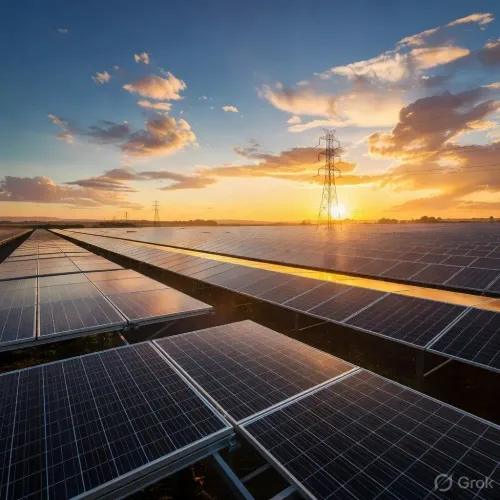
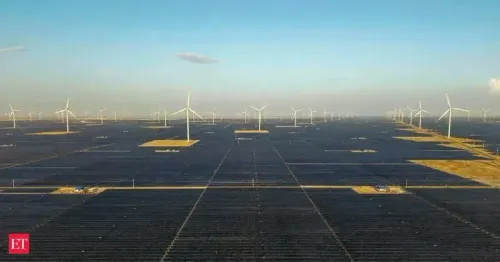
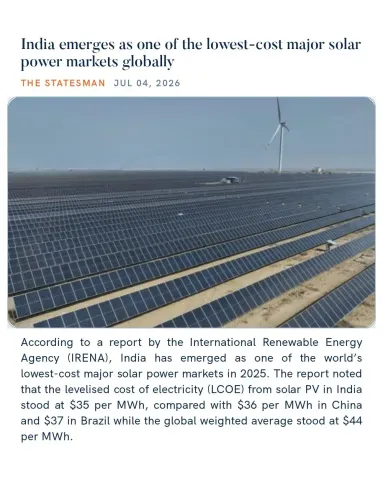
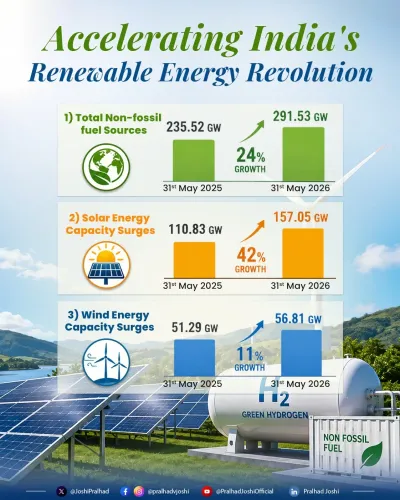
Joshi's post — terse but pointed — framed India's renewable energy expansion not merely as a climate commitment but as hard-nosed national security strategy. The argument is straightforward: every gigawatt of domestic solar or wind capacity is a barrel of imported crude oil India does not need to buy at the mercy of volatile global prices. India's installed renewable capacity has scaled steadily over the past decade, with solar and wind at the core of a diversification drive that has reduced the country's exposure to supply shocks from West Asia, Russia, and global LNG markets.
Panchamrit Roots: From Glasgow to the Grid
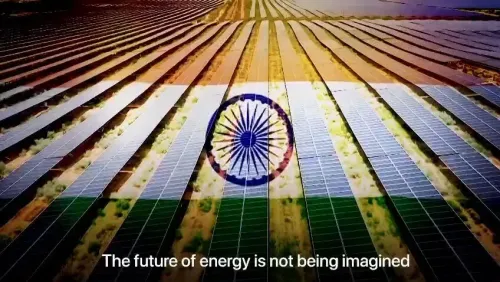
The ideological spine of this push runs back to COP26 in Glasgow in 2021, where PM Modi announced India's 'Panchamrit' climate commitments — five pledges including reaching 500 GW of non-fossil fuel capacity by 2030 and achieving net-zero emissions by 2070. What began as a diplomatic commitment at a climate summit has since been prosecuted as an energy-independence project at home. Joshi, holding both the Consumer Affairs and New and Renewable Energy portfolios, sits at the intersection of those two goals: cheaper, stable energy for consumers and a cleaner grid for the planet.
Why the Timing of This Message Matters
The minister's framing — crisis-proofing through green transition — lands at a moment when the geopolitical case for energy self-sufficiency is arguably stronger than ever. Earlier global energy shocks, from post-pandemic demand surges to supply disruptions triggered by geopolitical conflicts, punished import-dependent economies with fuel price spikes and inflation. India's government has consistently pointed to its diversification away from fossil-fuel imports as a reason domestic energy prices remained more insulated than those in comparable emerging economies. Joshi's post reinforces that official narrative with a sharp political edge: this was not accident, it was policy.
What to Watch on the Renewable Scorecard
The proof, as always, will be in the capacity numbers. Quarterly renewable addition figures — and any fresh targets the government chooses to flag in the forthcoming Union Budget or at the next COP session — will tell investors, energy analysts, and consumers how far the 500 GW goal is being closed. For now, Joshi has placed a clear political marker: India's green bet is paying dividends, and the government intends to keep the credit firmly in frame.
For a country that once ran its growth story almost entirely on imported hydrocarbons, that is not a small claim — and the world is watching whether the grid data backs it up.
Point of View
Once seen primarily through a diplomatic lens, are now being repackaged as the reason Indian consumers were insulated from imported inflation during global energy disruptions. This narrative feeds a broader BJP arc that links environmental ambition with economic nationalism. If capacity figures continue to hold, it is a message the government will amplify at every global platform it attends.
NationPress
3 Nov 2026
Frequently Asked Questions
What did Pralhad Joshi say about India's green energy and global crises?
Joshi credited PM Modi's green energy expansion with shielding India from global energy market shocks, arguing that domestic renewable capacity has reduced the country's dependence on volatile imported fossil fuels.
What is India's Panchamrit climate commitment?
Announced by PM Modi at the COP26 summit in Glasgow in 2021, the Panchamrit strategy includes five targets: reaching 500 GW of non-fossil fuel energy capacity, meeting 50 per cent of energy needs from renewables, cutting cumulative carbon emissions by one billion tonnes, reducing the carbon intensity of the economy by 45 per cent — all by 2030 — and achieving net-zero emissions by 2070.
How has India's renewable energy expansion helped protect it from global price shocks?
By scaling up solar and wind capacity, India has reduced its need to import crude oil and natural gas, insulating domestic energy prices from the supply disruptions and price spikes that have battered more import-dependent economies during global energy crises.
What is India's renewable energy target for 2030?
India has committed to achieving 500 GW of non-fossil fuel electricity capacity by 2030 as part of its Panchamrit pledges made at COP26 in Glasgow.
Who is Pralhad Joshi and what ministries does he hold?
Pralhad Joshi is a senior BJP leader from Karnataka who serves as Union Minister of Consumer Affairs, Food and Public Distribution, and Minister of New and Renewable Energy in the Government of India.