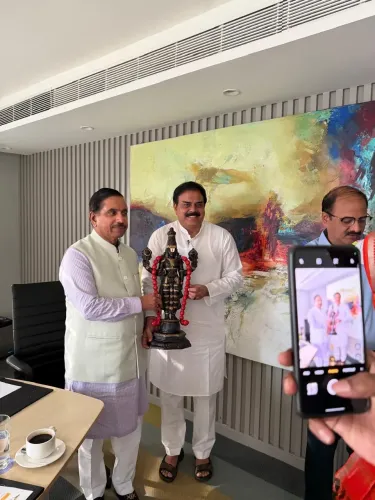
Joshi visits ISRO, hails One Nation One Time milestone
Synopsis
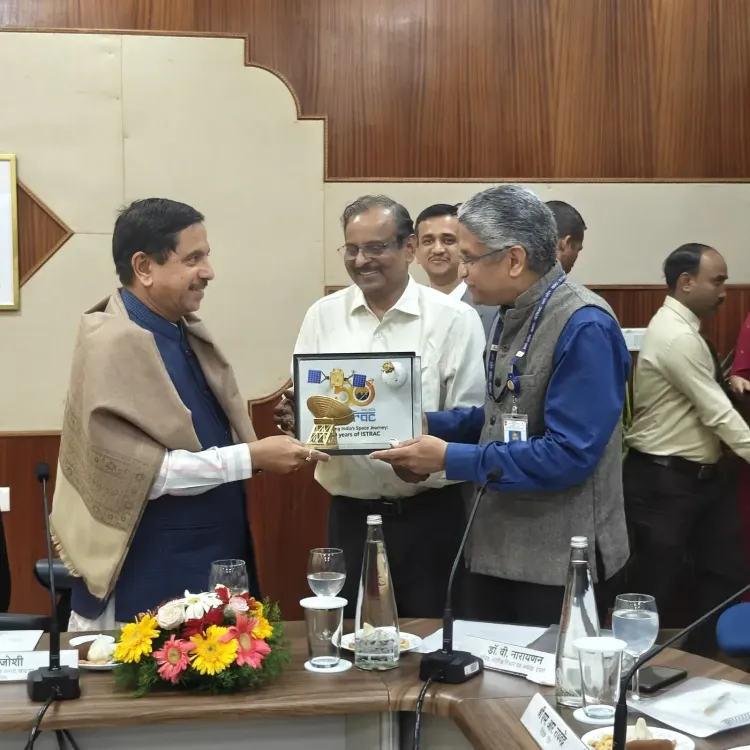
Union Consumer Affairs Minister Pralhad Joshi visited ISRO on 16 July 2026 and commended a tripartite collaboration between the Department of Consumer Affairs, CSIR–NPL, and ISRO on the 'One Nation, One Time' initiative. A Proof of Concept using White Rabbit PTP technology between RRSL Bengaluru and the National Stock Exchange, Chennai, marks a milestone in indigenous precision timekeeping.
Key Takeaways
Union Consumer Affairs Minister Pralhad Joshi visited ISRO on 16 July 2026 and praised the 'One Nation, One Time' initiative.
The initiative involves a tripartite collaboration between the Department of Consumer Affairs , CSIR–NPL , and ISRO to build an indigenous national time synchronisation system.
A Proof of Concept using White Rabbit Precision Time Protocol (PTP) was successfully conducted between RRSL Bengaluru and the National Stock Exchange, Chennai .
The initiative aims to reduce India's dependence on foreign GNSS signals for precision timekeeping, aligning with the Atmanirbhar Bharat framework.
Precision time synchronisation has direct implications for financial market integrity , secure communications, power grids, and navigation systems.
The PoC success is expected to drive expanded deployments across additional financial and critical infrastructure sites.
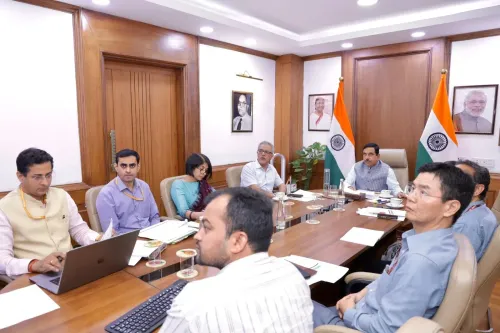
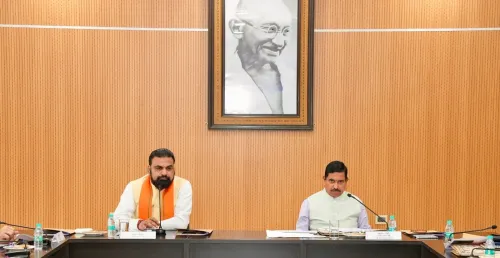
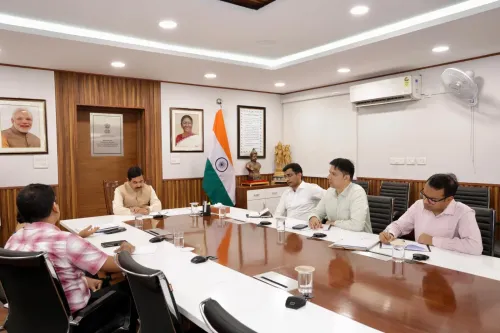
Union Consumer Affairs Minister Pralhad Joshi visited the Indian Space Research Organisation (ISRO) on 16 July 2026, lauding a landmark collaboration between the Department of Consumer Affairs, CSIR–National Physical Laboratory (CSIR–NPL), and ISRO to build an indigenous national time synchronisation system under the 'One Nation, One Time' initiative. The Minister highlighted a successful Proof of Concept (PoC) between RRSL Bengaluru and the National Stock Exchange, Chennai, using White Rabbit Precision Time Protocol (PTP) technology as a significant step toward a secure and self-reliant time dissemination infrastructure.
Context
Posting on X in both English and Kannada, Minister Joshi described the ISRO visit as 'a privilege,' calling the space agency 'a beacon of India's scientific excellence and innovation.' He commended the tripartite collaboration as 'remarkable' and congratulated scientists, engineers, and technical professionals from ISRO, CSIR–NPL, and all partner institutions for what he termed 'an extraordinary achievement.'
The Kannada portion of the post — 'ಒಂದು ರಾಷ್ಟ್ರ, ಒಂದು ಸಮಯ' [One Nation, One Time] — reinforced the initiative's name and underscored the Minister's outreach to his home-state audience in Karnataka.
Policy Backdrop
The 'One Nation, One Time' initiative seeks to replace India's dependence on foreign Global Navigation Satellite System (GNSS) signals for precision timekeeping with a fully indigenous, secure, and verifiable national time standard. CSIR–NPL, India's national metrology institute and the custodian of Indian Standard Time (IST), anchors the scientific backbone of this effort, while ISRO contributes satellite-based time transfer capabilities.
The initiative sits within the broader Atmanirbhar Bharat framework — announced in May 2020 — which mandates reducing import dependence in critical technology domains. Precision timing is considered a foundational layer for secure communications, financial market integrity, and navigation systems, making indigenous capability strategically significant.
The White Rabbit Precision Time Protocol, originally developed at CERN, enables sub-nanosecond synchronisation over fibre-optic networks and has been adopted globally for critical infrastructure timing. Its successful deployment in an Indian PoC between a government metrology laboratory and a major stock exchange marks a technically sophisticated application of the protocol in a domestic context.
Stakeholders and Impact
The National Stock Exchange (NSE) is India's largest stock exchange by trading volume. Precision time synchronisation is legally mandated for financial transactions — even microsecond discrepancies can affect trade sequencing, audit trails, and regulatory compliance. A secure, indigenous time source insulates financial markets from potential vulnerabilities in foreign satellite signals.
RRSL Bengaluru, a Regional Reference Standard Laboratory under the Department of Consumer Affairs, functions as a traceability node linking national standards to industry. Its role in the PoC positions the consumer affairs infrastructure as an active participant in national digital security, beyond its traditional weights-and-measures mandate.
Broader beneficiaries of a scaled 'One Nation, One Time' network would include telecom operators, power grids, defence networks, and e-governance platforms — all of which rely on synchronised, tamper-proof time signals.
What's Next
The success of the RRSL Bengaluru–NSE Chennai PoC is expected to pave the way for expanded pilot deployments across additional financial institutions and critical infrastructure sites. Stakeholders will watch for formal policy announcements on scaling the White Rabbit PTP network nationally, as well as any legislative or regulatory references to indigenous time standards in upcoming parliamentary sessions on digital infrastructure or metrology standards.
Minister Joshi's visit signals that the Department of Consumer Affairs is positioning itself as a key driver of India's precision infrastructure ambitions — a role that could draw increased budgetary and inter-ministerial attention as the #ViksitBharat roadmap advances toward 2047.
Point of View
One Time' initiative signal that the Department of Consumer Affairs is expanding its mandate well beyond retail markets and weights-and-measures into strategic digital infrastructure — a notable bureaucratic repositioning. The successful RRSL–NSE Proof of Concept is a technically credible milestone that lends substance to what could otherwise be dismissed as aspirational branding under Atmanirbhar Bharat. By linking precision timekeeping to financial market security and indigenous technology, the government is building a political and policy case for sustained investment in metrology infrastructure that has historically been underfunded. The bilingual English-Kannada post also reflects a deliberate effort to connect a complex technology story to a Karnataka constituency that is home to both ISRO and a significant scientific workforce.
NationPress
16 Jul 2026
Frequently Asked Questions
What is the 'One Nation, One Time' initiative in India?
'One Nation, One Time' is a government initiative to establish an indigenous, secure, and precise national time synchronisation system, led by the Department of Consumer Affairs in collaboration with CSIR–NPL and ISRO, reducing India's reliance on foreign satellite time signals.
What is White Rabbit Precision Time Protocol and why does India need it?
White Rabbit Precision Time Protocol (PTP) is a technology enabling sub-nanosecond time synchronisation over fibre-optic networks. India is adopting it to build a tamper-proof, indigenous time dissemination system for critical sectors like financial markets, telecom, and power grids.
What was the RRSL Bengaluru and NSE Chennai Proof of Concept about?
The Proof of Concept tested the use of White Rabbit PTP technology to synchronise time between the Regional Reference Standard Laboratory in Bengaluru and the National Stock Exchange in Chennai, demonstrating the feasibility of an indigenous precision time network for financial infrastructure.
Why is precise time synchronisation important for stock exchanges in India?
Stock exchanges require microsecond-accurate time stamps for trade sequencing, audit trails, and regulatory compliance. An indigenous time source protects financial systems from vulnerabilities associated with dependence on foreign satellite signals.
What is CSIR-NPL's role in Indian Standard Time?
CSIR–National Physical Laboratory is India's national metrology institute and the official custodian of Indian Standard Time (IST). It maintains the atomic clocks and standards that underpin time traceability across the country.