Karnataka CM's Office: 112 Govt Schools to Get ₹355 Cr CSR Upgrade
Synopsis
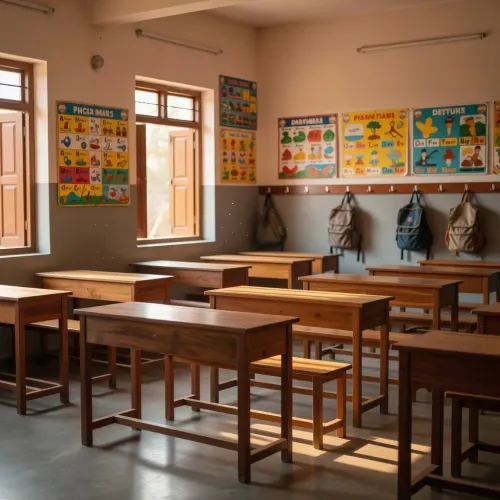
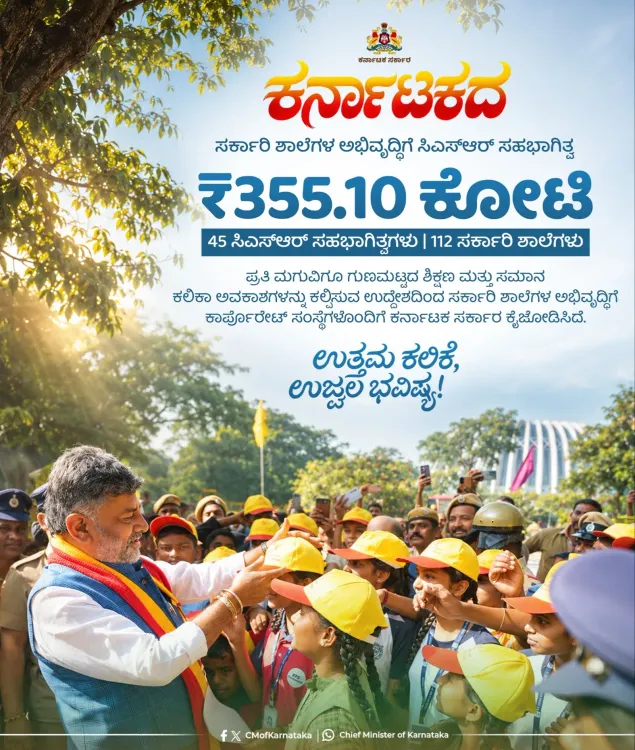
The Chief Minister's Office of Karnataka announces that 112 government schools will be upgraded through 45 CSR partnerships at a cost of ₹355.10 crore, aiming to build top-quality learning environments for children across the state through structured public-private collaboration.
Key Takeaways
112 government schools in Karnataka are being developed under a new upgrade programme announced by the CMO on 6 November 2026 .
The programme is funded through 45 Corporate Social Responsibility (CSR) partnerships , leveraging the Companies Act 2013 mandate for private-sector social spending.
Total outlay for the programme is ₹355.10 crore , averaging approximately ₹3.17 crore per school .
The government's stated goal is 'holistic development' of government schools and creating the best possible learning environment for Karnataka's children.
The initiative aligns with infrastructure targets set under the National Education Policy 2020 .
Implementation quality across 45 different corporate partners will be the key operational challenge to watch.
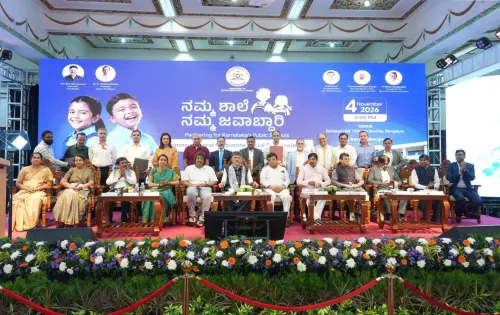
A promise backed by a price tag — the Chief Minister's Office of Karnataka announced on Friday, 6 November 2026 that 112 government schools across the state will be developed through 45 Corporate Social Responsibility (CSR) partnerships at a combined outlay of ₹355.10 crore, in what the government frames as a commitment to building world-class learning environments for the state's children.
The post, written in Kannada, states: 'ಸರ್ಕಾರಿ ಶಾಲೆಗಳ ಸರ್ವಾಂಗೀಣ ಅಭಿವೃದ್ಧಿಯೇ ನಮ್ಮ ಸರ್ಕಾರದ ಗುರಿ' — 'The holistic development of government schools is our government's goal.' The CMO added that upgrading school infrastructure through private-sector participation, to create the best possible learning environment for children across the state, is their 'sankalpa' — a solemn resolve, not merely a promise.
CSR Funds as a Force-Multiplier for Karnataka's Schools
The model at work here is not new, but the scale is notable. Under the Companies Act 2013, qualifying companies are mandated to spend a portion of profits on social-sector activities — and education has long been one of the most common recipients. Karnataka's move to formalise 45 such partnerships under a coordinated school-upgrade programme channels that legally required corporate spending into a single, measurable state initiative.
The logic is straightforward: government budgets alone cannot close infrastructure gaps in hundreds of state-run schools fast enough. Bringing in private capital — without privatising the schools themselves — allows the state to accelerate physical upgrades such as classrooms, sanitation, digital infrastructure, and libraries, while keeping access free for students.
Where This Fits Karnataka's Education Push
The initiative aligns with the framework set by the National Education Policy 2020, which explicitly called for upgrading government school infrastructure and improving learning environments as prerequisites for raising enrolment and learning outcomes. Karnataka is not alone in this approach — several states have tapped corporate partnerships for school development — but a coordinated programme spanning 112 schools in a single announcement signals institutional intent rather than ad-hoc project approvals.
The ₹355.10 crore figure averages out to roughly ₹3.17 crore per school — a meaningful intervention if spent on physical infrastructure and learning materials. The CMO's framing of this as 'baddhatey' (commitment) rather than a future aspiration suggests implementation timelines have already been set, though specific school-level rollout details have not been made public in this announcement.
What to Watch as the Programme Rolls Out
The real test will come at the school level. CSR-funded education projects in India have a mixed record — some transformative, others stalled by coordination gaps between company timelines and government approvals. With 45 different corporate partners involved, maintaining uniform quality standards and monitoring progress across all 112 schools will be the defining operational challenge for Karnataka's education department.
If the programme delivers on its infrastructure targets, it could become a replicable template for other state governments looking to stretch public spending further — and a credible data point in Karnataka's case for education investment ahead of future budget cycles.
Point of View
Numbered school-upgrade programme represents a maturing of the state's public-private education model — moving from opportunistic donations to structured, accountable deployment of corporate funds. The ₹355.10 crore figure gives the initiative political salience and an auditable benchmark, raising the stakes for delivery. Set against the NEP 2020 framework, this also positions Karnataka as a state actively operationalising national policy rather than waiting for central transfers. The critical question is whether a coordination architecture exists to hold 45 disparate corporate partners to uniform quality and timelines — that governance layer will determine whether this becomes a model or a cautionary tale.
NationPress
6 Nov 2026
Frequently Asked Questions
How many government schools is Karnataka upgrading under the CSR programme?
112 government schools across Karnataka are being developed under this initiative, funded through 45 CSR partnerships at a total cost of ₹355.10 crore .
What is CSR funding and why is it being used for Karnataka schools?
Corporate Social Responsibility (CSR) funding is mandated under the Companies Act 2013 , requiring qualifying companies to spend a portion of profits on social causes including education. Karnataka is channelling these contributions to upgrade government school infrastructure without fully depending on the state budget.
How much is being spent per school under Karnataka's CSR school upgrade plan?
With ₹355.10 crore spread across 112 schools , the average investment works out to approximately ₹3.17 crore per school , though individual allocations may vary depending on each school's requirements and the partner company.
Is Karnataka's school CSR programme connected to the National Education Policy?
Yes. The initiative aligns with the National Education Policy 2020 , which set national targets for upgrading government school infrastructure and improving learning environments as a foundation for better enrolment and learning outcomes.
Which companies are part of Karnataka's 45 CSR school partnerships?
The CMO's announcement confirmed 45 CSR partnerships are involved but did not publicly name the individual companies in this post. Further details are expected from the state education department as the programme rolls out.