Karnataka CM Office pays tribute to S. Nijalingappa
Synopsis
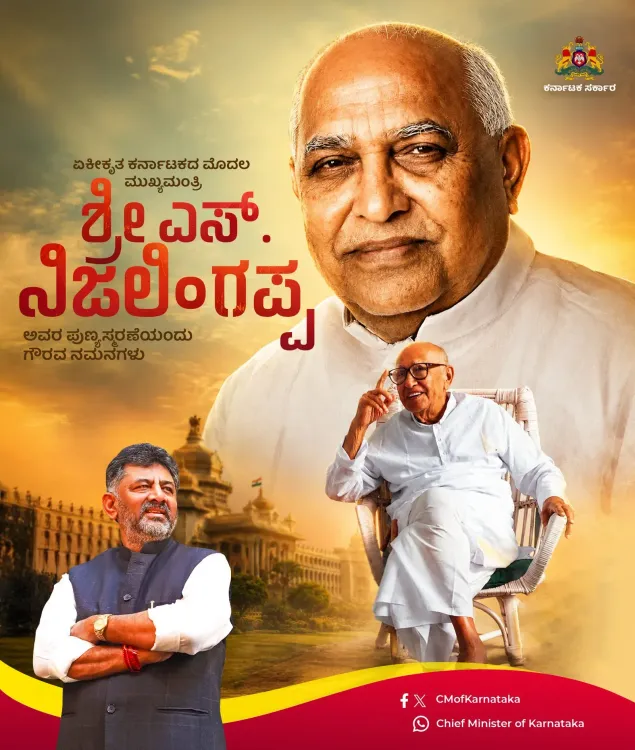
On his death anniversary, the Chief Minister's Office of Karnataka paid tribute to S. Nijalingappa — the first CM of unified Mysore State — honouring his role in the Sharavati Hydroelectric Project, Almatti Dam, Harangi Project, Cauvery water supply to Bengaluru, and M. Chinnaswamy Stadium.
Key Takeaways
The Chief Minister's Office of Karnataka posted a death-anniversary tribute to S.
Nijalingappa on 8 August 2026 .
Nijalingappa was the first Chief Minister of unified Mysore State , created by the States Reorganisation Act of 1956 .
His tenure initiated the Sharavati Hydroelectric Project with the Linganamakki reservoir , a major power source for Karnataka.
He laid the foundation for the Almatti Dam on the Krishna river, part of the Upper Krishna Project irrigating northern Karnataka.
The tribute also credits him with the Harangi Project in Kodagu, early Cauvery water supply infrastructure for Bengaluru, and the M.
Chinnaswamy Stadium .
The man who first held the reins of a unified Karnataka left behind rivers tamed, cities watered, and stadiums built — and on his death anniversary, the Chief Minister's Office of Karnataka paused to remember him. On Saturday, 8 August 2026, the official CMO account offered a respectful tribute to S. Nijalingappa, the first Chief Minister of the unified Mysore State, honouring a legacy etched into the state's soil, water, and skyline.
The post, written in Kannada, reads: 'ಏಕೀಕೃತ ಕರ್ನಾಟಕದ ಮೊದಲ ಮುಖ್ಯಮಂತ್ರಿಯಾಗಿ ನಾಡನ್ನು ಮುನ್ನಡೆಸಿದ ಎಸ್. ನಿಜಲಿಂಗಪ್ಪನವರ ಪುಣ್ಯಸ್ಮರಣೆಯಂದು ಗೌರವಪೂರ್ವಕ ನಮನಗಳು' — 'Respectful salutations on the death anniversary of S. Nijalingappa, who led the state as the first Chief Minister of unified Karnataka.' The tribute specifically names the projects he set in motion: the Linganamakki reservoir and Sharavati Hydroelectric Project, the foundation of the Almatti Dam, the Harangi Project, Cauvery water supply to Bengaluru, and the iconic M. Chinnaswamy Stadium.
The architect of unified Karnataka's first decade
When the States Reorganisation Act of 1956 drew new borders along linguistic lines, it brought together Kannada-speaking regions from across the Deccan into a single Mysore State. Nijalingappa became its first Chief Minister — inheriting not a going concern but a patchwork of regions with mismatched infrastructure, competing water needs, and a capital city, Bengaluru, already straining at the seams.
His response was structural. The Sharavati Hydroelectric Project in present-day Shivamogga district, anchored by the Linganamakki reservoir, became one of the most consequential power projects in peninsular India — lighting homes and running mills across the state for decades. In the north, he laid the groundwork for the Almatti Dam on the Krishna river, the cornerstone of the Upper Krishna Project that would eventually irrigate vast swaths of arid northern Karnataka. In Kodagu, the Harangi Project brought water to Cauvery basin farmlands. And in the capital, early pipeline and reservoir works ensured that a growing Bengaluru had drinking water to match its ambitions.
A stadium, a symbol, and a statesman's full picture
The CMO's tribute also names the M. Chinnaswamy Stadium — a reminder that Nijalingappa's vision was not confined to dams and turbines. The stadium, which would go on to become one of India's most celebrated cricket venues, stands in the heart of Bengaluru as a monument to a leader who understood that a state needs more than irrigation to thrive.
Karnataka governments have long marked the death anniversaries of early post-reorganisation leaders, using these moments to draw a line of continuity between the Congress-era river valley projects of the 1950s and 1960s and the state's present infrastructure priorities. The pattern is deliberate: the Cauvery and Krishna basins remain live political and legal arenas, and invoking Nijalingappa is also, quietly, a reminder of who first staked Karnataka's claim on those waters.
Seven decades on, the turbines at Linganamakki still spin, the Almatti reservoir still fills, and the debates over Cauvery sharing still simmer. The foundation Nijalingappa poured has never stopped bearing weight.
Point of View
Sharavati, Harangi — the post implicitly frames today's water and power disputes as continuations of a legacy the state has a historic duty to protect. It is a quiet but deliberate act of political lineage-claiming, connecting the ruling establishment to the founding generation of post-reorganisation Karnataka.
NationPress
8 Aug 2026
Frequently Asked Questions
Who was S. Nijalingappa?
S. Nijalingappa was the first Chief Minister of the unified Mysore State (later renamed Karnataka), formed after the States Reorganisation Act of 1956. He served multiple terms and is credited with initiating major irrigation, power, and urban infrastructure projects across the state.
What is the Sharavati Hydroelectric Project?
The Sharavati Hydroelectric Project is a major power generation initiative in Shivamogga district, anchored by the Linganamakki reservoir. It was developed in the late 1950s and 1960s under Nijalingappa's leadership and remains one of Karnataka's most important power sources.
What is the Almatti Dam and why is it significant?
The Almatti Dam on the Krishna river is the cornerstone of the Upper Krishna Project, designed to provide irrigation to arid northern Karnataka districts. Its foundation was laid during Nijalingappa's tenure, though construction and expansion continued over subsequent decades.
Why does Karnataka's CMO post tributes to early Chief Ministers?
Karnataka governments regularly mark death anniversaries of early post-reorganisation leaders to highlight policy continuity in irrigation, power, and water supply — sectors that remain politically significant given ongoing Cauvery and Krishna river water-sharing disputes.
What is the Harangi Project?
The Harangi Project is an irrigation dam in Kodagu district, initiated during Nijalingappa's tenure to support agriculture in the Cauvery river basin. It is one of the four dams on the Cauvery system in Karnataka.