CM Siddaramaiah Hikes Minimum Wages Up to 60% in Karnataka
Synopsis
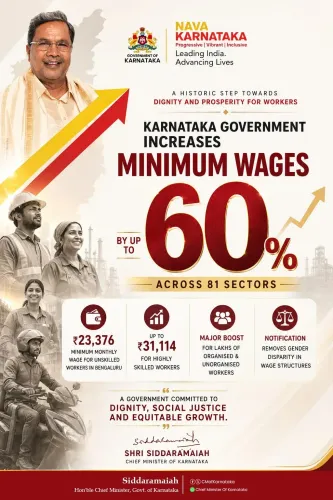
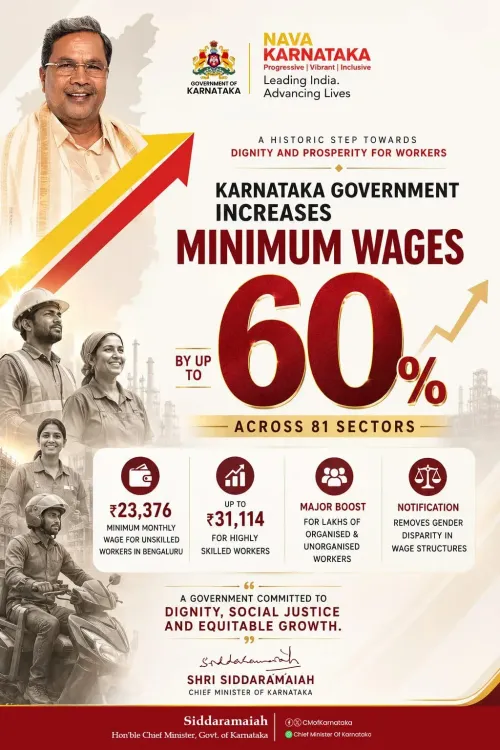
Karnataka CM Siddaramaiah has announced a minimum wage hike of up to 60% across 81 sectors, raising the monthly floor to ₹23,376 for unskilled workers and up to ₹31,114 for highly skilled workers in Bengaluru, while removing gender-based wage disparities.
Key Takeaways
Karnataka has revised minimum wages across 81 sectors , with hikes of up to 60 per cent .
The monthly minimum wage for unskilled workers in Bengaluru is now set at ₹23,376 .
Highly skilled workers will receive up to ₹31,114 per month under the new schedule.
Gender disparity in wage structures has been formally removed as part of the revision.
The revision benefits lakhs of organised and unorganised workers across the state.
The revised rates will take legal effect upon notification in the Karnataka Gazette , followed by labour department enforcement drives.
Karnataka Chief Minister Siddaramaiah on Tuesday, 26 May 2026 announced a sweeping revision of minimum wages across 81 sectors in the state, raising pay floors by up to 60 per cent and extending the benefit to lakhs of organised and unorganised workers. The revision sets a monthly floor of ₹23,376 for unskilled workers in Bengaluru and up to ₹31,114 for highly skilled workers, while also eliminating gender disparity in wage structures.
Context
Siddaramaiah shared the announcement on X, describing the move as 'a historic step towards dignity and prosperity for workers.' His post included the Kannada phrase ಶ್ರಮಕ್ಕೆ ಗೌರವ • ಬದುಕಿಗೆ ಭದ್ರತೆ [meaning: 'Dignity for labour, security for life'], underscoring the government's framing of the revision as a social-justice measure. The hike covers both the organised and unorganised workforce, the latter of which makes up the bulk of employment in the state.
The revision spans 81 sectors, making it one of the broadest wage-revision exercises undertaken by a state government in recent years. The removal of gender-based wage disparity is a notable structural change, addressing a long-standing inequity in sector-wise pay schedules.
Policy Backdrop
States in India fix and revise minimum wages under the Minimum Wages Act, 1948, which empowers them to schedule employments and set sector-specific floors. The Code on Wages, 2019 — a central consolidation of wage-related statutes — further mandates a national floor wage framework that state governments are expected to implement through expert-committee recommendations.
Karnataka has periodically revised its minimum wages, with a notable earlier revision notified in 2017. The current exercise, which the government says covers 81 sectors, follows the pattern of constituting expert committees to recommend sector-wise rates aligned with the central Code on Wages framework. Across southern and western India, several states have notified similar upward revisions in the post-pandemic period to offset inflation and rising living costs.
Stakeholders and Impact
The primary beneficiaries are lakhs of workers in Karnataka's organised and unorganised sectors — from manufacturing and construction to services and agriculture. For unskilled workers in Bengaluru, the new floor of ₹23,376 per month represents a significant income floor in one of India's most expensive cities. Highly skilled workers stand to receive up to ₹31,114 per month under the revised schedule.
The elimination of gender disparity in wage structures is expected to benefit a large share of women workers employed in informal and semi-formal roles across the state. Employers across the 81 covered sectors will be required to align their pay structures with the revised rates once the notification is published in the Karnataka Gazette.
What's Next
The revised rates will take legal effect upon formal notification in the Karnataka Gazette, after which the state labour department is expected to initiate enforcement drives across all covered sectors. Compliance monitoring — particularly in the unorganised sector — will be critical to translating the wage revision into actual income gains for workers on the ground.
The announcement is likely to sharpen the political debate around labour welfare ahead of future electoral cycles in Karnataka, with the Indian National Congress government positioning the revision as a centrepiece of its social-justice agenda under the #NavaKarnataka banner.
Point of View
Not merely a routine administrative exercise. Coming mid-term in a Congress government that has staked its identity on social-justice schemes, the announcement fits a pattern of high-visibility welfare measures designed to consolidate support among working-class and women voters. The move also puts pressure on the central government's pace of implementing the Code on Wages, 2019, since state-level action has visibly outpaced national floor-wage enforcement. Whether the gains reach informal workers will depend entirely on the rigour of post-notification enforcement — historically the weakest link in India's minimum-wage machinery.
NationPress
10 Oct 2026
Frequently Asked Questions
What is the new minimum wage in Karnataka for unskilled workers?
The revised minimum monthly wage for unskilled workers in Bengaluru is ₹23,376 , as announced by Chief Minister Siddaramaiah on 26 May 2026.
How many sectors are covered by Karnataka's minimum wage hike?
The revision covers 81 sectors , spanning both organised and unorganised employment across the state.
By how much has Karnataka increased minimum wages?
Karnataka has raised minimum wages by up to 60 per cent across the 81 covered sectors, according to the government's announcement.
Has Karnataka removed gender disparity in minimum wages?
Yes. The revised wage structure explicitly removes gender-based disparity, meaning women and men in the same skill category must receive the same minimum wage.
When will the new Karnataka minimum wages come into effect?
The revised rates will take legal effect once they are formally notified in the Karnataka Gazette , after which the state labour department is expected to begin enforcement across all covered sectors.