Karnataka CM raises minimum wages up to 60% across 81 sectors
Synopsis
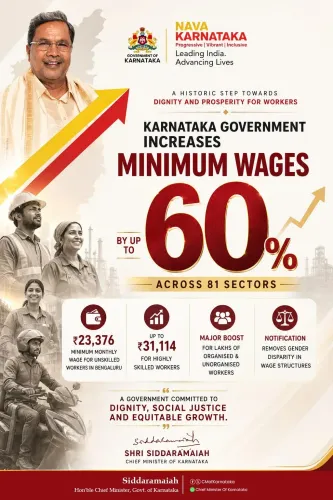
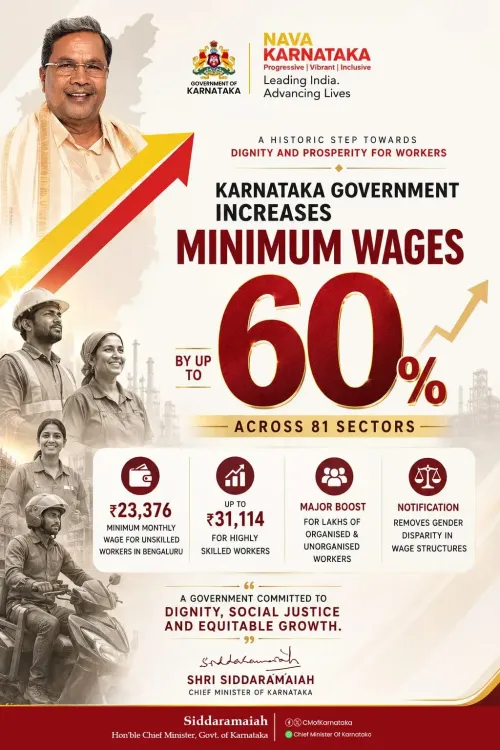
The Karnataka government has hiked minimum wages by up to 60 per cent across 81 sectors, fixing ₹23,376 per month for unskilled workers and ₹31,114 for highly skilled workers in Bengaluru, while abolishing gender-based wage differentials — one of the largest state-level wage revisions in recent years.
Key Takeaways
Karnataka has revised minimum wages by up to 60 per cent across 81 scheduled sectors .
The minimum monthly wage for unskilled workers in Bengaluru is now set at ₹23,376 .
Highly skilled workers are entitled to a minimum of ₹31,114 per month under the new schedule.
Gender-based disparities in wage structures have been formally removed across all covered categories.
The revision covers both organised and unorganised workers , with the informal sector among the primary beneficiaries.
Revised rates will be operative once published in the official Karnataka Government Gazette .
The Chief Minister's Office of Karnataka announced on Tuesday, 26 May 2026 that the state government has revised minimum wages upward by up to 60 per cent across 81 sectors, covering both organised and unorganised workers. The revision sets a monthly floor of ₹23,376 for unskilled workers in Bengaluru and up to ₹31,114 for highly skilled workers, while also eliminating gender disparity in wage structures.
Context
The official post declared: 'Karnataka has taken a historic step towards dignity and prosperity for workers.' The Kannada line ಶ್ರಮಕ್ಕೆ ಗೌರವ • ಬದುಕಿಗೆ ಭದ್ರತೆ [Respect for labour, security for life] frames the revision as a social-justice commitment rather than a routine administrative update. The announcement covers workers across 81 scheduled employments, spanning both the formal and informal economy.
Policy Backdrop
Minimum wages in India are governed by the Minimum Wages Act, 1948, a central legislation that empowers individual states to notify rates for scheduled employments within their jurisdiction. Since labour is a concurrent subject under the Constitution, state governments bear primary responsibility for periodic revisions, typically pegged to movements in consumer price indices and changes in the cost of living. Karnataka has historically tiered its wage schedules by geography, with Bengaluru commanding the highest rates owing to its elevated cost of living relative to the rest of the state.
The elimination of gender-based wage differentials within the same employment category marks a notable structural change. Several Indian states have carried gender-specific rates in legacy wage schedules, and their removal aligns with the equal-remuneration principle embedded in national labour law.
Stakeholders and Impact
The revision directly affects lakhs of organised and unorganised workers employed across sectors ranging from construction and domestic work to retail and manufacturing. Unskilled workers in Bengaluru will now receive a minimum of ₹23,376 per month, while highly skilled workers can earn at least ₹31,114 per month under the new schedule. Employers across all 81 notified sectors are legally obligated to comply once the revised rates are officially gazetted.
Unorganised workers — who make up the bulk of Karnataka's labour force and have historically been the most vulnerable to wage suppression — stand to gain the most. The removal of gender disparity is expected to benefit women workers in sectors such as garment manufacturing, agriculture, and domestic services, where pay gaps have been documented.
What's Next
The operative details — sector-wise rate tables, effective dates, and enforcement mechanisms — will be set out in the official Karnataka Government Gazette notification. Labour department inspectors and employer associations will be the key actors in determining on-the-ground compliance. Any disputes over implementation are adjudicated through the quasi-judicial machinery established under the Minimum Wages Act, 1948. Observers will watch whether the revision triggers corresponding upward pressure on wages in neighbouring states and how quickly the new rates are absorbed by high-employment sectors in Bengaluru's gig and construction economy.
Point of View
And signals the ruling government's intent to anchor its political identity around worker welfare ahead of future electoral cycles. The simultaneous removal of gender-based wage differentials is a structurally meaningful reform that goes beyond the routine cost-of-living indexation that typically drives minimum wage revisions. Taken together, these moves reflect a broader pattern in which state governments use concurrent-list powers over labour to differentiate themselves on social-justice credentials. The real test will be enforcement: India's minimum wage compliance record in the unorganised sector remains uneven, and the gap between notified rates and actual wages paid is often wide.
NationPress
22 Sept 2026
Frequently Asked Questions
What is the new minimum wage in Karnataka for unskilled workers?
The revised minimum monthly wage for unskilled workers in Bengaluru is ₹23,376 , as announced by the Karnataka government in May 2026.
By how much has Karnataka increased minimum wages?
Karnataka has increased minimum wages by up to 60 per cent across 81 sectors , covering both organised and unorganised workers.
What is the minimum wage for highly skilled workers in Karnataka?
Highly skilled workers in Karnataka are now entitled to a minimum wage of up to ₹31,114 per month under the revised schedule.
Has Karnataka removed gender pay disparity in minimum wages?
Yes. The Karnataka government has formally removed gender-based disparities from its minimum wage structures, ensuring equal minimum pay for men and women in the same employment category.
Under which law does Karnataka revise minimum wages?
Minimum wage revisions in Karnataka are made under the Minimum Wages Act, 1948 , a central law that empowers state governments to notify and revise wage rates for scheduled employments.