Karnataka CM Shivakumar demands fair Central funds share at NITI Aayog meet
Synopsis
Karnataka CM D.K. Shivakumar took his state's fiscal grievances directly to NITI Aayog — demanding overdue Central funds, challenging the population-based allocation formula that disadvantages southern states, and pitching a ₹32.81 lakh crore economy that produces 1.6 lakh engineers a year. The meeting also surfaced a concrete proposal: a 'second Bengaluru' to ease pressure on a city bursting at its seams.
Key Takeaways
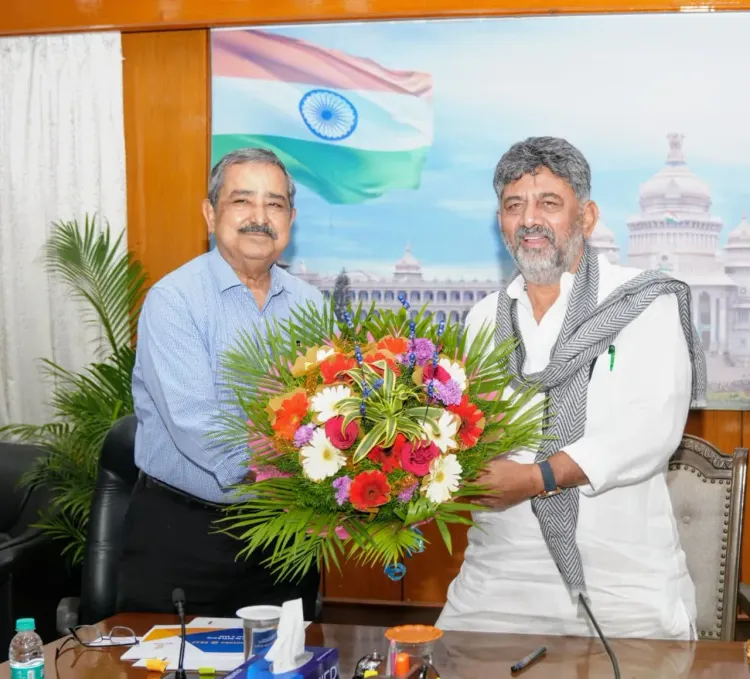
Shivakumar met NITI Aayog Vice-Chairman Ashok Kumar Lahiri on 2 September in Bengaluru to demand the state's due share of Central funds.
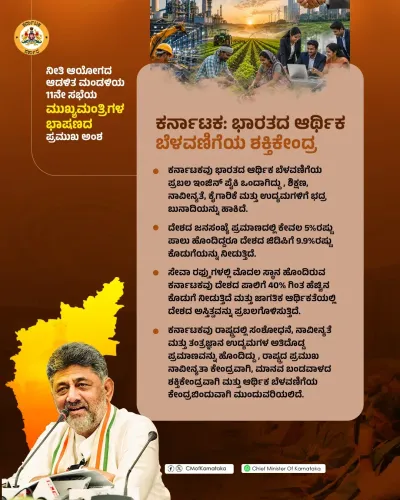
Karnataka's GSDP stood at ₹32.81 lakh crore in 2025-26 , growing at 8.1 per cent , with services accounting for 70 per cent .
Shivakumar argued that southern states should not be penalised through population-based fund allocation, having successfully implemented population-control measures.
The state spends more than ₹50,000 crore annually on five guarantee schemes and around ₹20,000 crore on electricity subsidies for farmers.
NITI Aayog endorsed exploring a 'second Bengaluru' to reduce pressure on the city, which hosts around 2.6 million IT professionals .
Karnataka produces around 1.6 lakh engineers and nearly 13,000 doctors every year, according to the Chief Minister.
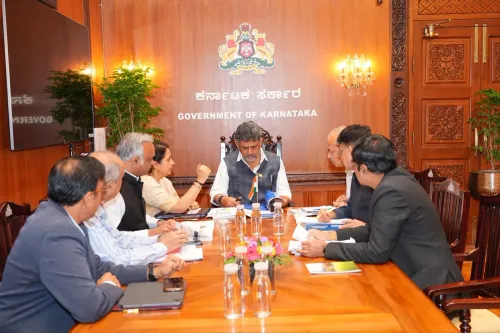
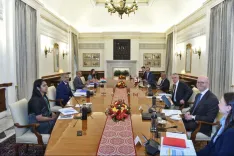
Karnataka Chief Minister D.K. Shivakumar on Wednesday, 2 September pressed NITI Aayog to ensure the state receives its rightful share of Central funds — including allocations announced in previous Union Budgets — during a meeting with NITI Aayog Vice-Chairman Ashok Kumar Lahiri at his official residence, Krishna, in Bengaluru. The appeal underscores a long-running friction between southern states and the Centre over fiscal devolution.
Key Demands Placed Before NITI Aayog
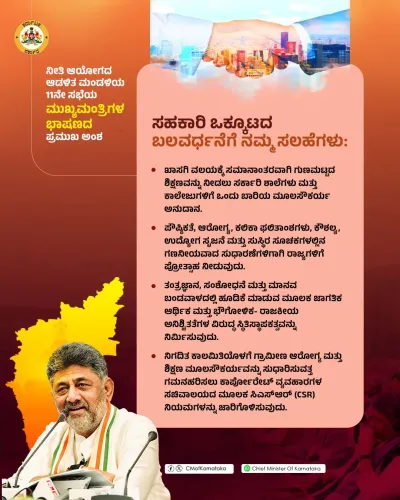
Shivakumar stressed the principle of cooperative federalism, arguing that national growth is impossible without the parallel development of states. He called on NITI Aayog to extend 'all possible support' to Karnataka and said the state had waited a long time for a dedicated bilateral meeting with the body.
The Chief Minister also raised Karnataka's case for special consideration in dryland agriculture, noting that the state has the second-largest extent of dryland after Rajasthan. He urged the planning body to factor in this agricultural reality when determining support and resource allocation.
The Population-Formula Flashpoint
One of the sharpest points raised by Shivakumar concerned the formula used to distribute Central funds. He argued that southern states, which successfully implemented population-control measures decades ago, are now being penalised through population-based allocation norms that reward states with higher headcounts.
'The Southern states have effectively implemented population-control measures, whereas the Northern states have not done so adequately. The Southern states should not be penalised by determining the share of funds primarily on the basis of population,' Shivakumar said, adding that he had raised the same concern directly with Union Home Minister Amit Shah in a recent discussion.
This concern is not new — it has been a recurring grievance across southern states, particularly during Finance Commission deliberations, and Karnataka's articulation of it at a NITI Aayog forum adds institutional weight to the argument.
Karnataka's Economic Standing
Officials at the meeting presented data showing Karnataka's Gross State Domestic Product (GSDP) stood at ₹32.81 lakh crore in 2025-26, registering a growth rate of 8.1 per cent. The services sector accounted for 70 per cent of the GSDP, followed by industry at 19 per cent and agriculture at 11 per cent.
Shivakumar highlighted Karnataka's leadership across multiple indicators — GSDP, per capita income, human development, technology, foreign direct investment, exports, startups, and IT services. He noted that the state produces around 1.6 lakh engineers and nearly 13,000 doctors every year, while Bengaluru alone is home to approximately 2.6 million IT professionals.
'Karnataka has the highest quality human resources in the country,' he said, recalling former Prime Minister Atal Bihari Vajpayee's observation that world leaders visiting India would prefer to visit Bengaluru before Delhi — a remark Shivakumar said he had recently shared with Prime Minister Narendra Modi.
The 'Second Bengaluru' Proposal
NITI Aayog Vice-Chairman Lahiri endorsed the idea of developing a 'second Bengaluru' within Karnataka to relieve pressure on the existing city, whose population is continuously rising as people from across the country migrate there for employment. Shivakumar said the state government would study similar initiatives in other states before formulating a concrete plan.
'All these factors are putting pressure on Bengaluru. We have formulated several ambitious projects to improve the city's infrastructure, and they are at various stages of implementation,' Shivakumar said.
Lahiri expressed confidence in the state's growth potential, saying, 'Karnataka has all the potential to grow rapidly. The country can grow and develop only when the states grow.' He also stressed the need to formulate plans to boost productivity in dryland areas.
Welfare Spending and What the State Is Asking For
The Chief Minister also drew attention to the fiscal burden of the state government's five guarantee schemes, on which it reportedly spends more than ₹50,000 crore every year. Additionally, the state spends around ₹20,000 crore annually on electricity subsidies to provide free power to farmers.
Shivakumar said plans to develop government schools and improve rural education were also in progress, and called on NITI Aayog to back these initiatives. Senior officials present included Minister Priyank Kharge, Chief Secretary Shalini Rajneesh, Economic Adviser L.K. Atheeq, Political Secretary A.S. Ponnanna, Development Commissioner Uma Mahadevan, and Additional Chief Secretary Tushar Girinath.
With Karnataka's next budget cycle approaching and Finance Commission recommendations still a live debate, how NITI Aayog responds to these demands could shape the state's fiscal planning for the years ahead.
Point of View
And doing so through an institution that has limited binding power over Finance Commission awards. The population-formula argument is constitutionally legitimate and widely shared across the south, but it has been raised at every Finance Commission cycle without producing a structural fix. What is new here is the explicit invocation of Home Minister Amit Shah's name in the same breath — suggesting the state is simultaneously lobbying through political and technocratic channels. The 'second Bengaluru' idea, meanwhile, is intriguing but vague; without land, governance, and connectivity details, it risks becoming another aspirational headline.
NationPress
2 Sept 2026
Frequently Asked Questions
What did Karnataka CM Shivakumar ask NITI Aayog for?
Chief Minister D.K. Shivakumar urged NITI Aayog to ensure Karnataka receives its due share of Central funds, including allocations announced in previous Union Budgets. He also sought special consideration for the state's dryland agriculture and called for support for Karnataka's infrastructure and welfare initiatives.
Why do southern states object to population-based fund allocation?
Southern states like Karnataka implemented population-control measures successfully decades ago, which has kept their population growth lower than northern states. Under a primarily population-based allocation formula, they receive proportionally less Central funding despite their stronger economic contribution — effectively being penalised for compliance with national policy.
What is Karnataka's current GSDP and economic profile?
Karnataka's Gross State Domestic Product stood at ₹32.81 lakh crore in 2025-26, with a growth rate of 8.1 per cent. Services dominate at 70 per cent of GSDP, followed by industry at 19 per cent and agriculture at 11 per cent. Bengaluru alone hosts around 2.6 million IT professionals.
What is the 'second Bengaluru' proposal discussed at the meeting?
NITI Aayog has suggested developing a second urban centre in Karnataka to reduce the mounting population and infrastructure pressure on Bengaluru. CM Shivakumar said the state would study similar initiatives in other states and formulate a concrete plan. NITI Aayog Vice-Chairman Ashok Kumar Lahiri endorsed the idea at the meeting.
How much does Karnataka spend on its welfare and subsidy schemes?
Karnataka reportedly spends more than ₹50,000 crore annually on its five guarantee schemes and around ₹20,000 crore per year on electricity subsidies to provide free power to farmers, according to Chief Minister Shivakumar's statement at the NITI Aayog meeting.