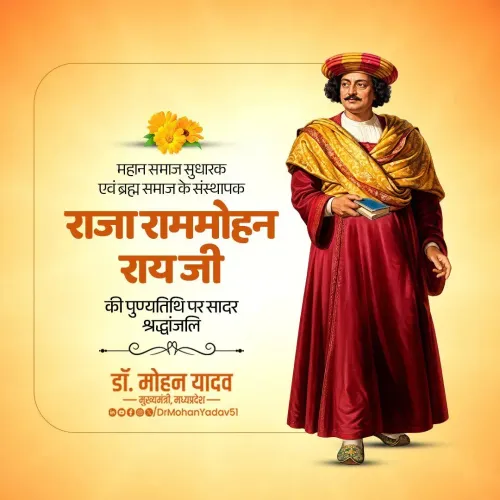
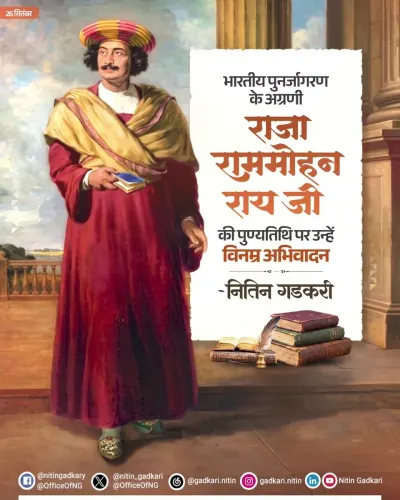
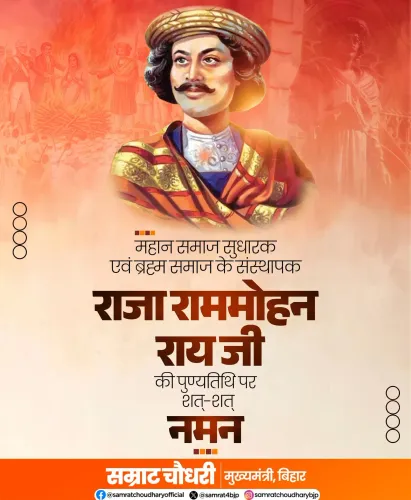
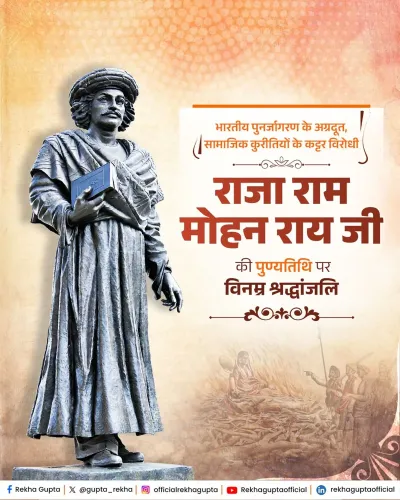
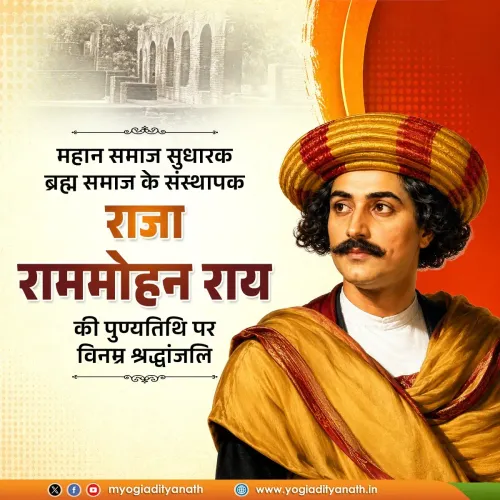
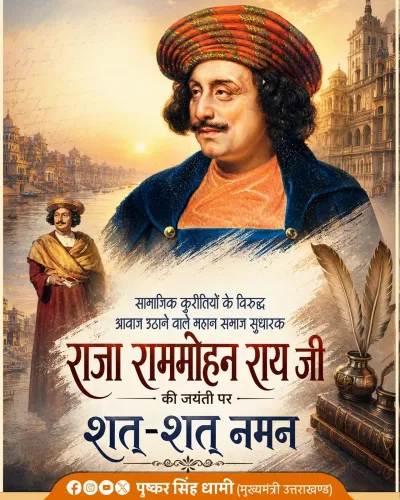
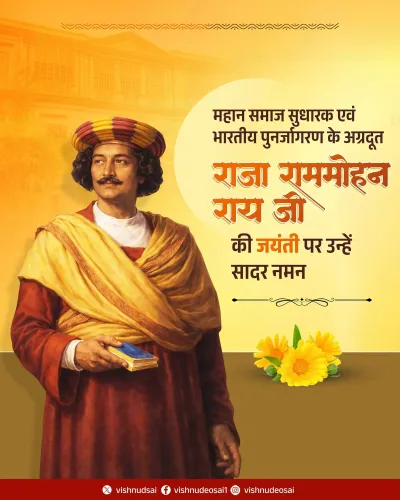
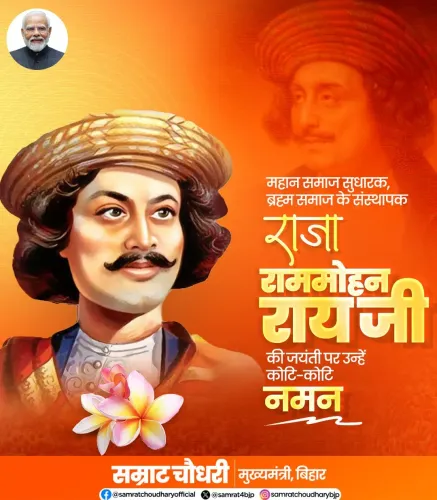
Karnataka CM Office pays tribute to Raja Ram Mohan Roy
Synopsis
The Chief Minister's Office of Karnataka honoured Raja Ram Mohan Roy on his death anniversary, calling the 19th-century reformer a guiding light for his campaigns to abolish Sati and advance women's rights and modern education in India.
Key Takeaways
Raja Ram Mohan Roy's death anniversary was observed on 27 September 2026 with a tribute from the Chief Minister's Office of Karnataka.
Roy is credited with the abolition of the Sati practice, which led to the landmark Bengal Sati Regulation of 1829 .
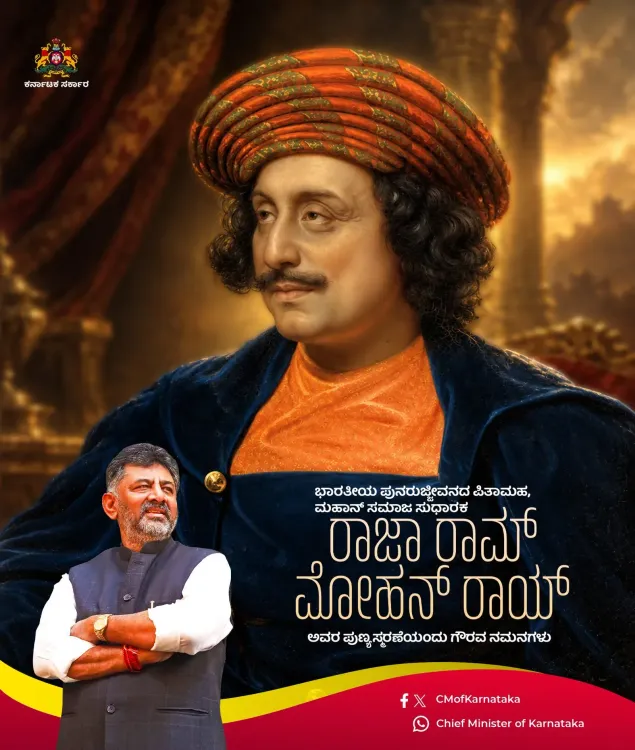
The Karnataka government's post, in Kannada , described Roy as the 'patriarch of the Indian Renaissance' and a 'great social reformer.' Roy's legacy includes founding the Brahmo Samaj and championing women's education and modern schooling in 19th-century India.
The tribute highlighted Roy's ideals of equality, modern education, and women's empowerment as a continuing beacon for Indian society.
On his death anniversary, Raja Ram Mohan Roy — the 19th-century reformer who bent the arc of Indian society toward equality — was remembered by the Chief Minister's Office of Karnataka with a tribute posted on Sunday, 27 September 2026, honouring the man history calls the father of the Indian Renaissance.
The Kannada-language post saluted Roy's 'selfless service' in eradicating practices such as Sati and advancing the cause of women's empowerment, calling his ideals a 'guiding light' for all — 'ನಮ್ಮೆಲ್ಲರಿಗೂ ದಾರಿದೀಪವಾಗಿವೆ' ('a beacon for all of us'). The message also credited Roy with laying the groundwork for modern education and the idea of a new, equal India.
The reform that changed India: Sati abolition and Roy's enduring legacy
Roy's most consequential campaign was against the practice of Sati — the ritual immolation of widows on their husbands' funeral pyres. His relentless advocacy directly led to the Bengal Sati Regulation of 1829, the colonial-era law that banned the practice, marking one of the earliest legislative victories for women's rights in modern Indian history.
Beyond abolition, Roy championed the cause of women's education and inheritance rights, founded the Brahmo Samaj religious reform movement, and pushed for English-medium instruction at a time when access to modern knowledge was tightly controlled by tradition and orthodoxy. He is widely credited with igniting the Bengal Renaissance, a cultural and intellectual flowering that reshaped the subcontinent's trajectory into the 20th century.
A standard commemoration with an enduring political resonance
Tributes to 19th-century social reformers on their birth and death anniversaries are a fixture of Indian political communication — from the Centre to state capitals. For Karnataka, a state with its own deep tradition of social reform thought rooted in the Veerashaiva-Lingayat and Basavanna movements, invoking Roy's legacy carries particular resonance: the ideals of dismantling caste hierarchy, expanding education, and empowering women remain live political values rather than mere historical footnotes.
The post names no new policy or programme, but the themes it invokes — modern education, gender equality, social justice — speak directly to debates that continue to shape Karnataka's governance agenda.
Nearly two centuries after Roy's campaigns forced the hand of a colonial government, the state of Karnataka is still measuring its present against his benchmark.
Point of View
Invoking Raja Ram Mohan Roy's campaigns against Sati and for women's education is politically coherent — it aligns with the state's own tradition of progressive reform and keeps socially liberal credentials visible without requiring a new policy announcement. The gesture costs nothing legislatively but signals cultural alignment with the ideals of rationalism and gender justice that remain electorally relevant in urban Karnataka.
NationPress
27 Sept 2026
Frequently Asked Questions
Why is Raja Ram Mohan Roy called the father of the Indian Renaissance?
Raja Ram Mohan Roy is called the father of the Indian Renaissance because he led a sweeping 19th-century movement to modernise Indian society, campaigning against practices like Sati, advocating for women's rights, and championing English-medium modern education — transformations that catalysed India's social and intellectual awakening.
When was Sati abolished in India and what role did Raja Ram Mohan Roy play?
Sati was formally abolished by the Bengal Sati Regulation of 1829 . Raja Ram Mohan Roy's sustained public advocacy and petitions to the colonial government were the decisive force behind the legislation, making it one of the earliest legislative victories for women's rights in modern India.
When is Raja Ram Mohan Roy's death anniversary?
Raja Ram Mohan Roy's death anniversary falls on 27 September . He passed away in 1833 in Bristol, England, while on a diplomatic mission.
What was the Brahmo Samaj founded by Raja Ram Mohan Roy?
The Brahmo Samaj was a religious and social reform movement founded by Raja Ram Mohan Roy in 1828 . It promoted monotheism, rejected idol worship, opposed caste discrimination, and advocated for the equal treatment of women — becoming a cornerstone of the Bengal Renaissance.
Why did Karnataka CM Office post a tribute to Raja Ram Mohan Roy?
The Chief Minister's Office of Karnataka posted the tribute on Roy's death anniversary, 27 September 2026 , as part of the standard Indian political practice of publicly commemorating transformative historical figures whose ideals of social reform, education, and equality remain relevant to contemporary governance.