Kejriwal Demands Arrests Over Ram Mandir Donation Theft Allegations
Synopsis
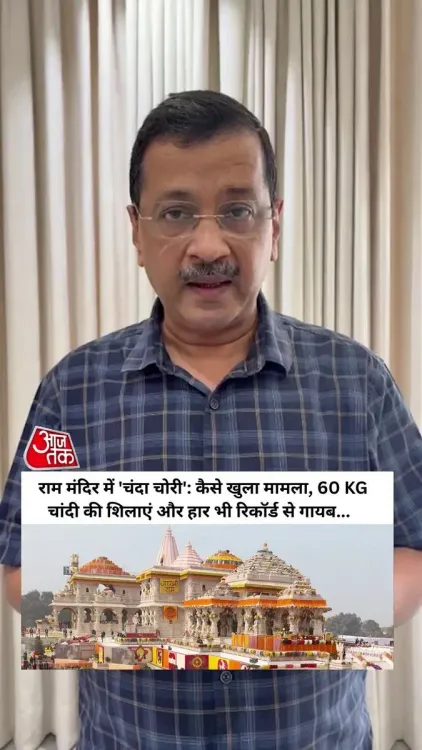
AAP convenor Arvind Kejriwal on 21 June 2026 alleged that crores of rupees in donations were stolen from the Ram Mandir in Ayodhya, demanded immediate arrests, and questioned why no FIR has been registered — accusing the government of protecting those responsible.
Key Takeaways
AAP convenor Arvind Kejriwal posted on X on 21 June 2026 alleging theft of crores in donations from the Ram Mandir, Ayodhya .
Kejriwal stated that not a single FIR has been registered despite the alleged financial irregularity.
He demanded that those involved — 'however powerful' — be 'sent straight to jail.' The Ram Mandir was inaugurated on 22 January 2024 ; its funds are managed by the Shri Ram Janmabhoomi Teerth Kshetra Trust , notified by the Union government in 2020 .
The specific claim of stolen crores remains unverified by official public records; no FIR or trust response has been confirmed as of publication.
Responses from Uttar Pradesh Police and the Teerth Kshetra Trust are awaited, with the matter likely to surface in the monsoon session of Parliament.
AAP convenor Arvind Kejriwal on Sunday, 21 June 2026, demanded immediate arrests over alleged theft of crores of rupees in donations from the Ram Mandir in Ayodhya, questioning why no FIR has been registered in the matter and accusing the government of shielding those responsible.
Posting in Hindi on X, Kejriwal wrote: 'राम मंदिर में करोड़ों हिंदुओं की आस्था है। उसी राम मंदिर से करोड़ों रुपये के चंदे की चोरी हो गई, लेकिन एक भी FIR दर्ज नहीं हुई।' ('Crores of Hindus have faith in the Ram Mandir. Crores of rupees in donations have been stolen from that very Ram Mandir, yet not a single FIR has been registered.') He went on to ask, 'Who is the government protecting?' and demanded that those involved — 'however powerful they may be' — be 'sent straight to jail.'
Context
The Ram Mandir in Ayodhya, Uttar Pradesh, was inaugurated on 22 January 2024 in the presence of the Prime Minister and senior government functionaries. The temple, dedicated to Lord Ram, was constructed following a landmark Supreme Court verdict in November 2019 that awarded the disputed site to a trust for temple construction. It draws donations from millions of Hindu devotees across the country and abroad, making financial oversight a matter of significant public interest.
The Shri Ram Janmabhoomi Teerth Kshetra Trust, constituted by the Union government in February 2020, is the statutory body responsible for managing the temple's construction, administration, and funds. Kejriwal's post is directed at the absence of a police complaint despite what he characterises as large-scale financial irregularities within this trust-managed institution.
Policy Backdrop
Indian opposition parties have periodically raised questions about financial transparency in religious institutions and trusts, particularly those established or overseen after the 2019 Ayodhya verdict. Large-scale public donations to temples with national significance occupy a legal grey area — they are not always subject to the same audit mechanisms as government funds, even when the managing trust is notified by the Union government.
Debates over the regulation of temple donations and the accountability of trusts have intensified as the volume of contributions to high-profile shrines has grown substantially in recent years. Kejriwal's demand for FIRs reflects a broader opposition argument that symbolic institutions must be held to the highest standards of financial accountability.
Stakeholders and Impact
The allegation, if substantiated, would directly concern the Shri Ram Janmabhoomi Teerth Kshetra Trust, Uttar Pradesh Police, and the Union government, which notified the trust. For the tens of millions of Hindu devotees who have contributed to or visited the temple, the integrity of donation management carries deep religious and emotional significance.
Politically, the post places the ruling dispensation — both at the Centre and in Uttar Pradesh — on the defensive over an institution they have closely associated with. Kejriwal's framing, invoking the faith of 'crores of Hindus,' is calibrated to make financial accountability a matter of religious sentiment rather than partisan politics alone.
What's Next
Attention will now turn to whether the Uttar Pradesh Police or the Teerth Kshetra Trust issues a formal response addressing the donation audit trail and the absence of any registered complaint. Statements on the matter are also anticipated during the upcoming monsoon session of Parliament, where opposition members are expected to press the government for details. Any official clarification or denial from the trust or state government will be a key indicator of how the controversy develops.
Point of View
He signals AAP's intent to position itself as a defender of Hindu devotees' interests — a space the ruling party has long claimed as its own. The move fits a broader opposition pattern of targeting the governance record around Ayodhya as the temple transitions from a construction project to an administered institution. Whether the allegation gains traction will depend heavily on whether any formal inquiry or audit finding emerges to substantiate the claim.
NationPress
21 Jun 2026
Frequently Asked Questions
What did Kejriwal say about Ram Mandir donations?
AAP convenor Arvind Kejriwal alleged on 21 June 2026 that crores of rupees in donations were stolen from the Ram Mandir in Ayodhya and demanded immediate arrests, questioning why no FIR has been registered.
Has any FIR been filed in the Ram Mandir donation theft case?
According to Kejriwal's post, no FIR has been registered in the matter as of 21 June 2026. There has been no confirmed official response from Uttar Pradesh Police or the Shri Ram Janmabhoomi Teerth Kshetra Trust as of publication.
Who manages Ram Mandir donations and funds?
The Shri Ram Janmabhoomi Teerth Kshetra Trust, constituted by the Union government in February 2020, is responsible for managing the Ram Mandir's construction, administration, and funds.
When was the Ram Mandir inaugurated?
The Ram Mandir in Ayodhya was inaugurated on 22 January 2024 in the presence of the Prime Minister and senior government functionaries, following a Supreme Court verdict in November 2019.
Why is Kejriwal raising the Ram Mandir donation issue?
Kejriwal framed his demand around the faith of crores of Hindu devotees, arguing that financial misconduct at a site of such religious significance must be met with criminal accountability regardless of the seniority of those involved.