Khattar hails India's first hydrogen train flagged off by PM Modi

Synopsis
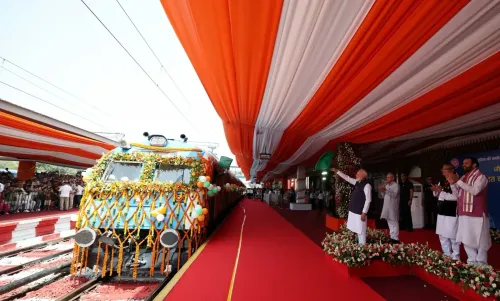
Prime Minister Narendra Modi flagged off India's first hydrogen-powered train on the 89-km Jind–Sonipat corridor in Haryana on 17 July 2026. Union Power Minister Manohar Lal Khattar hailed the launch as a historic milestone, saying India has joined a select group of nations operating hydrogen trains and demonstrated its commitment to indigenous green technology.
Key Takeaways
India's first hydrogen train was flagged off by PM Narendra Modi on 17 July 2026 .
The train operates on the Jind–Sonipat rail corridor in Haryana , spanning 89 kilometres .
The launch is a zero-emission initiative aligned with the National Green Hydrogen Mission launched in January 2023 .
Union Power Minister Manohar Lal Khattar described it as a symbol of indigenous innovation, green technology, and sustainable development.
The achievement places India among a small group of countries that have operationalised hydrogen-powered trains.
The initiative supports Indian Railways' broader goal of achieving net-zero carbon emissions and India's 2070 net-zero commitment.
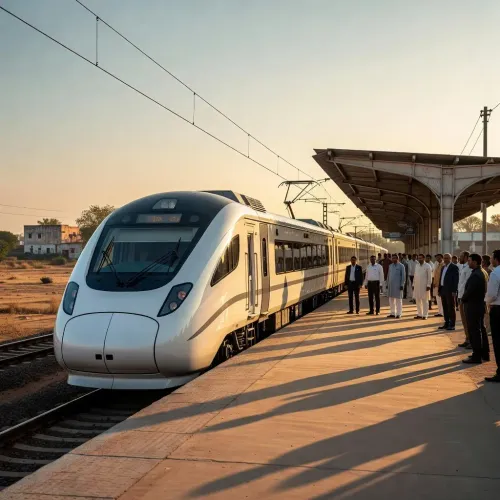
Union Power Minister Manohar Lal Khattar on Friday, 17 July 2026 celebrated the flagging off of India's first hydrogen-powered train by Prime Minister Narendra Modi, calling it a glorious chapter in the history of Indian Railways. The zero-emission train was launched on the Jind–Sonipat rail section in Haryana, covering a corridor of 89 kilometres.
Context
Khattar, a former Chief Minister of Haryana, posted on X describing the development as a landmark moment rooted in the vision of 'development, environmental protection, and cutting-edge technology advancing together' — 'विकास, पर्यावरण संरक्षण और अत्याधुनिक तकनीक साथ-साथ आगे बढ़ते हैं'. He noted that with this achievement, India has joined a select group of nations that have successfully operated hydrogen-powered trains. The minister specifically highlighted the Jind–Sonipat corridor as the site of this inaugural run, marking it as a milestone for both Haryana and the country.
The post was accompanied by a video and carried the hashtags #HaryanaWelcomesModiJi and #NaMoGreenRail, underlining the political and environmental significance attached to the event by the ruling dispensation.
Policy Backdrop
Indian Railways has long outlined an ambition to achieve net-zero carbon emissions by 2030, pursuing multiple low-carbon technology pathways including electrification, battery-powered trains, and hydrogen fuel-cell technology. The hydrogen train initiative aligns directly with the National Green Hydrogen Mission, launched in January 2023, which seeks to scale domestic green hydrogen production and expand its use across mobility and industrial sectors.
India's broader climate commitments — including the pledge made at COP26 in 2021 to achieve net-zero emissions by 2070 — have provided the policy architecture within which rail decarbonisation projects have accelerated. The Atmanirbhar Bharat framework has further pushed for indigenous development of rolling stock and propulsion technology, a dimension Khattar explicitly invoked by calling the achievement a 'testament to indigenous innovation and green technology.'
Stakeholders and Impact
Railway passengers across Haryana, particularly those travelling the Jind–Sonipat route, stand to be the immediate beneficiaries of cleaner, quieter hydrogen-powered transit. Renewable energy companies and domestic rolling-stock manufacturers are also positioned to gain as the government looks to expand the hydrogen train fleet to additional corridors.
For the broader clean-energy ecosystem, the launch signals that India is moving from policy commitment to operational deployment in hydrogen mobility — a credibility boost in international climate negotiations. Khattar emphasised that the initiative 'will not only help reduce carbon emissions but will also strengthen India's leading role in clean mobility globally.'
What's Next
The immediate question is how quickly Indian Railways can procure and deploy additional hydrogen train rakes on other high-density or environmentally sensitive corridors. Progress on domestic green hydrogen production capacity — a key cost variable — will determine how rapidly the technology can be scaled beyond the pilot Jind–Sonipat section.
If domestic manufacturing targets under the National Green Hydrogen Mission are met on schedule, hydrogen trains could become a commercially viable and replicable model for decarbonising rail corridors across the country, reinforcing India's position as a serious player in the global clean-mobility transition.
Point of View
The event carries dual value: it advances a credible green-technology narrative ahead of international climate forums while anchoring a high-visibility infrastructure win in Haryana, a politically consequential state. Khattar's enthusiastic endorsement — invoking indigenous innovation and global clean-mobility leadership — reflects a deliberate effort to frame hydrogen rail as a signature of the Atmanirbhar Bharat vision. The real test, however, will be whether domestic green hydrogen production scales fast enough to make hydrogen trains economically competitive beyond a single pilot corridor.
NationPress
17 Jul 2026
Frequently Asked Questions
Where was India's first hydrogen train launched?
India's first hydrogen train was launched on the Jind–Sonipat rail section in Haryana , a corridor spanning 89 kilometres .
Who flagged off India's first hydrogen train?
Prime Minister Narendra Modi flagged off India's first hydrogen-powered train on 17 July 2026 .
What is the significance of the hydrogen train for India?
The launch makes India one of a small group of countries to have operationalised hydrogen-powered trains, supporting its net-zero emissions goals and the National Green Hydrogen Mission .
What is the National Green Hydrogen Mission?
The National Green Hydrogen Mission is a central government scheme launched in January 2023 to scale domestic green hydrogen production and promote its use in sectors like transportation.
What did Manohar Lal Khattar say about the hydrogen train launch?
Union Power Minister Manohar Lal Khattar called it a 'glorious chapter' in Indian Railways history and said it demonstrates India's commitment to indigenous innovation, green technology, and sustainable development.