Rijiju rejects Chinese intrusion claims, blames Congress border policy

Synopsis
Rijiju's rebuttal to Rahul Gandhi goes beyond denial — it reframes the entire border debate as a legacy failure of Congress infrastructure policy. By citing Antony's own parliamentary statement and pointing to roads built only after 2014, the minister is turning a national security allegation into an electoral liability for the opposition.
Key Takeaways
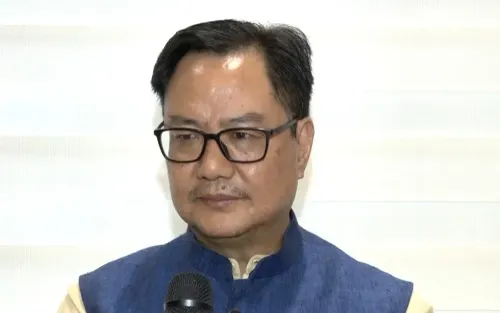
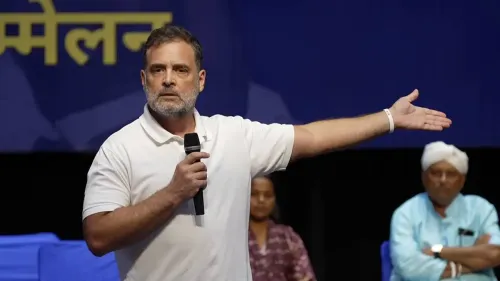
Kiren Rijiju on 19 August rejected Rahul Gandhi 's claims of Chinese intrusion into Indian territory in Arunachal Pradesh .
Rijiju argued the core issue is the absence of a formally delineated India-China border — a situation predating the current government.
He accused former Defence Minister A.K.
Antony of stating in Parliament that it was Congress policy not to build border infrastructure on the Indian side.
The minister credited PM Modi with reversing that policy, citing road construction to Maza and Taksing (completed 2019 ) as examples.
Rijiju acknowledged Chinese PLA structures beyond Longju date to 1959-1962 but denied any occupation of Indian villages.
He accused the Congress of circulating a video purportedly from Bangladesh to manufacture a political narrative, calling it damaging to armed forces morale.
Union Parliamentary Affairs Minister Kiren Rijiju on Wednesday, 19 August firmly dismissed allegations by Lok Sabha Leader of Opposition Rahul Gandhi concerning alleged Chinese intrusion into Indian territory, arguing that the situation in Arunachal Pradesh must be understood against the backdrop of an undemarcated India-China border — a problem, he said, that predates the current government by decades.
Rijiju's remarks came as a direct rebuttal to Gandhi's repeated claims that the Centre has concealed Chinese incursions and failed to adequately defend Indian territory along the frontier.
The Core Argument: No Formal Border Line
Rijiju maintained that the root of the dispute lies in the absence of a formally delineated boundary. 'India and China share a very long border in Arunachal Pradesh that has not been formally delineated. There are no border pillars, and the boundary is not clearly marked on the ground; there is no distinct border line. This is not a recent issue. Even when Tibet was a separate entity, the border between Tibet and India had not been delineated,' he said.
He acknowledged that concerns among residents of border villages were legitimate, but cautioned against the spread of unverified videos and claims. 'It is wrong for people to spread confusion by sharing various videos. There is indeed an issue regarding the border. Some villagers in Arunachal Pradesh have expressed concerns about the border, and rightly so, because the boundary has not been delineated there,' he added.
Congress Infrastructure Policy Under Fire
Rijiju directed sharp criticism at previous United Progressive Alliance (UPA) governments, alleging that the Indian National Congress (Congress) actively discouraged border infrastructure development. He cited former Defence Minister A.K. Antony, claiming that Antony had stated in Parliament that it was government policy not to build infrastructure on the Indian side of the frontier — while China continued developing its own.
'At that time, the Congress was in power in India. A.K. Antony, the then Defence Minister under the Congress government, stated in Parliament that it was the government's policy not to build infrastructure on the Indian side. Meanwhile, China continued to develop infrastructure steadily,' Rijiju said.
This claim has been a recurring point of contention between the ruling Bharatiya Janata Party (BJP) and the Congress, with the opposition disputing both the characterisation of Antony's remarks and the broader narrative.
What Changed After 2014, According to Rijiju
The minister credited Prime Minister Narendra Modi with reversing course after 2014, pointing to road construction reaching previously inaccessible border villages. He said he personally visited Maza, described as a village at the last border point, where road work had been completed — the first such connectivity since 1947, he claimed.
Rijiju also referenced the road to Taksing, which he said was built in 2019 under the Modi government. 'We previously lacked a road connection. PM Modi had the road to Taksing built in 2019. Because we lacked a road while China had built one, the Chinese army occupied certain high-altitude areas and constructed border infrastructure; we are now responding by building our own infrastructure,' he said.
On Chinese Structures and Military Activity
Rijiju rejected suggestions that China had occupied Indian villages outright, but acknowledged that Chinese forces had established structures in disputed stretches. He pointed to a location beyond Longju, saying Chinese People's Liberation Army (PLA) structures there date to 1959 and were further consolidated in 1962.
'It is not the case that they have occupied any of our villages. They have set up camp on a certain stretch of land because the boundary there is not demarcated. Our people believe our territory extends further, whereas the locals there claim the land belongs to them,' he said.
He also noted increased Chinese military activity along the ridgeline and said patrolling by the Indian Army and the Indo-Tibetan Border Police (ITBP) had been strengthened. 'Chinese military activity has certainly increased along the ridgeline. This has heightened the concerns of our villagers, and we must take their apprehensions seriously,' he added.
Fake Video Allegation Against Congress
Rijiju also accused the Congress of circulating a video purportedly from Bangladesh to build a political narrative around the border issue, calling it misleading and damaging to the morale of the armed forces. 'Spreading such narratives by circulating a fake video, purportedly from Bangladesh, is wrong. Doing so undermines the morale of the armed forces,' he said.
With the border infrastructure debate intensifying ahead of the next session of Parliament, both sides appear set to escalate their positions — making the India-China frontier a defining political flashpoint in the months ahead.
Point of View
Which Rijiju himself acknowledges, suggests infrastructure investment alone has not resolved the standoff. The reference to Antony's parliamentary remarks is a well-worn BJP talking point, but the absence of a formal border delineation is a bilateral diplomatic failure that spans multiple governments. Most critically, dismissing opposition concerns as 'fake videos' without a transparent, independently verifiable account of the situation in Arunachal Pradesh does little to reassure the border communities whose anxieties Rijiju himself concedes are 'genuine.'
NationPress
19 Aug 2026
Frequently Asked Questions
What did Kiren Rijiju say about Chinese intrusion in Arunachal Pradesh?
Rijiju rejected claims of Chinese intrusion, arguing that the situation stems from the absence of a formally delineated India-China border in Arunachal Pradesh — a long-standing issue with no border pillars or clearly marked boundary line. He said presenting the matter through unverified videos could mislead the public.
What is Rijiju's allegation against the Congress on border infrastructure?
Rijiju alleged that the Congress-led UPA government, under then Defence Minister A.K. Antony, followed a policy of not building infrastructure on the Indian side of the border, while China steadily developed its own. He credited the Modi government with reversing this policy after 2014.
Has China occupied Indian villages in Arunachal Pradesh?
Rijiju denied that China has occupied any Indian villages, but acknowledged that Chinese forces have set up camp on disputed stretches where the boundary is not demarcated. He noted that PLA structures beyond Longju date to 1959 and were consolidated in 1962.
What infrastructure has the Modi government built along the Arunachal border?
According to Rijiju, the Modi government completed road construction to Maza — described as the last border village — marking the first such road since 1947. A road to Taksing was also built in 2019. Rijiju said these projects were part of a broader push to match Chinese border connectivity.
Why did Rijiju accuse the Congress of spreading a fake video?
Rijiju alleged that the Congress circulated a video purportedly from Bangladesh to construct a political narrative around Chinese border activity. He said doing so was wrong and undermined the morale of the Indian armed forces.