Kishan Reddy pitches CAPEX Scheme to end EV mineral imports

Synopsis
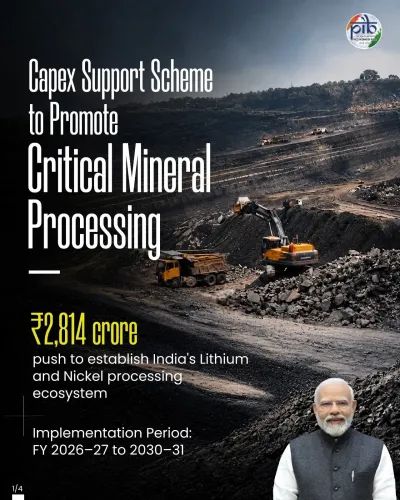
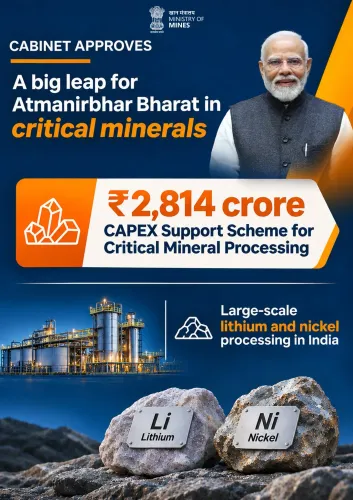
Union Mines Minister G. Kishan Reddy has spotlighted the Cabinet-approved CAPEX Support Scheme for Critical Mineral Processing, positioning it as India's strategic answer to EV battery import dependence on lithium and nickel — a policy bet backed by PM Modi's Ministry of Mines.
Key Takeaways
The Cabinet has approved the CAPEX Support Scheme for Critical Mineral Processing , driven by the Ministry of Mines under PM Narendra Modi.
The scheme provides capital expenditure support to build domestic processing capacity for lithium and nickel — core EV battery materials.
India currently relies heavily on China and Australia for critical mineral processing, a supply chain vulnerability the scheme aims to address.
The move extends a legislative chain: the MMDR Amendment Act, 2023 enabled commercial mineral auctions; this scheme incentivises downstream refining.
Detailed project eligibility criteria, subsidy amounts and private-player selection norms are yet to be announced by the Ministry.
Implementation linkages with the proposed National Critical Minerals Mission and state governments will be a key watch point.
What if India's electric vehicles never had to depend on a single gram of imported lithium or nickel? That is the precise question Union Coal and Mines Minister G. Kishan Reddy is now framing as a national inflection point, anchoring it to the Cabinet-approved CAPEX Support Scheme for Critical Mineral Processing driven by the Ministry of Mines on Wednesday, November 11, 2026.
The scheme India's EV battery chain has been waiting for
The CAPEX Support Scheme for Critical Mineral Processing is designed to do one thing with surgical clarity: put capital expenditure support behind domestic facilities that refine and process minerals — primarily lithium and nickel — the two materials sitting at the heart of every electric vehicle battery pack. Without a processing base at home, India's EV ambitions have rested on supply chains running through China and Australia, a vulnerability that policymakers have flagged for years. This scheme is the financial lever meant to close that gap.
Minister Reddy framed it as a deliberate strategic bet under Prime Minister Narendra Modi's leadership — not a routine subsidy, but a structural shift in how India intends to compete in the global clean-energy economy.
From auction reform to processing incentive: the policy chain
The scheme does not arrive in isolation. The Mines and Minerals (Development and Regulation) Amendment Act, 2023, cracked open commercial auctions of critical and strategic minerals for the first time, creating a pipeline of domestically sourced raw material. The National Mineral Policy, 2019, had already set the target of reducing import dependence through exploration and downstream value addition. The CAPEX Support Scheme is now the downstream piece — turning auctioned ore into processed, battery-ready material inside India's borders.
Together, the three moves sketch a coherent arc: legislate faster access to the ground, extract it through competitive auctions, and then refine it at home with government-backed capital. The logic is industrial policy built for a world where battery supply chains are as strategically sensitive as oil fields once were.
What EV makers and battery processors stand to gain
For EV manufacturers and battery cell processors, the scheme signals that the government is willing to de-risk the capital-intensive first steps of building a refining industry from scratch. Processing critical minerals requires specialised infrastructure and carries significant upfront costs — historically the reason private capital has stayed away and import dependency has persisted.
Detailed guidelines on eligible projects, the subsidy quantum, and the selection of private players for processing facilities are yet to be announced. Watchers will also track how the scheme links with the proposed National Critical Minerals Mission and how individual states implement their end of the bargain.
India has set itself ambitious 2030 EV penetration targets. Whether domestic mineral processing can scale fast enough to actually feed those targets — that is the bet Kishan Reddy is now publicly staking his ministry on.
Point of View
End-to-end supply chain control. By pairing auction reforms with downstream processing incentives, the Modi government is effectively treating battery materials the way earlier governments treated steel and petroleum — as strategic industrial inputs that require state-backed capital formation. For Minister Kishan Reddy, whose ministry has anchored several auction-stage reforms, this scheme is a credibility test: the gap between mineral availability and processed output has been the missing link, and industry will watch whether the financial incentives are large enough to actually crowd in private capital. If the guidelines deliver on the framing, it could meaningfully reduce India's exposure to Chinese refining dominance in the global clean-energy race.
NationPress
11 Nov 2026
Frequently Asked Questions
What is the CAPEX Support Scheme for Critical Mineral Processing?
It is a Cabinet-approved scheme that provides capital expenditure support to companies setting up domestic facilities for processing critical minerals such as lithium and nickel, which are essential for electric vehicle batteries.
Why is India trying to process critical minerals domestically?
India currently depends heavily on imports from China and Australia for processed lithium and nickel. Building domestic processing capacity reduces this vulnerability and supports India's 2030 EV penetration targets.
Which ministry is driving the CAPEX Support Scheme for Critical Mineral Processing?
The Ministry of Mines, headed by Union Minister G. Kishan Reddy, is driving the scheme under Prime Minister Narendra Modi's leadership.
How does this scheme connect to India's earlier mining reforms?
The MMDR Amendment Act, 2023, enabled commercial auctions of critical minerals for the first time, creating a domestic raw material pipeline. The CAPEX Support Scheme is the downstream complement, incentivising refining of that ore inside India.
What details of the CAPEX Support Scheme are still awaited?
The government has not yet released detailed guidelines on eligible projects, the quantum of subsidy, and how private players will be selected for processing facilities. Linkages with the proposed National Critical Minerals Mission are also pending.