Kishan Reddy credits PM Modi for push on organic farming
Synopsis
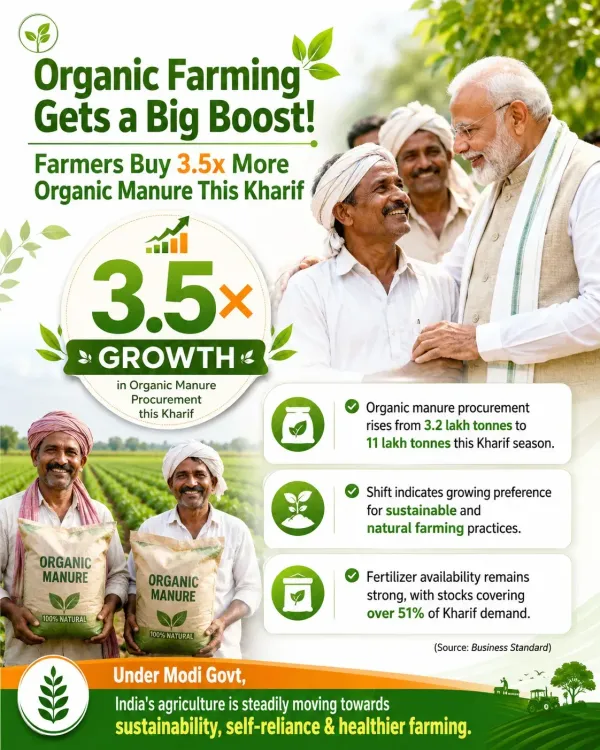
Union Coal and Mines Minister G. Kishan Reddy credited PM Modi on June 23 for championing natural and organic farming, citing targeted policies that he says are transforming India's agricultural landscape and inspiring a behavioural shift among farmers.
Key Takeaways
Union Coal and Mines Minister G.
Kishan Reddy credited PM Modi with transforming India's agricultural landscape through a push for natural and organic farming.
The Paramparagat Krishi Vikas Yojana (PKVY) , launched in 2015 , supports organic farming through 50-acre clusters offering certification and marketing assistance.
A separate Mission Organic Value Chain Development for North Eastern Region covers eight northeastern states and was also approved in 2015 .
Sikkim became India's first fully organic state in 2016 , serving as a policy benchmark for wider replication.
The organic farming push is part of India's National Action Plan on Climate Change and aims to reduce chemical input dependence while linking farmers to premium markets.
Union Coal and Mines Minister G. Kishan Reddy on Tuesday, June 23, 2026, praised Prime Minister Narendra Modi for what he described as a transformative commitment to sustainable agriculture, saying the Prime Minister's championing of natural and organic farming goes beyond crop yields to ensure long-term ecological balance.
Context
In his post, Kishan Reddy — who also serves as BJP's Telangana state president — wrote that PM Modi's 'steadfast commitment to sustainable development is fundamentally transforming India's agricultural landscape.' He added that 'through targeted policies and direct encouragement,' the Prime Minister has 'inspired a massive behavioral shift among the nation's farmers.'
The remarks come as the central government has, over the past decade, incrementally expanded its policy architecture around organic and natural farming, driven in part by concerns over soil degradation and high chemical input costs that trace back to the Green Revolution era.
Policy Backdrop
The flagship scheme underpinning these efforts is the Paramparagat Krishi Vikas Yojana (PKVY), launched in 2015, which promotes organic farming through 50-acre clusters, providing farmers with certification support and marketing linkages. A separate Mission Organic Value Chain Development for North Eastern Region, also approved in 2015, targets organic value chains across eight northeastern states.
The National Mission for Sustainable Agriculture has further included components for soil health, organic inputs, and climate-resilient practices since 2010. Together, these programmes form part of India's broader National Action Plan on Climate Change and aim to connect farmers to premium domestic and export markets.
Sikkim became a landmark reference point in this journey when it was declared India's first fully organic state in 2016, having phased out chemical inputs across all agricultural land — a model that policymakers have cited as proof of concept for wider replication.
Stakeholders and Impact
Small and marginal farmers and certified organic producers are the primary beneficiaries of these schemes, which offer financial assistance, group certification under clusters, and access to organic markets. Reducing dependence on chemical fertilisers also carries direct implications for the government's subsidy burden.
The promotion of organic and natural farming spans multiple ministries and state governments, reflecting what policy observers describe as a gradual, multi-stakeholder shift rather than a single top-down programme. The alignment of Kishan Reddy's remarks with the government's stated ecological goals underscores the cross-ministerial political investment in the agenda.
What's Next
Attention will now focus on the expansion of certified organic area under PKVY and state-level natural farming programmes, as well as any new budgetary allocations or marketing linkages that may be announced in forthcoming agricultural policy statements. The trajectory of farmer uptake and the pace of certification across new clusters will be key indicators of whether the policy push translates into measurable ground-level change.
Point of View
Not just an agri-ministry brief. The timing reinforces a broader pattern of party leaders building a narrative around ecological stewardship ahead of electoral cycles in agrarian states like Telangana. While the policy lineage of PKVY and allied schemes is real and traceable, the claim of a 'massive behavioral shift' among farmers remains difficult to verify independently and will depend on certified-area data that is yet to be publicly established for 2026. The post reflects how organic farming has evolved from a niche environmental concern into a mainstream political talking point bridging rural welfare, climate commitments, and export ambitions.
NationPress
23 Jun 2026
Frequently Asked Questions
What is Paramparagat Krishi Vikas Yojana and how does it help farmers?
Paramparagat Krishi Vikas Yojana (PKVY) is a central government scheme launched in 2015 that organises farmers into 50-acre clusters to adopt organic practices, providing financial assistance, group certification, and marketing support to reduce dependence on chemical inputs.
Which Indian state was declared fully organic first?
Sikkim was declared India's first fully organic state in 2016 after phasing out chemical fertilisers and pesticides across all its agricultural land, making it a national and international model for organic farming policy.
What did Kishan Reddy say about PM Modi and organic farming?
On June 23, 2026, Union Coal and Mines Minister G. Kishan Reddy posted on X that PM Modi's commitment to sustainable development is transforming India's agricultural landscape and has inspired a behavioral shift among farmers toward natural and organic farming.
What is India's policy on natural farming?
India supports natural farming through multiple schemes including PKVY, the Mission Organic Value Chain Development for North Eastern Region, and the National Mission for Sustainable Agriculture, all of which form part of the National Action Plan on Climate Change.
Why is the Indian government promoting organic farming?
The government promotes organic farming to counter soil degradation and high chemical input costs associated with the Green Revolution era, while also aiming to link farmers to premium domestic and export markets and meet climate commitments.