Kishan Reddy: PM SVANidhi lights up Hyderabad street vendors
Synopsis
Union Minister G. Kishan Reddy highlights that over 1.75 lakh collateral-free loans worth ₹311.02 crore have been sanctioned to street vendors in Hyderabad-Secunderabad under PM SVANidhi, with women comprising 66% of beneficiaries as of September 2026.
Key Takeaways
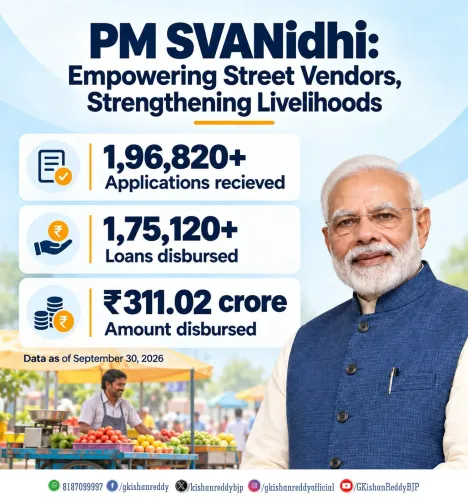
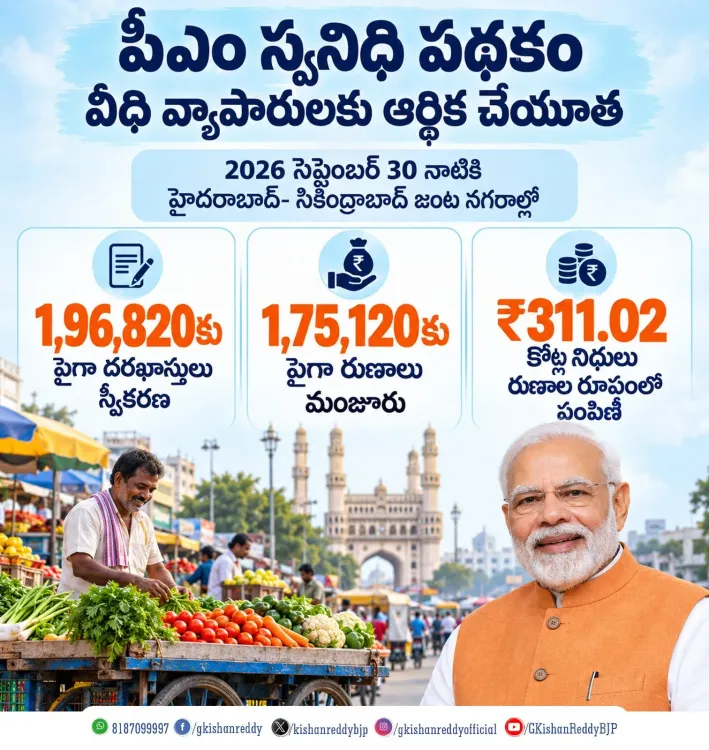
Over 1,96,820 applications received under PM SVANidhi in Hyderabad–Secunderabad as of 30 September 2026 .
More than 1,75,120 loans sanctioned , all without collateral requirements. ₹311.02 crore disbursed to street vendors in the twin cities.
Approximately 66% of beneficiaries are women , highlighting strong gender inclusion.
PM SVANidhi was launched in June 2020 under the Atmanirbhar Bharat package to support vendors hit by COVID-19.
Kishan Reddy also serves as BJP's Telangana state president, posting the update on 19 October 2026.
More than 1.75 lakh street vendors in Hyderabad–Secunderabad have received collateral-free loans under the PM SVANidhi scheme — and nearly two-thirds of them are women. Union Coal and Mines Minister and BJP Telangana president G. Kishan Reddy shared the milestone figures on Monday, 19 October 2026, underlining how the Centre's flagship urban micro-credit programme is reshaping livelihoods in the twin cities.
What the numbers say about Hyderabad's street-vendor push
Kishan Reddy's post — written in Telugu — laid out the scheme's progress in the twin cities as of 30 September 2026. More than 1,96,820 applications had been received; of those, 1,75,120-plus loans were sanctioned. In total, ₹311.02 crore has been disbursed — all without a rupee of collateral demanded from borrowers. The minister noted that approximately 66 percent of beneficiaries are women, a figure that reflects the scheme's deliberate gender-inclusion design.
The post credited Prime Minister Narendra Modi's 'visionary leadership' (dārśanika nāyakatvam) for the scheme's reach, framing SVANidhi as an instrument of self-reliance for small traders who have historically been locked out of formal credit.
PM SVANidhi: from COVID relief to urban financial inclusion backbone
PM SVANidhi — formally, the Pradhan Mantri Street Vendor's AtmaNirbhar Nidhi — was launched in June 2020 as part of the Atmanirbhar Bharat economic package. Its original mandate was to extend working-capital loans to street vendors whose incomes had been wiped out by COVID-19 lockdowns. The scheme provides initial loans of ₹10,000, with higher-tier credit available to vendors who repay on time, creating a structured ladder out of informal moneylending.
The absence of collateral is the scheme's central promise. For a pheriwaala or a roadside food vendor with no property deed to pledge, that single feature is the difference between access and exclusion. Hyderabad–Secunderabad, one of India's largest urban agglomerations, has a dense informal trading economy — making it a bellwether for how well the scheme translates from policy paper to pavement-level impact.
Why 66% women beneficiaries is the headline inside the headline
The gender breakdown deserves its own moment. Roughly two in three loan recipients in the twin cities being women points to either a deliberately targeted outreach strategy or an organic reflection of who actually runs street-side businesses — often women selling vegetables, flowers, or cooked food as the household's primary earner. Either way, the figure aligns with the broader push across central welfare schemes to close gender gaps in formal financial access.
Kishan Reddy, as Telangana BJP president, has a clear political interest in highlighting central-scheme performance in a state governed by the opposition — but the data points, if borne out by official disbursal records, speak to real credit flowing to real vendors on real streets.
With over ₹311 crore already out the door in just one urban cluster, the question now is whether loan-repayment rates and credit-cycle uptake will sustain the programme's momentum — and whether the Centre extends SVANidhi's scope as urban informal employment remains one of India's most critical, and most underfunded, economic frontiers.
Point of View
A narrative the BJP has been carefully cultivating across welfare communication. The broader arc here is the Centre's long-running effort to bring the informal urban economy — estimated to employ hundreds of millions — into a structured financial ecosystem, using collateral-free micro-credit as the entry point. Whether repayment rates and higher-tier credit uptake hold up will determine if SVANidhi becomes a durable ladder or a one-rung boost.
NationPress
19 Oct 2026
Frequently Asked Questions
What is the PM SVANidhi scheme?
PM SVANidhi — Pradhan Mantri Street Vendor's AtmaNirbhar Nidhi — is a central government scheme launched in June 2020 that provides collateral-free working capital loans to street vendors, initially to help them recover from COVID-19 income losses.
How many street vendors got loans in Hyderabad under PM SVANidhi?
As of 30 September 2026, more than 1,75,120 loans had been sanctioned in Hyderabad–Secunderabad, with ₹311.02 crore disbursed, according to Union Minister G. Kishan Reddy.
What percentage of PM SVANidhi beneficiaries in Hyderabad are women?
Approximately 66 percent — roughly two in three — of PM SVANidhi beneficiaries in Hyderabad–Secunderabad are women, according to figures shared by Kishan Reddy.
Does PM SVANidhi require collateral or a guarantor?
No. PM SVANidhi is specifically designed as a collateral-free loan scheme, allowing street vendors with no property to pledge to access formal credit for the first time.
Who is G. Kishan Reddy?
G. Kishan Reddy is India's Union Minister of Coal and Mines and the president of the BJP's Telangana state unit. He represents the Secunderabad constituency and is a senior BJP leader from Telangana.