Kolkata hawker crisis: Four decades after Usha Uthup's ode, footpaths still blocked
Synopsis
Usha Uthup sang about hawkers blocking Kolkata's footpaths over four decades ago — and the city is still fighting the same battle. Fresh eviction drives in central commercial corridors are meeting hawker protests and the same political hesitancy that has stalled every previous attempt. The song was a lament dressed as a love letter; the city has yet to resolve the contradiction.
Key Takeaways
Usha Uthup's ode to Kolkata , recorded over four decades ago , explicitly named hawker encroachment on footpaths as one of the city's defining problems.
Major vending clusters persist at Esplanade , Gariahaat , Burrabazar , College Street , and Camac Street , with stalls frequently spilling onto carriageways.
Most hawkers are migrants from neighbouring districts and states, operating without formal licences, and rely on street vending as their primary income.
Past hawker uchhed abhijans have been largely symbolic — cleared stalls typically return within days due to limited political will.
Fresh municipal eviction drives in central Kolkata have drawn protests from hawker associations demanding negotiated relocation plans.
Blocked footpaths contribute to pedestrian risk, increased commute times, sanitation failures, localised flooding, and restricted emergency access.
Kolkata's chronic hawker problem — immortalised in Usha Uthup's celebrated ode to the city over four decades ago — remains as entrenched as ever, even as local authorities have launched fresh eviction drives across central commercial corridors. The song's lyric, 'Hawker footpath-e bendhechhe ghorbari' (hawkers have set up houses on the sidewalks), reads less like poetry today and more like a municipal complaint register.
A Song That Became a Mirror
When Uthup first sang her tribute to Kolkata (then spelt Calcutta) in the early years of Communist rule in West Bengal, the lyrics catalogued the city's familiar contradictions: incessant political processions, hawkers colonising footpaths, power cuts, traffic gridlock, handcarts and rickshaws blocking roads. Her refrain — 'Tobi tumi sundari koto Kolkata' (Yet, how beautiful you are, Kolkata) — turned urban dysfunction into a term of endearment. More than four decades on, the dysfunction persists; the endearment is wearing thin.
Where the Hawkers Are — and Why They Stay
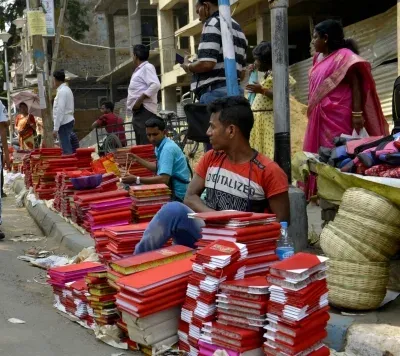
The most visible concentrations of pavement vending run through Esplanade, Gariahaat, Burrabazar, Lalbazar, New Market, College Street, and Camac Street in central Kolkata. Stalls frequently spill from sidewalks onto carriageways, obstructing both pedestrian movement and emergency vehicle access.
The vendors' wares span clothing, stationery, household goods, artwork, and food. Along Camac Street, a stretch flanked by office buildings and restaurants, food stalls cater to workers who rely on them as cheaper alternatives to adjacent eateries. At College Street — one of Asia's largest second-hand book markets — pavement booksellers offer new, old, and out-of-print titles at prices formal shops cannot match.
Most hawkers are migrants from neighbouring districts and states, for whom street vending is a primary livelihood. The majority operate without formal licences or fixed premises, making them legally vulnerable but politically significant.
The Political Arithmetic of Eviction
Successive administrations have attempted what locals call 'hawker uchhed abhijan' — remove-hawker operations — but these have historically been symbolic rather than sustained. The Left Front governments that dominated West Bengal for over three decades positioned themselves as champions of the labouring poor, which made any iron-fisted eviction drive politically costly. Makeshift stalls cleared one week would typically reappear at the same spot within days.
Critics argue this pattern reflects a structural lack of political will rather than a failure of enforcement capacity. The hawker vote bank, spread across multiple constituencies in a densely populated city, has long acted as a check on decisive action.
The Urban Cost
The consequences extend beyond aesthetics. Blocked footpaths increase pedestrian risk and commute times. Waste accumulation from vending clusters strains already limited drainage and sanitation infrastructure, contributing to localised flooding during the monsoon. In a city with a documented stock of dilapidated and hazardous buildings, restricted lane access also complicates emergency response.
Pedestrians across affected areas continue to report daily impediments, particularly near railway stations and busy market belts where footpath encroachment is heaviest.
Fresh Drives, Familiar Resistance
Authorities have recently launched more systematic decongestion operations in central Kolkata, targeting high-visibility stretches to restore pedestrian space and traffic flow. Municipal teams have removed unauthorised stalls and relocated some vendors to designated vending zones. However, hawker associations have responded with protests, demanding negotiated and humane relocation plans rather than forced removal.
Whether this round of drives will hold — or fade like its predecessors — remains to be seen. As Uthup's song reminds the city, the gap between Kolkata's beauty and its livability has been acknowledged for generations. Closing it will require more than an eviction notice.
Point of View
But without a credible, funded relocation infrastructure and a legal vending framework with enforceable limits, they will follow the same arc as every previous drive: visible action, quiet retreat, stalls back within the week. Usha Uthup's song should not still be a documentary.
NationPress
19 Sept 2026
Frequently Asked Questions
What is the hawker problem in Kolkata?
Kolkata has a long-standing issue of pavement vendors occupying footpaths and spilling onto carriageways in central commercial areas such as Esplanade, Gariahaat, Burrabazar, College Street, and Camac Street. The encroachment blocks pedestrian movement, worsens traffic congestion, and hampers emergency access. Most vendors are unlicensed migrants who depend on street vending as their primary livelihood.
What is the connection between Usha Uthup's song and Kolkata's hawker issue?
Usha Uthup's celebrated ode to Kolkata, recorded over four decades ago, explicitly referenced hawkers setting up homes on the city's sidewalks as one of its defining urban contradictions. The song's Bengali lyric — 'Hawker footpath-e bendhechhe ghorbari' — translates roughly to 'hawkers have set up houses on the sidewalks.' The fact that the same conditions persist today underscores how little has changed despite repeated eviction attempts.
Why have past hawker eviction drives in Kolkata failed?
Analysts and critics point to a structural lack of political will. During decades of Left Front rule, the government positioned itself as a protector of the labouring poor, making sustained evictions politically costly. Cleared stalls would typically return within days. Subsequent administrations have faced the same electoral arithmetic, as hawkers represent a significant vote bank across multiple constituencies.
What are the latest eviction drives targeting in Kolkata?
Local authorities have recently launched systematic decongestion operations in central Kolkata's commercial corridors, removing unauthorised stalls and relocating some vendors to designated vending zones. However, hawker associations have protested the drives and are calling for negotiated, humane relocation plans rather than forced removal.
Who are Kolkata's street hawkers and what do they sell?
The majority of Kolkata's street vendors are migrants from neighbouring districts and states for whom vending is a primary income source. They sell a wide range of goods — clothing, stationery, household items, artwork, and food. College Street is particularly known for new and second-hand books, while Camac Street hosts food stalls serving office workers at prices below nearby restaurants.