Lalan Singh: Congress wiped out in ballot-paper council polls

Synopsis
Union Minister Lalan Singh declares Congress was swept out across all 28 Legislative Council seats in four states, arguing the ballot-paper results demolish Rahul Gandhi's long-running EVM narrative — even in Congress-ruled Karnataka.
Key Takeaways
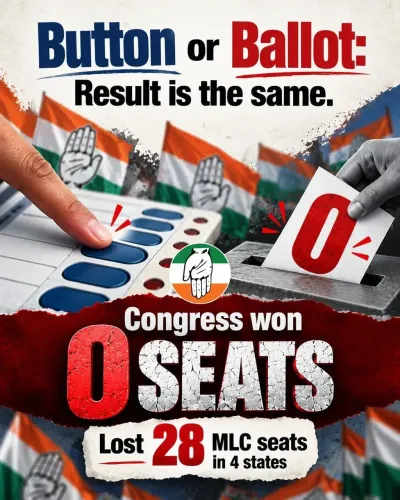
28 Legislative Council seats across 4 states were contested; Congress won none, according to Union Minister Lalan Singh's post.
The elections were conducted by ballot paper , directly undercutting Congress leader Rahul Gandhi 's recurring EVM-integrity argument.
In Karnataka , where Congress holds government after its 2023 assembly victory , the party was still shut out of the council results.
The NDA claimed victories across the contested seats, reinforcing the coalition's claim of broad public support.
Lalan Singh also attacked Congress leaders for using 'indecent language' against PM Narendra Modi , warning of further electoral consequences.
As a senior JD(U) figure and Union Minister, Singh's statement doubles as a public reaffirmation of NDA alliance solidarity .
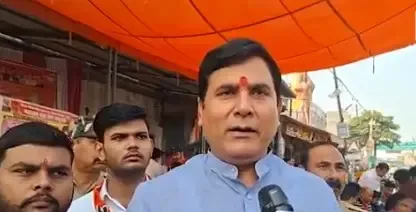
Ballot paper, no EVMs — and Congress still lost. Union Minister Rajiv Ranjan Singh, popularly known as Lalan Singh, fired a pointed broadside at the opposition on Wednesday, 28 October 2026, after Legislative Council elections across four states delivered a near-total rout of the Congress party across all 28 seats in play — including in Karnataka, the one large state where the party currently holds power.
The ballot-paper argument — turned on its head
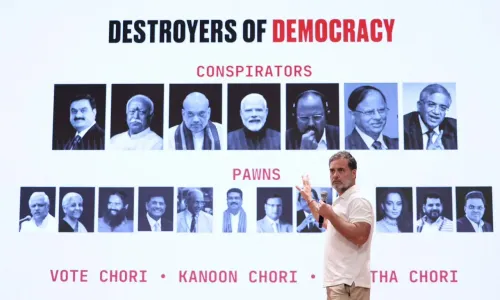
Legislative Council elections in India are indirect polls conducted by ballot paper, with Members of Legislative Assemblies, local-body representatives, and other specified electorates casting votes. Congress leader Rahul Gandhi has repeatedly and publicly questioned the integrity of Electronic Voting Machines, alleging 'vote theft' in EVM-based general and state elections. Lalan Singh's post targets that argument directly: 'bainlat pepar se hue in chunaavon mein bhi Congress ko jeet naseeb nahin hui' — 'even in these elections held by ballot paper, Congress could not secure a win.'
It is a rhetorical pressure point the NDA has deployed before — pointing to outcomes in paper-ballot formats to counter the EVM narrative. The minister's post sharpens that line with the Karnataka data point: a Congress-governed state where the party's own legislative majority did not translate into an upper-house sweep.
Karnataka: Congress in power, out of the council
Karnataka became a flashpoint in 2023 when Congress won a decisive assembly majority, ending a BJP government and giving the grand old party its most significant southern foothold. That assembly win, however, did not carry into Wednesday's Legislative Council results, where the minister says the party was 'wiped out' — 'suupda saaf ho gaya' — and the NDA recorded a strong victory.
Legislative Councils are elected through a staggered, multi-constituency process. Control of the assembly does not guarantee council dominance, especially when local-body and graduate-constituency electorates hold separate weightage. The result, as framed by the minister, undercuts the Congress claim that NDA victories are a product of digital manipulation rather than ground-level political support.
A sharper edge: language about PM Modi
Lalan Singh did not stop at electoral arithmetic. He accused Congress leaders of repeatedly using 'indecent and unbecoming language' — 'abhad aur ashobhaniya shabdon ka istemaal' — against Prime Minister Narendra Modi. The minister issued a direct warning: 'Congress and its leaders should learn from this defeat, otherwise the public will wipe them out at the roots.'
The post closes on a coalition-confidence note: 'The country is with the NDA, and these election results have made that even more certain.' For a JD(U) leader — whose party remains a critical NDA ally — the statement also serves an internal purpose, publicly reinforcing the alliance's solidarity and electoral momentum heading into future state and national contests.
For Congress, the challenge is familiar and uncomfortable: explaining losses in a format their own narrative said would be fairer. The next move is theirs.
Point of View
The 'vote theft' argument loses structural credibility with a significant portion of the electorate. For Lalan Singh and the JD(U), amplifying this outcome is also a loyalty signal — demonstrating active ideological investment in the broader NDA project beyond portfolio duties. Congress faces a compounding problem: its 2023 Karnataka assembly win, its most celebrated recent state victory, is now being used as the very backdrop against which its council failure is measured. How the opposition responds — and whether it contests the framing or pivots to a new issue — will define the next phase of this electoral conversation.
NationPress
28 Oct 2026
Frequently Asked Questions
What are Legislative Council elections and why are they held by ballot paper?
Legislative Councils are the upper houses of state legislatures in bicameral states. Their elections are indirect, conducted by ballot paper among MLAs, local-body members, and other designated electorates — not by general public voting using EVMs.
Which four states had Legislative Council elections in October 2026?
The specific four states are mentioned in Union Minister Lalan Singh's post but are not independently verified in available records. Karnataka is explicitly named as one of them, and it is a state with an active Legislative Council.
Why is Rahul Gandhi's EVM criticism relevant to these council results?
Rahul Gandhi has repeatedly alleged that EVM-based elections are susceptible to manipulation. Since Legislative Council polls use ballot paper, the NDA argues that Congress losses in this format disprove the EVM-fraud narrative.
How did Congress win Karnataka in 2023 but lose the council elections there?
Karnataka's 2023 assembly elections gave Congress a legislative majority, but Legislative Council seats have staggered terms and are elected by separate electorates including local-body representatives, where NDA appears to have retained strength.
Who is Lalan Singh and what is his role in the NDA government?
Lalan Singh is the popular name for Rajiv Ranjan Singh , a senior Janata Dal (United) leader and Union Minister holding the portfolios of Panchayati Raj, Fisheries, Animal Husbandry and Dairying. JD(U) is a key constituent of the NDA coalition.