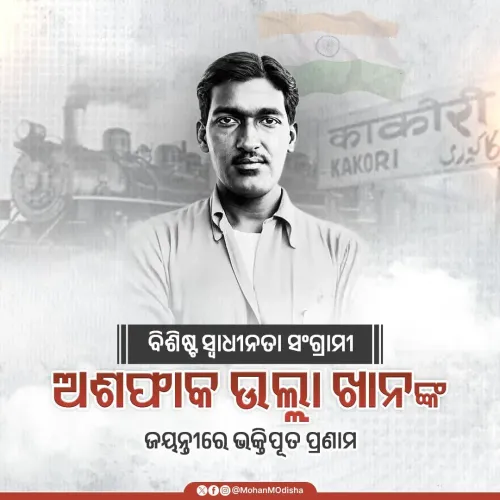
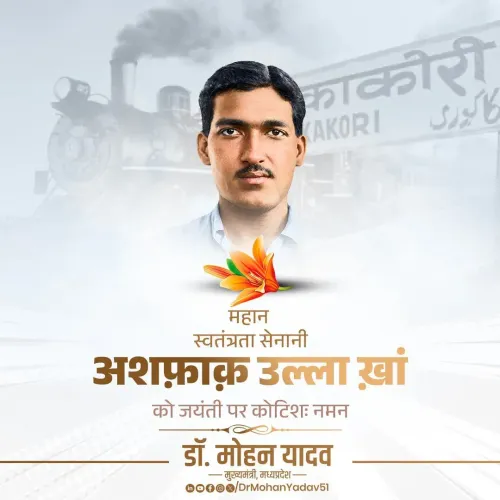
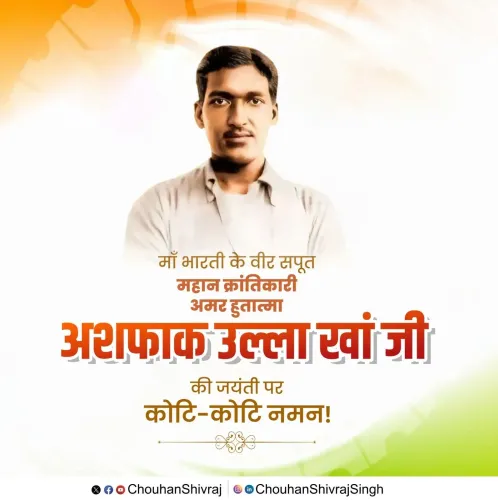
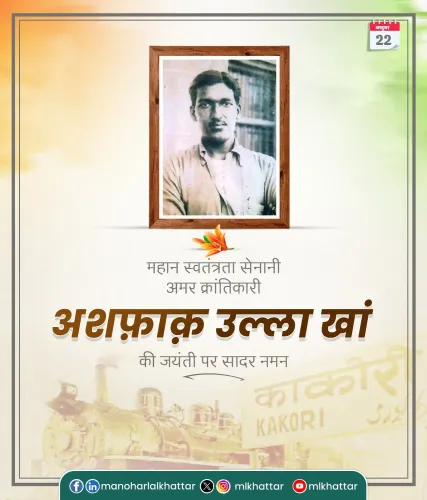
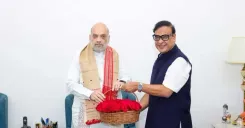
Lalan Singh pays tribute to Ashfaqulla Khan on birth anniversary
Synopsis
Union Minister Rajiv Ranjan Singh (Lalan Singh) honoured revolutionary martyr Ashfaqulla Khan on his birth anniversary, calling his sacrifice and patriotism a timeless inspiration for national unity and freedom.
Key Takeaways
Union Minister Lalan Singh posted a tribute to Ashfaqulla Khan on his birth anniversary on 22 October 2026 .
Ashfaqulla Khan (born 1900 ) was a member of the Hindustan Republican Association and a key figure in the Kakori train robbery of 1925 .
He was executed at Faizabad jail on 19 December 1927 , aged 27 .
Lalan Singh highlighted Khan's 'indomitable courage, unbreakable patriotism and supreme sacrifice' as an enduring inspiration.
The tribute underscored themes of national unity and integrity , connecting Khan's cross-community legacy to contemporary civic values.
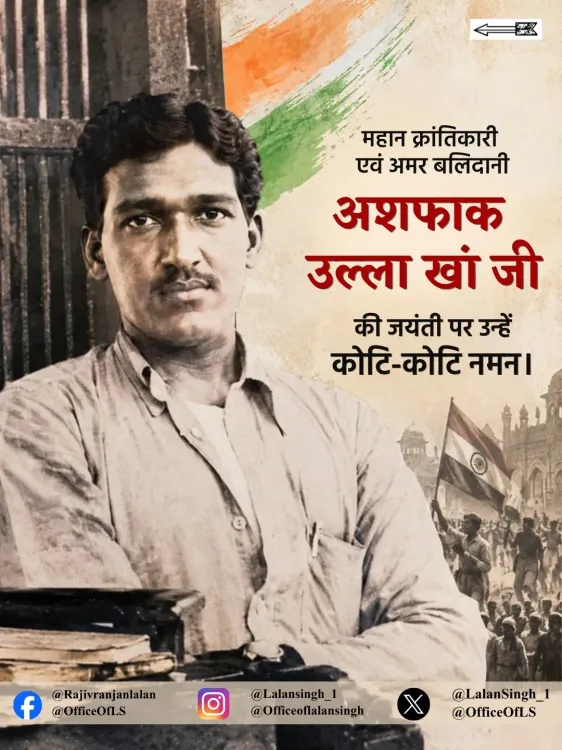
A revolutionary who chose the gallows over surrender — Union Panchayati Raj and Fisheries Minister Rajiv Ranjan Singh, popularly known as Lalan Singh, marked the birth anniversary of freedom fighter Ashfaqulla Khan on Thursday, 22 October 2026, with a heartfelt salute to one of India's most fearless anti-colonial voices.
Posting in Hindi on X, the senior Janata Dal (United) leader wrote: 'महान क्रांतिकारी एवं अमर बलिदानी अशफाक उल्ला खां जी की जयंती पर उन्हें कोटि-कोटि नमन' — 'On the birth anniversary of the great revolutionary and immortal martyr Ashfaqulla Khan, I bow to him a million times.' He added that Khan's 'indomitable courage, unbreakable patriotism and supreme sacrifice for the freedom of the motherland will forever inspire the people of this nation.'
Who was Ashfaqulla Khan — and why does his anniversary still resonate
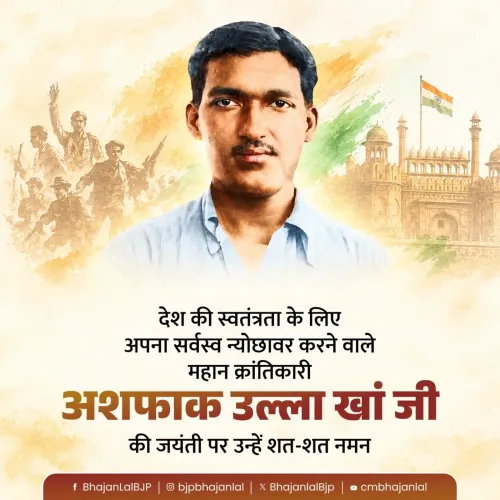
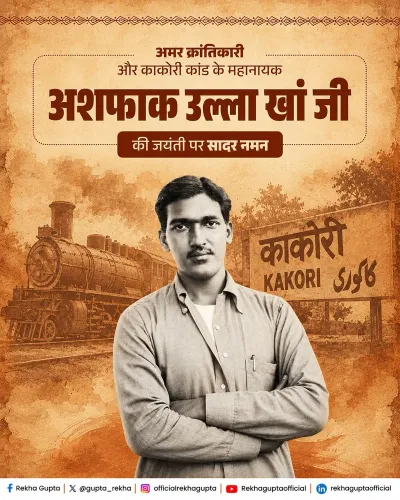
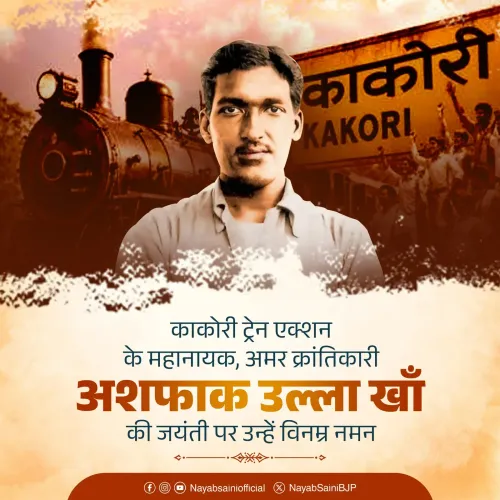
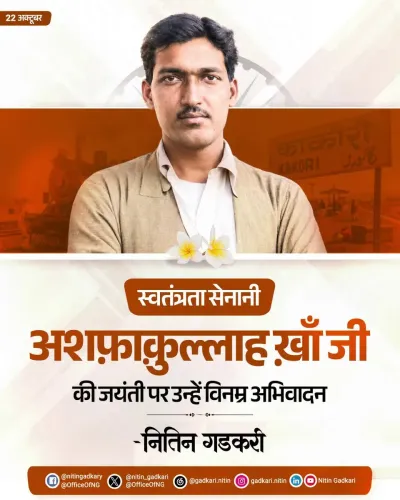
Ashfaqulla Khan was born in 1900 in Shahjahanpur, United Provinces, and grew up to become one of the boldest young faces of armed resistance against British rule. A devoted member of the Hindustan Republican Association (HRA), he planned and participated in the Kakori train robbery of August 1925 — a daring operation to seize British treasury funds and finance the independence movement.
The British crackdown was swift and brutal. Khan was hunted, captured, tried, and hanged at Faizabad jail on 19 December 1927, aged just 27. His bond with fellow revolutionary Ram Prasad Bismil — a Hindu-Muslim friendship forged in the crucible of resistance — became a lasting symbol of composite nationalism. He was executed the same day as Bismil, a detail history has never let fade.
Why ministers mark these dates — and what it signals
Official tributes to independence-era revolutionaries are a consistent feature of Indian political culture across parties and governments. For leaders like Lalan Singh, invoking figures such as Khan is not merely ceremonial — the minister specifically cited themes of 'national unity, integrity and the defence of freedom', connecting a century-old sacrifice to present-day civic values.
The framing carries weight. Khan's story — a young Muslim revolutionary dying alongside a Hindu comrade for a shared motherland — is routinely cited as evidence that the freedom struggle was a plural, cross-community project. In an era of frequent debates about national identity, his anniversary is rarely just a calendar entry.
India's pantheon of lesser-celebrated revolutionaries is vast, and Singh's post is part of a broader official effort to ensure their stories outlast textbook margins. The real tribute, the minister implied, is not just remembrance — it is readiness.
Point of View
Rather than a more prominent freedom fighter, also reflects a growing political appetite to recover lesser-told chapters of the independence movement.
NationPress
22 Oct 2026
Frequently Asked Questions
Who was Ashfaqulla Khan?
Ashfaqulla Khan was an Indian revolutionary freedom fighter born in 1900 in Shahjahanpur. He was a member of the Hindustan Republican Association and participated in the Kakori train robbery of 1925. He was hanged by the British on 19 December 1927 .
What was the Kakori train robbery?
The Kakori train robbery took place in August 1925 , when members of the Hindustan Republican Association intercepted a British train near Kakori in United Provinces to seize colonial treasury funds for the independence movement. It led to mass arrests and the execution of several revolutionaries, including Ashfaqulla Khan and Ram Prasad Bismil.
When is Ashfaqulla Khan's birth anniversary?
Ashfaqulla Khan's birth anniversary falls on 22 October . He was born in 1900 in Shahjahanpur, United Provinces (present-day Uttar Pradesh).
Why did Lalan Singh pay tribute to Ashfaqulla Khan?
Union Minister Rajiv Ranjan Singh (Lalan Singh) posted a tribute on 22 October 2026 — Khan's birth anniversary — honouring his sacrifice and patriotism, and citing his legacy as an inspiration for national unity and integrity.
What is Ashfaqulla Khan's connection to Ram Prasad Bismil?
Ashfaqulla Khan and Ram Prasad Bismil were close friends and fellow revolutionaries in the Hindustan Republican Association. Their Hindu-Muslim bond became a symbol of India's plural freedom struggle. Both were executed on the same day, 19 December 1927 .